
Practice Free AB-100 Exam Online Questions
What should you configure for the custom Al agent?
- A . Azure OpenAI reasoning models
- B . generative orchestration
- C . classic orchestration
- D . Al-assisted evaluators
B
Explanation:
The custom AI agent must select topics based on a description of the purpose of the query, rather than relying on fixed trigger phrases. That is exactly the scenario where generative orchestration is the right configuration.
Why B is correct:
It enables the agent to choose the best topic, tool, or action based on the semantic meaning of the user’s request
It supports more conversational interactions
It aligns directly with the requirement that topic selection should not depend on trigger phrases
Why the other options are not correct:
You need to recommend a Microsoft Power Platform business solution that consolidates data from multiple internal and external data sources. The solution must meet the following requirements: Provide the data as a centralized source for multiple AI systems, including Microsoft Copilot Studio agents, Dynamics 365 applications, and external AI models. Support built-in data classification and protection policies.
Provide data for grounding and analytics.
What should you include in the recommendation?
- A . Microsoft Dataverse
- B . Azure Data Lake Storage
- C . a Microsoft Power BI semantic model
- D . Azure Cosmos DB
A
Explanation:
Comprehensive and Detailed Explanation From Agentic AI Business Solutions Topics:
The correct answer is A. Microsoft Dataverse.
This question is asking for a Microsoft Power Platform business solution that can act as a centralized data foundation across multiple AI and business application workloads.
The requirements are very specific:
consolidate data from multiple internal and external sources
serve as a centralized source for Copilot Studio agents, Dynamics 365, and external AI models
support built-in data classification and protection policies
provide data for grounding and analytics
Among the options, Microsoft Dataverse is the best fit.
Why A is correct
Microsoft Dataverse is the native business data platform for Microsoft Power Platform and Dynamics 365. It is designed to act as a structured, centralized, governed source of business data.
That makes it the strongest answer when the scenario explicitly involves:
Copilot Studio
Dynamics 365
broader Power Platform
governed enterprise business data
AI grounding and analytics
Dataverse supports these needs because it provides:
a common business data model
secure centralized storage
integration across Power Platform and Dynamics 365
metadata-rich tables and relationships
role-based security
support for business rules and governance
compatibility with analytics and AI-based experiences
From an AI business solutions perspective, Dataverse is especially strong because it can act as the single source of truth for enterprise business data that powers both transactional applications and AI systems.
Why Dataverse fits the AI requirements
For AI systems, especially Copilot and agent scenarios, centralized structured business data is essential for:
grounding responses in current operational data
supporting retrieval across customer, sales, finance, or service records
enabling governed access to sensitive information
providing high-quality data for downstream reporting and analytics
Dataverse also aligns well with the requirement for built-in data classification and protection policies, because it works within Microsoft’s enterprise governance ecosystem and supports security, auditing, and compliance-oriented controls better than the other listed options in a Power Platform business context.
Why the other options are incorrect
B. Azure Data Lake Storage
Azure Data Lake Storage is excellent for large-scale analytics and raw data storage, but it is not the best Power Platform business solution answer here. It lacks the same native business application integration and governed operational data model that Dataverse provides for Copilot Studio and Dynamics 365 scenarios.
C. a Microsoft Power BI semantic model
A semantic model is useful for reporting and analytics, but it is not the central operational data platform for multiple AI systems. It sits more at the reporting layer than the transactional and grounding layer.
D. Azure Cosmos DB
Cosmos DB is a scalable NoSQL database, but it is not the native Microsoft Power Platform business data platform for Dynamics 365 and Copilot Studio integration. It also does not provide the same built-in business data modeling and governance experience expected here.
Expert reasoning
When the question combines:
Power Platform
Dynamics 365
Copilot Studio
centralized business data
governance
AI grounding
the best answer is almost always Microsoft Dataverse.
So the correct choice is: Answer. A
You are designing a low-code Al business solution by using Microsoft Copilot Studio.
The solution must include an agent that automates tasks by simulating user interactions across third-party apps and websites, such as clicking buttons, entering text, and extracting information from screens.
You need to recommend what to include in the agent.
What should you recommend?
- A . a natural language understanding + (NLU+) model in Copilot Studio
- B . Copilot skills
- C . Computer Use in Copilot Studio
- D . Model Context Protocol (MCP)
C
Explanation:
This requirement is very specific: the agent must automate tasks by simulating user interactions across third-party apps and websites, including:
clicking buttons
entering text
extracting information from screens
That is exactly what Computer Use in Copilot Studio is designed for.
Why C is correct:
Computer Use enables agents to interact with user interfaces in a human-like way.
It is intended for scenarios where the agent must work across apps and websites that may not expose direct APIs.
It supports low-code business automation where the AI performs on-screen actions rather than just answering questions.
Why the other options are not correct:
You need to design an application lifecycle management (ALM) process for a Microsoft Power Platform environment that contains a solution named Solution1.
Solution1 must include a custom connector for Copilot in Microsoft Dynamics 365 Customer Service.
Solution1 must meet the following requirements:
• Ensure that the custom connector can be deployed consistently across environments as part of the ALM process.
• Allow the custom connector to be edited only in the development environment.
What should you include in the design?
- A . Share the custom connector.
- B . Add the custom connector to Solution1.
- C . Create the custom connector in the default solution.
- D . Add the custom connector to GitHub.
B
Explanation:
The requirements are classic Power Platform ALM requirements:
the custom connector must be deployed consistently across environments it should be editable only in development
The correct design choice is to add the custom connector to Solution1.
Why B is correct:
Putting the custom connector inside the solution makes it part of the ALM package It can then be exported and imported consistently across environments
In production, when deployed properly through managed solutions, it is not freely edited there, which supports the requirement that editing happens only in development
Why the other options are not correct:
A company has Microsoft 365 Copilot agents.
You need to design a security solution for the agents. The solution must meet the following requirements:
Identify and mitigate potential risks that relate to AI use.
Protect AI apps and the sensitive data processed or generated by the agents.
Support responsible AI governance by retaining and logging interactions, detecting policy violations, and investigating incidents.
Which two components should you include in the design? Each correct answer presents part of the solution. NOTE: Each correct selection is worth one point.
- A . Microsoft Purview
- B . Azure AI Content Safety
- C . role-based access control (RBAC) in Microsoft Foundry
- D . Microsoft Defender
A, D
Explanation:
Comprehensive and Detailed Explanation From Agentic AI Business Solutions Topics:
The correct answers are A. Microsoft Purview and D. Microsoft Defender.
This question is asking for an enterprise security and governance design for Microsoft 365 Copilot agents.
The requirements span three major control areas:
identify and mitigate AI-related risks
protect AI apps and sensitive data
retain/log interactions, detect policy violations, and investigate incidents
No single tool in the list fully covers all of those needs. The best solution is the combination of Microsoft Purview and Microsoft Defender.
Why
You are evaluating a Microsoft Copilot Studio agent that supports Microsoft Dynamics 365 Customer Service representatives.
You need to recommend a testing solution that meets the following requirements:
Evaluates agent effectiveness during active sessions
Validates whether the agent delivers accurate and helpful responses Provides measurable, actionable insights for continuous improvement
What should you recommend?
- A . Track resolution, deflection, and accuracy by using dashboards and use scripts to ensure consistent responses.
- B . Perform load testing to validate how the agent scales under a high chat volume.
- C . Review historical tickets to find agents that have the shortest resolution times.
- D . Measure uptime and page load times.
A
Explanation:
Comprehensive and Detailed Explanation From Agentic AI Business Solutions Topics:
The correct answer is A. Track resolution, deflection, and accuracy by using dashboards and use scripts to ensure consistent responses.
This question is about evaluating a Copilot Studio agent in live support operations, not just testing technical uptime or infrastructure performance.
The requirements emphasize three things:
effectiveness during active sessions
response accuracy and helpfulness
measurable insights for continuous improvement
That combination points to operational quality metrics and analytics dashboards.
Why A is correct
Tracking resolution, deflection, and accuracy directly measures how well the agent performs in real support conversations:
Resolution shows whether the issue is successfully handled
Deflection shows whether the agent reduces human workload appropriately
Accuracy shows whether responses are correct and helpful
Using dashboards gives leaders and support teams measurable, ongoing visibility into agent behavior. Adding scripts for consistent testing further supports repeatable evaluation and improvement.
From an AI business solutions perspective, this is the right recommendation because it combines:
business outcome measurement
quality validation
operational analytics
continuous improvement feedback loops
This is exactly how enterprise copilots should be managed after deployment.
Why the other options are incorrect
B. Perform load testing to validate how the agent scales under a high chat volume
Load testing is useful for scalability and capacity planning, but it does not directly validate whether responses are accurate, helpful, or effective during active sessions from a business-outcome perspective.
C. Review historical tickets to find agents that have the shortest resolution times
This may give some retrospective insight, but it does not directly evaluate the Copilot Studio agent during active sessions, and shortest resolution time alone does not prove response quality or helpfulness.
D. Measure uptime and page load times
These are infrastructure and availability metrics. They are important for system health, but they do not evaluate conversational effectiveness or answer quality.
Expert reasoning
For Copilot evaluation questions:
if the goal is business effectiveness in active sessions, use resolution/deflection/accuracy
if the goal is system scale, use load testing
if the goal is infrastructure reliability, use uptime and latency
A company uses Microsoft Dynamics 365 finance and operations apps.
The company plans to use Microsoft Copilot in-app help and guidance to generate responses for internal business processes.
You need to add an additional knowledge source for the business processes. The solution must NOT add new topics to the Copilot agent for the finance and operations apps.
Which knowledge source should you add?
- A . Microsoft Dataverse
- B . a public website
- C . Azure AI Search
- D . a file upload
D
Explanation:
Comprehensive and Detailed Explanation From Agentic AI Business Solutions Topics:
The correct answer is D. a file upload.
In this scenario, the company is using Microsoft Copilot in-app help and guidance in Dynamics 365 finance and operations apps and wants to extend the business-process knowledge available to Copilot without creating new topics.
That requirement matters because the solution is not asking for topic authoring or dialog design. It is asking for an additional knowledge source that Copilot can use directly for response generation.
A file upload is the correct choice because this approach allows you to provide business-process documentation directly as knowledge content for Copilot to reference, without requiring the creation of new conversational topics. This is especially useful for internal process guides, SOPs, policy documents, and operational instructions that already exist in document form.
Why D is correct
A file upload is appropriate when:
the knowledge already exists as documentation
you want Copilot to use that content directly
you do not want to build separate topics
the source is intended for internal business-process guidance
From an AI business solutions perspective, this is a strong pattern because it speeds up enablement.
Instead of modeling every internal process as a structured dialog tree, the organization can ground
Copilot on uploaded documentation and let it generate answers from that knowledge source.
This is a common enterprise AI design principle:
use topics when you need controlled conversation flow or task orchestration
use knowledge sources when you need grounded answers from existing documentation
Since the requirement explicitly says must NOT add new topics, the best fit is a knowledge source such as file upload.
Why the other options are incorrect
A company has a Microsoft Foundry generative Al model.
You need to evaluate the model’s output to measure the overall quality and coherence of generated responses. The evaluation must use GPT-4o as a judge and return a numeric score for each output.
Which type of metric should you use?
- A . Groundedness
- B . Al quality (NLP)
- C . risk and safety
- D . Al quality (Al assisted)
D
Explanation:
The requirement says the evaluation must:
measure overall quality and coherence of generated responses
use GPT-4o as a judge
return a numeric score for each output
That maps directly to AI quality (AI assisted).
Why D is correct:
AI-assisted quality metrics use a strong model such as GPT-4o to evaluate generated outputs against
qualitative dimensions like coherence, relevance, completeness, and overall response quality, and
then assign scores.
Why the other options are not correct:
HOTSPOT
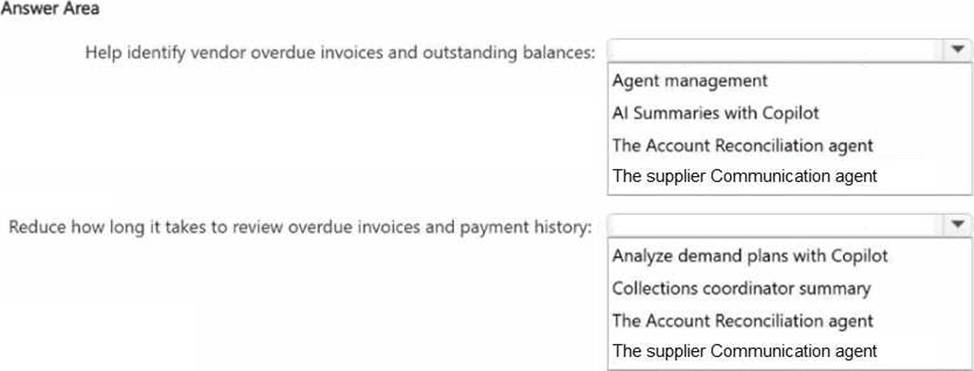
A company uses Microsoft Dynamics 365 Finance for accounts payable and customer debt recovery.
You are designing an Al finance process that meets the following requirements:
Provides Al-driven details to help staff identify overdue vendor invoices and outstanding balances
Helps staff reduce how long it takes to review overdue invoices and payment history
You need to recommend which Microsoft Copilot features to include in the design.
What should you recommend for each requirement? To answer, select the appropriate options in the answer area. NOTE: Each correct selection is worth one point.
Explanation:
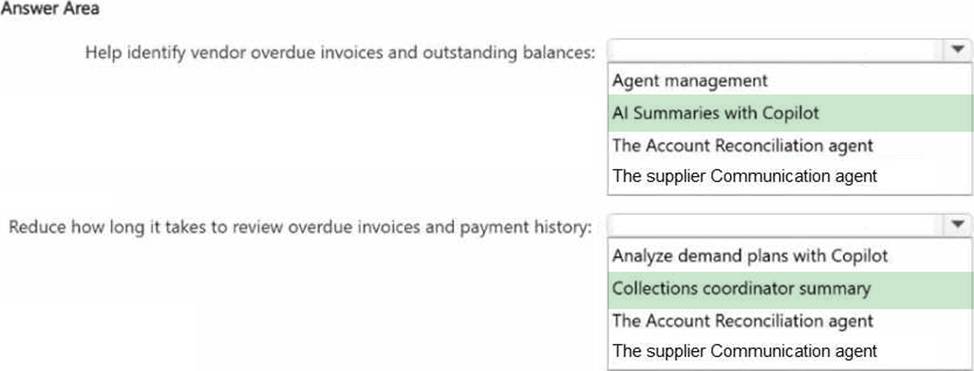
Vendor overdue invoices and outstanding balances → AI Summaries with Copilot
Review overdue invoices and payment history faster → Collections coordinator summary
This question combines two different finance-process needs inside Dynamics 365 Finance:
The first requirement is in the accounts payable / vendor context. Staff need AI-driven details to quickly understand overdue vendor invoices and outstanding balances. The best fit is AI Summaries with Copilot, because this feature is intended to surface concise, contextual summaries that help users understand finance records faster without manually opening and reviewing every transaction.
The second requirement is in the customer debt recovery / collections context. Staff need to reduce
the time spent reviewing overdue invoices and payment history. The best match here is Collections coordinator summary, because it is specifically aligned to collections work and helps users quickly review the customer’s collections status, invoice aging, and payment-related context.
Why the other options are less suitable:
Agent management is administrative and not the feature that provides invoice/balance insights.
The Account Reconciliation agent is more focused on reconciliation tasks than on these specific AP and collections-review needs.
The supplier Communication agent is oriented toward supplier interaction/communication, not primarily summarizing overdue invoice and balance insight for internal review.
Analyze demand plans with Copilot is unrelated to overdue invoices or payment-history review.
You are designing an Al business solution that contains the following components:
• A Microsoft Power Automate workflow
• A Microsoft Copilot Studio agent
• A Microsoft Dataverse database
• A Microsoft Power Apps app
As part of the application lifecycle management (ALM) process, you plan to package the components, so that they can be deployed to other environments as a group. You need to recommend a solution that supports versioning, dependencies, and deployments.
What should you include m the recommendation?
- A . Azure DevOps
- B . GitHub Actions
- C . Microsoft Power Platform solutions