
Practice Free 400-007 Exam Online Questions
You are designing a large-scale DMVPN network with more than 500 spokes using EIGRP as the IGP protocol.
Which design option eliminates potential tunnel down events on the spoke routers due to the holding time expiration?
- A . Increase the hold queue on the physical interface of the hub router.
- B . Increase the hold queue on the tunnel interface of the spoke routers
- C . Increase the hold queue on the tunnel interface of the hub router
- D . Apply QoS for pak_priority class
- E . Increase the hold queue on the physical interface of the spoke routers.
Company XYZ connects its sites over a private WAN. Their overlay network is running a DMVPN setup where the headquarters site is the hub. The company is planning on implementing multicast routing on the network.
What should be used in the multicast routing design?
- A . PIM dense mode with RP located at the hub
- B . PIM sparse mode with RP located at each remote site
- C . PIM sparse mode with RP located at the hub
- D . PIM dense mode with RP located at each remote site
As part of a new network design documentation, you are required to explain the reason for choosing cisco FabricPath for Layer 2 loop avoidance.
Which two elements help Cisco FabricPath mitigate Layer 2 loops if they happen in the Layer 2 MP network? (Choose two)
- A . MAC tunneling
- B . IS-IS multipath
- C . RPF check
- D . TTL header
DRAG DROP
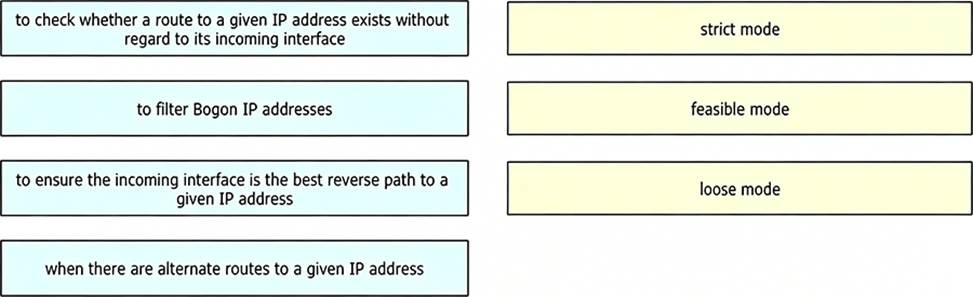
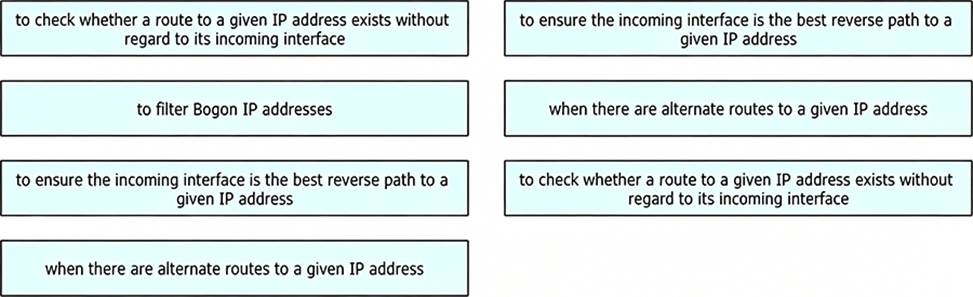
A networking team needs to prevent spoofing attacks They are describing the different uRPF design use cases so they can identify and deploy the optimal mode in various parts of their network.
Drag and drop the use cases from the left onto the corresponding uRPF technique on the right Not all options are used.
A communication network failure is usually defined as a situation where the network is unable to deliver communication services. Thus a failure can be viewed as a disruption of service rather than degradation due to congestion. One of the survivability techniques for improving network resilience is traffic management.
Which network-level traffic management and restoration technique can be used to achieve this?
- A . Multi-homing nodes for link level failure mitigations
- B . Prevention technique to improve component and system performance
- C . Provisioning backup power supplies for network equipment
- D . Pre-configured backup LSP paths in MPLS networks
Which relationship between IBGP and the underlying physical topology is true?
- A . iBGP full mesh requirement does not dictate any specific network topology.
- B . iBGP can worn only on a ring network topology with a link-state protocol like OSPF or IS-IS
- C . iBGP full mesh requires an underlying fully meshed network topology.
- D . iBGP does not work on a ring network topology even with an underlying IGP.
Which two network design considerations improve the maximum link utilization? (Choose two)
- A . centralizing the decision-making process
- B . channelizing the traffic at the receivers
- C . decentralizing the classes of traffic
- D . programmatically rate-limiting traffic at the senders
- E . differentiating the path calculation
DRAG DROP
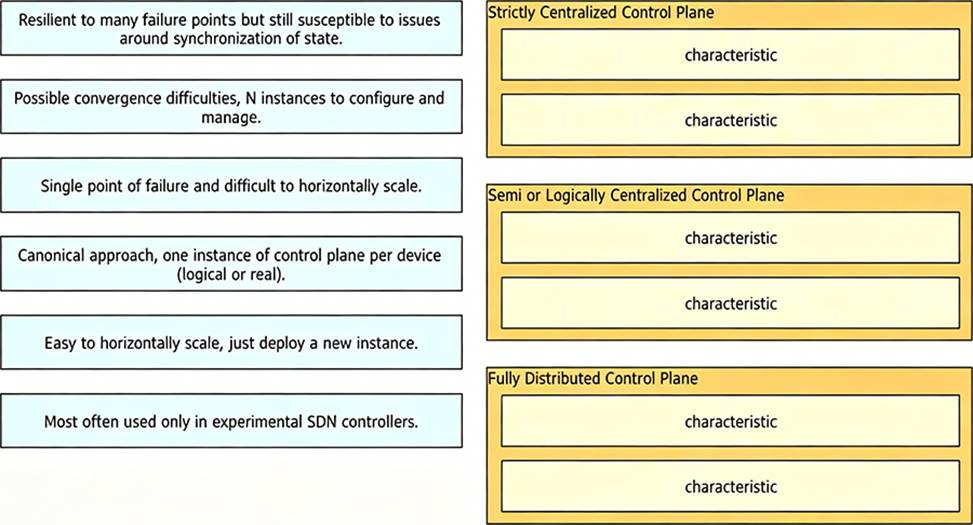
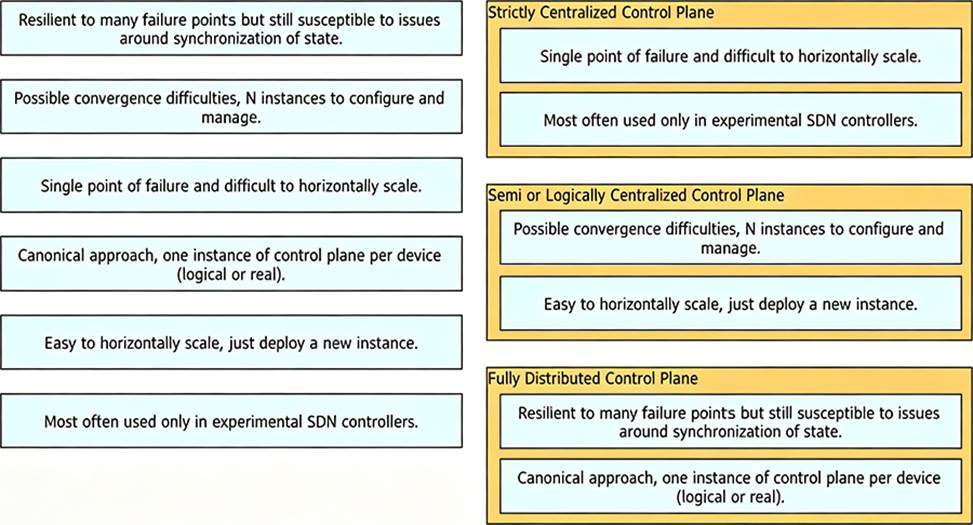
Network operators have many options available from fully centralized to fully distributed control planes and each approach has its own set of characteristics.
Drag and drop the characteristics from the left onto the corresponding approach on the right.
Sometimes SDN leverages various overlay networking technologies to create layer(s) of network abstraction.
What describes an overlay network?
- A . It transmits packets that traverse over network devices like switches and routers
- B . It encapsulates packets at source and destination, which incurs additional overhead
- C . Packet delivery and reliability occurs at Layer 3 and Layer 4
- D . It is responsible for the delivery of packets; NAT- or VRF-based segregation is required
Which two possible drawbacks should you consider when introducing Network Functions Virtualization in a network design? (Choose two)
- A . Bandwidth utilization increases
- B . Traffic flows are suboptimal
- C . High-end routers are required to support NFV
- D . OpenFlow must be supported in the network
- E . An SDN orchestration layer is required to support NFV