
Practice Free 3V0-23.25 Exam Online Questions
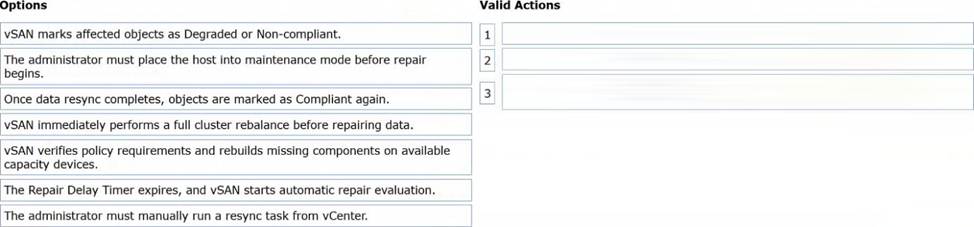
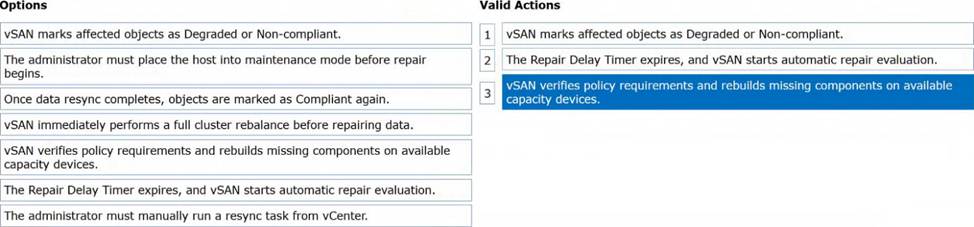
In a vSAN ESA cluster, one host goes offline unexpectedly for more than an hour.
When it returns online, vSAN needs to rebuild and restore compliance for several objects that became degraded during the outage.
Drag and drop the three correct options for the automatic recovery process from the Options list on the left and place them into the Valid Actions on the right in any order. (Choose three.)
An administrator is managing a local vSAN 3-node cluster running the Express Storage Architecture (ESA) as part of a VMware Cloud Foundation (VCF) Workload Domain.
The following parameters apply at the cluster level:
– HA is enabled
– Reserved Failover Capacity = 25% for both CPU and Memory
The administrator is tasked with configuring the VSAN storage policy so it will tolerate the maximum number of failures.
What two protection levels can the administrator configure? (Choose two.)
- A . RAID-1 (Mirroring) 1 Failure.
- B . No data redundancy.
- C . RAID-6 (Erasure Coding) 2 Failures.
- D . RAID-5 (Erasure Coding) 1 Failure.
- E . RAID-1 (Mirroring) 3 Failures.
- F . RAID-1 (Mirroring) 2 Failures.
An administrator has been tasked with suggesting storage models for a new VMware Cloud Foundation (VCF) Private Cloud with the following characteristics:
– Single VCF Instance with a single Workload Domain.
– The VCF Management Workload Domain will consist of a single cluster that uses a highly scalable, integrated storage solution that does not require additional management software or hardware.
– The VCF Workload Domain consists of with a single Cluster that requires a multiple tier storage solution consisting of:
o A highly scalable, policy-based storage solution for critical application workloads.s.
o A file-based storage solution that can scale independently of the cluster for workloads with large data requirements.
Which three storage models should the administrator recommend? (Choose three.)
- A . VMware vSAN should be the principal storage solution for the VCF Management Domain.
- B . VMware vSAN should be the principal storage solution for the VCF Workload Domain.
- C . iSCSI should be the supplemental storage solution for the VCF Workload Domain.
- D . iSCSI should be the principal storage solution for the VCF Management Domain.
- E . NFS v3 should be the supplemental storage solution for the VCF Workload Domain.
- F . NFS v4.1 should be the principal storage solution for the VCF Management Domain.
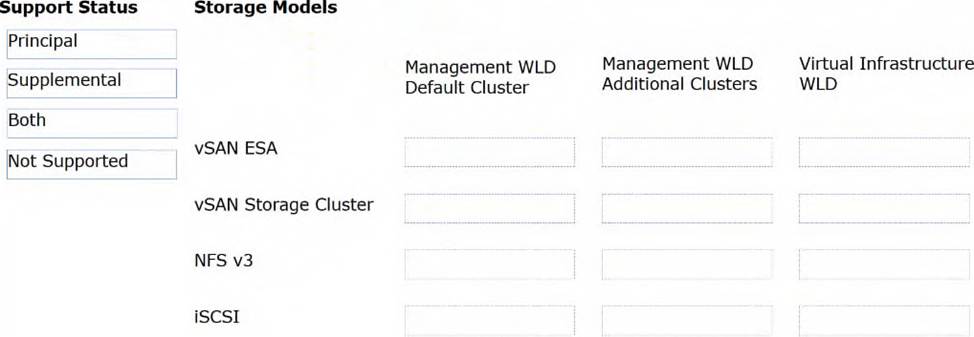
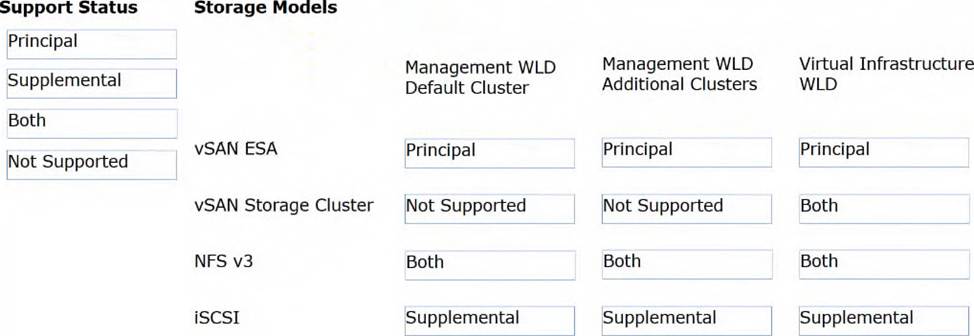
An administrator is responsible for a VMware Cloud Foundation (VCF) Private Cloud has been tasked with identifying which storage model is supported in the different VCF Workload Domains.
Drag and drop the Support Status of each storage model on the left to each type of Workload Domain on the right.
An administrator has been tasked with recommending a principal storage type for a new cluster within an existing VMware Cloud Foundation (VCF) Workload Domain.
The following information has been provided:
– The customer has a dedicated Fibre Channel (FC) Storage Area Network (SAN)Fabric.
– The customer has a 10GbE network.
– The new cluster will consist of three host servers that have been purchased as part of a previous project.
– Each of the host servers have the following configuration:
o Two 500GB Enterprise-grade SSD drives.
o Two 2-Port Host Bus Adapters (HBA).
o Two 2-Port 10GbE adapters.
– Storage traffic should be physically isolated from all other network traffic.
– There is no budget for additional hardware.
Which approach should the administrator recommend?
- A . NVMe over Fibre Channel
- B . Fibre Channel
- C . NFS v4.1
- D . iSCSI
After a planned power outage, an administrator decided to restart the vSAN cluster manually.
Drag and drop the three correct options from the Options list on the left and place them into the Required Options on the right in any order. (Choose three.)


An architect is presented with the following requirements for the storage solution in a VMware Cloud Foundation (VCF) Workload Domain.
The solution must:
– Allow for rapid recovery in case of an availability zone failure.
– Provide an extremely high amount of IOPS to all applications.
– Allow for additional storage to be added as application needs grow.
– Provide the lowest latency possible for configured applications.
– Provide recovery in case of datastore failure.
– Encrypt data in transit and at rest.
What two vSAN advanced technologies must be deployed to meet these requirements? (Choose two.)
- A . vSAN Data Protection Service
- B . vSAN iSCSI Target Service
- C . vSAN Stretched Clusters
- D . vSAN Global Deduplication
- E . vSAN Storage Cluster
A clustered legacy application is scheduled for decommissioning at the end of the month. While in use, it stored application and quorum data on a pair of vSAN iSCSI Target LUNs.
After the vSAN iSCSI Target Service is disabled, what will happen to the existing targets and LUNs?
- A . The targets and LUNs will be migrated to object’s namespace for retention.
- B . The targets and LUNs will remain intact but become unavailable.
- C . The targets and LUNs will be deleted.
- D . The targets and LUNs will be archived for 90 days.