
Practice Free 3V0-23.25 Exam Online Questions
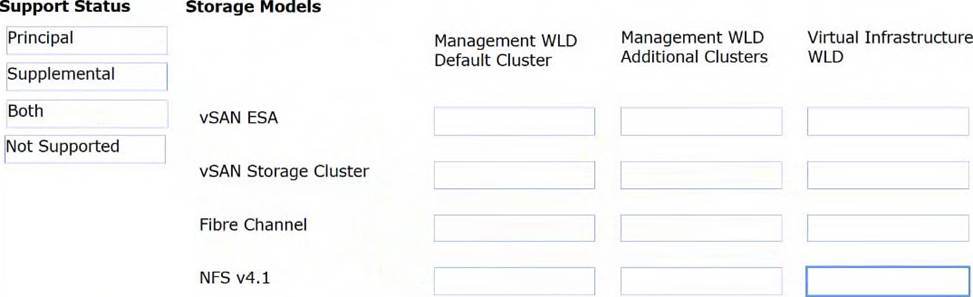
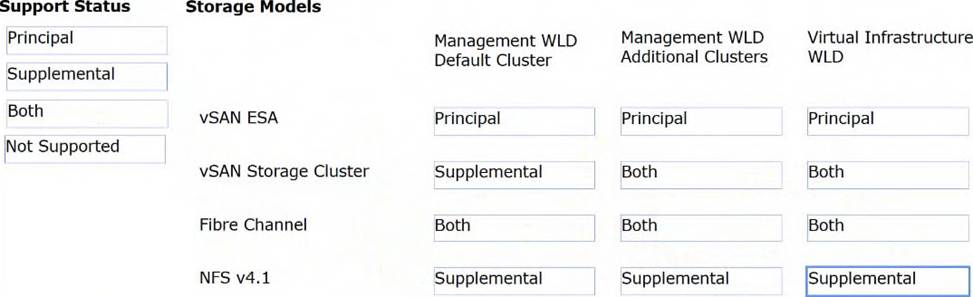
An administrator is responsible for a VMware Cloud Foundation (VCF) Private Cloud has been tasked with identifying which storage model is supported in the different VCF Workload Domains.
Drag and drop the Support Status of each storage model on the left to each type of Workload Domain on the right.
To respect the application criticality, an administrator is configuring the Recovery Priority of protected Virtual Machines (VMs).
What does VMware Live Site Recovery leverage to mark a recovery priority as completed?
- A . Virtual machines are registered.
- B . VMware tools heartbeat are present.
- C . Virtual machines are successfully recovered.
- D . Final replication is complete.
- E . Virtual machines are powered on.
A storage administrator is being presented with the following VMware Cloud Foundation (VCF) architectural details:
– The applications data will require 2.5 PB of capacity.
– The production applications will be hosting archival solutions and gateways.
– There will be some applications deployed for the purpose of testing and development.
What is the optimal principal storage that the administrator can recommend?
- A . vSAN OSA – All Flash
- B . vSAN ESA
- C . vSAN ESA Storage Clusters
- D . vSAN OSA – Hybrid
An administrator has been tasked with making changes to an VMware Cloud Foundation (VCF) Workload Domain cluster that is configured with Fibre Channel (FC) for Principal storage and NFS for Supplemental storage.
The cluster has the following configuration:
– There are 3 x ESX host servers.
– There are 3 x storage LUNS.
– Each Storage LUN has a single VMFS Datastore configured.
– All servers have access to a single NFS Datastore that has been provisioned to store ISO files.
The administrator has the following concerns with the existing configuration:
– Every time a new Virtual Machine is deployed to the Workload Domain, the administrator must choose which VMFS datastore should be used.
– When reviewing the Datastores in VCF Operations:
o One of the VMFS datastores has no Virtual Machines running in it.
o The other two VMFS datastores have an imbalance of Virtual Machines and this is causing resource contention.
The administrator has the following requirements:
– Virtual Machines must be placed automatically on the most appropriate VMFS datastore.
– Virtual Machines must be automatically balanced across VMFS datastores based on 50% of the available capacity being consumed within a single datastore.
What four actions should the administrator take to meet all of the requirements? (Choose four.)
- A . Configure the Datastore Cluster to set the Storage DRS storage space utilization difference to 50%.
- B . Create a new Datastore Cluster using all four available Datastores.
- C . Configure the Datastore Cluster to set the Storage DRS storage space threshold to 50%.
- D . Configure the Datastore Cluster to use Manual Storage DRS.
- E . Create a new Datastore Cluster using all three VMFS Datastores.
- F . Ensure all three storage LUNs are available to each ESX host server.
- G . Configure the Datastore Cluster to use Fully Automated Storage DRS.
An administrator notices alerts triggering IOPS and disk throughput storage performance problems in the Fibre Channel data storage in a VMware Cloud Foundation workload domain.
What can the administrator review to identify which Virtual Machines (VMs) may be experiencing storage IOPS and disk throughput performance issues?
- A . vSphere Storage Inventory dashboard.
- B . Storage Operations page.
- C . vSAN Health dashboard.
- D . Live! vSphere Heavy Hitter VM dashboard.
A agency is designing its secure private cloud on VMware Cloud Foundation with following requirements:
– Strict data segregation between the management and workload domains.
– Company policy prevents using vSAN as a storage solution.
– Data encryption at-rest is mandatory for both the management and workload domains.
– Data encryption in-transit is mandatory for the workload domains.
– Data-at-rest encryption must be performed by the storage aray and not rely on VMware native or vSAN-specific mechanisms.
– Allow for automated VM placement, operational integrity with VCF Operations, and assurance that file-based workloads scale efficiently.
Which storage architecture fulfills these technical and regulatory requirements?
- A . Enable VMware VM-level encryption using vSphere Native Key Provider (NKP) on local VMFS disks for all environments, implementing manual file workload allocation through generic SMB shares.
- B . Create a unified NAS platform offering both NFS and SMB exports shared across management and workload domains, then enable application-level encryption for sensitive workloads and restrict access via firewall rules.
- C . Deploy metro clusters backed by Self-Encrypting Disk (SED) using iSCSI for both domains and configure encrypted VLANs for data-in-transit between VCF Operations and hosts.
- D . Configure dedicated VMFS datastores on separate Fibre Channel arrays for management and workloads, with array-based encryption enabled and SPBM storage policies assigned. Use NFS v4.1 shares (with Kerberos-based encryption for in-transit data) for file workloads in the workload domain, restricting cross-domain datastore access.
An administrator is working on a VMware Cloud Foundation (VCF) Workload Domain that was configured to use vSAN for principal storage. The administrator wishes to create and configure a datastore cluster to host tenant VMs using that vSAN backed storage across multiple clusters (mixed OSA and ESA) in the domain.
What should the administrator consider?
- A . When using vSAN Datastores, Datastore Clusters are not supported. Each VM must be placed manually on the vSAN datastore.
- B . vSAN OSA and ESA based datastores must be added to a datastore cluster tag and then select them as part of a single storage policy.
- C . When using vSAN as the underlying datastore, an administrator must create the datastore cluster via vCenter APIs, include the vSAN datastore(s) in it, enable Storage DRS, and ensure the VM Storage Policies reference the appropriate vSAN-capable datastore.
- D . A datastore cluster can combine different storage types (i.e. vSAN, FC, and NFS datastores) as long as they are in the same vCenter; Storage DRS will treat them uniformly.
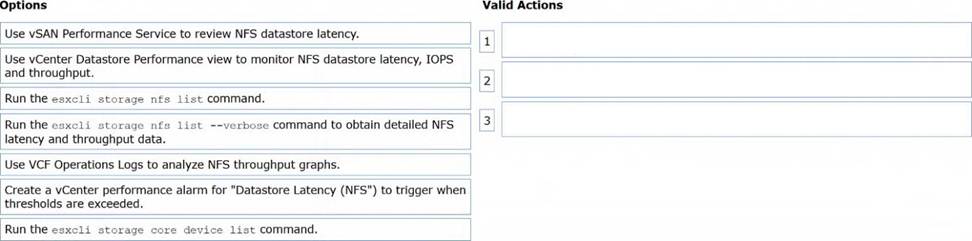
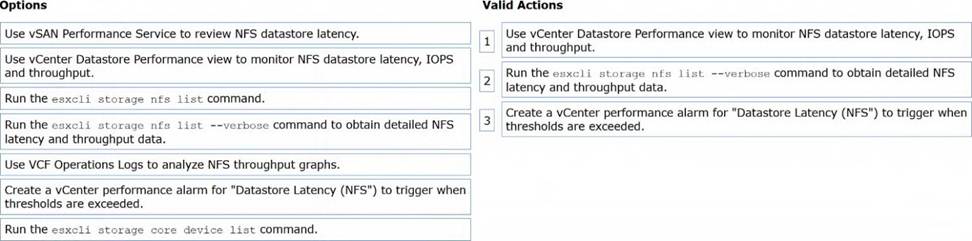
An administrator needs to monitor an external NFS datastore attached to a VMware Cloud Foundation (VCF) cluster to confirm that it meets latency and throughput targets.
Drag and drop the three correct options from the Options list on the left and place them into the Valid Actions on the right in any order. (Choose three.)
An administrator is tasked with vertically scaling a vSAN ESA deployment.
The curent cluster contains 6 hosts each with the following configuration:
– 8 X 7.68TB drives
– 2 X 25 GB NICS
– 2 X Intel Gold CPUs
What are the three reasons to add the same model and capacity drives when scaling each host? (Choose three.)
- A . vSAN File Services are configured on the cluster.
- B . Improved predictability of storage performance.
- C . Cache and capacity tiers should contain equal amounts of storage.
- D . 7.68TB drives can be used for cache drives.
- E . Consistent maintenance procedures.
- F . Balanced storage consumption across hosts in the cluster.
An administrator is tasked with deploying a vSAN ESA Stretched cluster for a VMware Cloud Foundation (VCF) workload domain.
The stretched cluster must meet the following requirements:
– Ensure the cluster supports a storage policy with a secondary level of resilience of FTT=2 using RAID-6 erasure coding.
– Allow vSAN to regain its prescribed level of resilience in the event of a sustained host outage.
What is the minimum number of hosts required in each availability zone?
- A . 14
- B . 7
- C . 6
- D . 12