
Practice Free AZ-900 Exam Online Questions
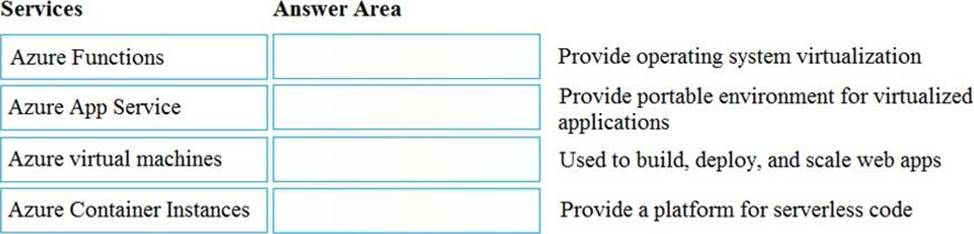
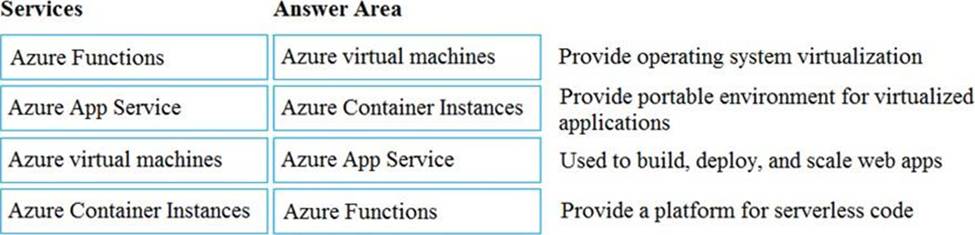
DRAG DROP
Match the Azure service to the correct description.
Instructions: To answer, drag the appropriate Azure service from the column on the left to its description on the right. Each service may be used once, more than once, or not at all
NOTE: Each correct match is worth one point.
Fill in the blank
(_________________) is a highly secure loT solution that includes a microcontroller unit (MCU) and a customized Linux operating system.
You plan to map a network drive from several computers that run Windows 10 to Azure Storage. You need to create a storage solution in Azure for the planned mapped drive.
What should you create?
- A . an Azure SQL database
- B . a virtual machine data disk
- C . a Files service in a storage account
- D . a Blobs service in a storage account
C
Explanation:
Azure Files is Microsoft’s easy-to-use cloud file system. Azure file shares can be seamlessly used in Windows and Windows Server.
To use an Azure file share with Windows, you must either mount it, which means assigning it a drive letter or mount point path, or access it via its UNC path.
Unlike other SMB shares you may have interacted with, such as those hosted on a Windows Server, Linux Samba server, or NAS device, Azure file shares do not currently support Kerberos authentication with your Active Directory (AD) or Azure Active Directory (AAD) identity, although this is a feature we are working on. Instead, you must access your Azure file share with the storage account key for the storage account containing your Azure file share. A storage account key is an administrator key for a storage account, including administrator permissions to all files and folders within the file share you’re accessing, and for all file shares and other storage resources (blobs, queues, tables, etc) contained within your storage account.
Reference: https://docs.microsoft.com/en-us/azure/storage/files/storage-how-to-use-files-windows
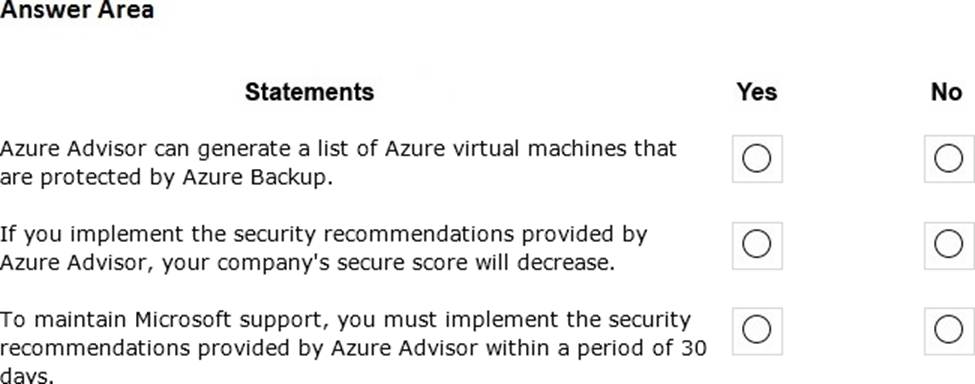
HOTSPOT
For each of the following statements, select Yes if the statement is true. Otherwise, select No. NOTE:
Each correct selection is worth one point.
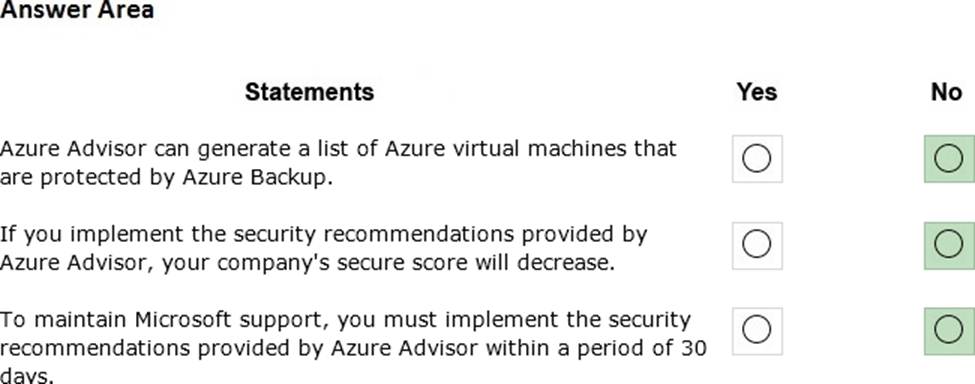
Explanation:
Reference:
https://docs.microsoft.com/en-us/azure/advisor/advisor-overview
https://microsoft.github.io/AzureTipsAndTricks/blog/tip173.html
This question requires that you evaluate the underlined text to determine if it is correct.
Resource groups provide organizations with the ability to manage the compliance of Azure resources across multiple subscriptions.
Instructions: Review the underlined text. If it makes the statement correct, select “No change is needed”. If the statement is incorrect, select the answer choice that makes the statement correct.
- A . No change is needed
- B . Management groups
- C . Azure policies
- D . Azure App Service plans
At which OSI layer does ExpressRoute operate?
- A . Layer 5
- B . Layer 7
- C . Layer 3
- D . Layer 2
Your company plans to migrate to Azure. The company has several departments. All the Azure resources used by each department will be managed by a department administrator.
You need to recommend an Azure deployment that provides the ability to segment Azure for the departments.
What are two possible techniques to segment Azure for the departments? Each correct answer presents a complete solution. NOTE: Each correct selection is worth one point.
- A . multiple subscriptions
- B . multiple Azure Active Directory (Azure AD) directories
- C . multiple regions
- D . multiple resource groups


What should you use to evaluate whether your company’s Azure environment meets regulatory requirements?
- A . Compliance Manager from the Security Trust Portal
- B . the Advisor blade from the Azure policy
- C . the Knowledge Center website
- D . the Security Center blade from the Azure portal
D
Explanation:
The Security Center blade from the Azure portal includes the ‘regulatory compliance dashboard’.
The regulatory compliance dashboard provides insight into your compliance posture for a set of supported standards and regulations, based on continuous assessments of your Azure environment.
In the Azure Security Center regulatory compliance blade, you can get an overview of key portions of your compliance posture with respect to a set of supported standards. Currently supported standards are Azure CIS, PCI DSS 3.2, ISO 27001, and SOC TSP.
In the dashboard, you will find your overall compliance score, and the number of passing versus failing assessments with each standard. You can now focus your attention on the gaps in compliance for a standard or regulation that is important to you.
Reference: https://azure.microsoft.com/en-us/blog/regulatory-compliance-dashboard-in-azure-security-center-now-available/

