
Practice Free Sales-Admn-202 Exam Online Questions
An admin has created a validation Product Rule that must display an error message upon clicking Sava if a Product Option is selected while a Configuration Attribute is set to a spacific value. When tha usar chooses the Product Option, than sets the Configuration Attribute to the specific value. The error massage appears before Save is clicked.
What can the admin change on the Product Rule or Configuration Attribute to ensure the error message only appears upon clicking Save?
- A . Add a Product Rule Error Condition to chack if Evaluation Action = Sava.
- B . Change tha Configuration Attribute field Apply Immadiately to False.
- C . Change tha Product Option fiald Apply Immediately to Trua.
- D . Change tha Product Rule field Evaluation Evant to Sava.
B
Explanation:
Issue:
The validation error message appears immediately after a user sets a specific value in the
Configuration Attribute, even before saving.
Solution:
Setting Apply Immediately to False ensures that changes in Configuration Attributes do not trigger immediate validations. Instead, validations occur only upon clicking Save. Why Other Options Are Incorrect:
A: Evaluation Action does not exist as a field for Product Rule Error Conditions.
C: Changing the Apply Immediately field for Product Options does not affect the Configuration Attribute’s behavior.
D: Setting Evaluation Event to Save applies to the rule’s scope but does not address Configuration Attribute settings.
Salesforce CPQ
Reference: Configuration Attribute Settings are explained in CPQ Configuration Attribute documentation .
Universal Containers (UC) has an approval structure that involves both the Deal Desk and Finance
teams. UC wants to send both Approval requests simultaneously when a Quote is submitted to
reduce the time for Quote approval.
Which Approval type best suits UC’s needs?
- A . Native Approvals; multiple Approval steps can be set up with the same Step Number to send Approval requests in parallel.
- B . Advanced Approvals; multiple Approval Chains can be set up to send Approval requests in parallel.
- C . Native Approvals; multiple Approval Processes can be set up to send Approval requests in parallel.
- D . Advanced Approvals; multiple Approval Steps can be set up in a single Approval Chain to send
Approval requests in parallel.
D
Explanation:
Requirement Overview:
Universal Containers needs to send Approval Requests to both the Deal Desk and Finance teams
simultaneously.
Solution:
Use Advanced Approvals to configure multiple Approval Steps within a single Approval Chain.
Set the steps to run in parallel to minimize the time required for approval.
Steps to Configure:
Navigate to Advanced Approvals in Salesforce CPQ.
Create an Approval Chain with two steps: one for the Deal Desk and one for the Finance team.
Configure both steps to run in parallel by assigning them the same step number.
Universal Containers needs to generate two styles of PDF output, one that includes prices in the line item table if the Quote is another that hides prices when the Quote Primary checkbox is False. Where should the admin reference the Primary checkbox field to set up this requirement?
- A . The Hide Group Subtotals Field on the Quote Template
- B . The Hide Totals Field on the Quote Template
- C . The Conditional Print Field for each price Line Column
- D . The Conditional Print Field of a Template Section for only price Line Columns
D
Explanation:
Requirement Overview:
Show or hide price-related data in the Quote PDF based on the Primary Checkbox field value.
Solution Details:
The Conditional Print Field on Template Sections enables dynamic visibility.
Add the Primary Checkbox as a reference in the Conditional Print Field for the section containing
price-related columns.
Steps to Configure:
Navigate to the Quote Template.
Locate the section containing price-related data.
Set the Conditional Print Field to reference the Primary Checkbox.
Validation:
Generate PDFs with the Primary checkbox set to both True and False and confirm the expected visibility of pricing data.
Universal Containers needs to generate two styles of PDF output, one that includes prices in the line item table if the Quote is another that hides prices when the Quote Primary checkbox is False. Where should the admin reference the Primary checkbox field to set up this requirement?
- A . The Hide Group Subtotals Field on the Quote Template
- B . The Hide Totals Field on the Quote Template
- C . The Conditional Print Field for each price Line Column
- D . The Conditional Print Field of a Template Section for only price Line Columns
D
Explanation:
Requirement Overview:
Show or hide price-related data in the Quote PDF based on the Primary Checkbox field value.
Solution Details:
The Conditional Print Field on Template Sections enables dynamic visibility.
Add the Primary Checkbox as a reference in the Conditional Print Field for the section containing
price-related columns.
Steps to Configure:
Navigate to the Quote Template.
Locate the section containing price-related data.
Set the Conditional Print Field to reference the Primary Checkbox.
Validation:
Generate PDFs with the Primary checkbox set to both True and False and confirm the expected visibility of pricing data.
Universal Containers (UC) sells product A with a tiered pricing model using a discount scheduled three discount tiers. UC signed an agreement that gives a client a 50% discount on product A with a flat rate for the next calendar year overriding the current discount schedule.
Which set of actions would meet these requirements?
- A . Create a price book for this client with a price book entry at half the price for Product A and create Flow that assigns this price book to all opportunities for this client.
- B . Create a product rule that clears the discount schedule an injects 50% into the Additional Discount field on the quote line for product A when the account associated with the quote is this client.
- C . Create a price rule that applies the 50% discount to the List Price and inserts it into the Customers price field on the quote line when the account associated with the quote is this client.
- D . Create a discount scheduled with the single discount tier at 0% discount and associated it with contracted Price giving 50% discount to product A on this client’s account record.
D
Explanation:
When creating Orders from Quotes with Salesforce CPQ, the Admin wants to separate similar Products into Orders based on the Product Family of the Products being ordered.
Which two steps must the Admin perform to automatically split these types of Orders? Choose 2 answers
- A . Set the Order By field on the Quote Line to Product Family.
- B . Enable Allow Multiple Orders from a checkbox in the CPQ Package Settings.
- C . Set the Order By field on the Quote to Product Family.
- D . Enable Allow Multiple Orders from a checkbox on the Quote.
B,C
Explanation:
Comprehensive Detailed Step-by-Step Explanation with all Salesforce CPQ Reference
To split orders based on product family when creating orders from quotes in Salesforce CPQ, the
following steps must be followed:
Enable the Allow Multiple Orders Setting
Navigate to Setup > Installed Packages and locate Salesforce CPQ.
Click Configure, then go to the Orders tab in the CPQ package settings.
Check the Allow Multiple Orders option. This allows multiple orders to be created from a single quote.
This setting ensures that products can be grouped and split into separate orders based on specific criteria like Product Family.
Set the Order By Field to Product Family
From the object management settings for Quotes, edit the Order By field.
Add "Product Family" as a picklist value if it is not already available.
On the Quote, select Product Family in the Order By field.
Save your changes. When creating an order, Salesforce CPQ will group quote lines into separate
orders based on the Product Family.
Process for Creating Orders
On the quote, select the Ordered checkbox.
Salesforce CPQ will automatically split the quote into multiple orders, grouping quote lines by the
Product Family value.
Notes and Considerations
If some quote lines do not have a value for the field used in the Order By, they will be grouped into one order.
This functionality is available in Salesforce CPQ editions starting from Summer ’16.
By following these steps, administrators can ensure that similar products are automatically separated into different orders based on their product family.
In what way does Smart Approvals expedite the approval process?
- A . Approving a quote will auto-approve any lesser-discount quotes related to the same opportunity.
- B . Quotes within defined thresholds will be automatically approved.
- C . Quotes with multiple steps in the approval chain go directly to the highest approver required.
- D . Rejected quotes that are resubmitted within previously approved values go directly to the person who rejected.
D
Explanation:
Smart Approvals Overview:
Salesforce CPQ’s Smart Approvals streamline the approval process by re-evaluating previously approved records to avoid redundant approvals. Rejected Quotes Resubmission:
If a quote is rejected, and the user resubmits it without exceeding previously approved values, it bypasses the full approval chain and is sent directly to the person who rejected it. This functionality minimizes unnecessary delays and ensures efficient quote handling.
Documentation Alignment:
Smart Approvals Configuration and behavior as outlined in CPQ guidelines ensure approval efficiency .
If a manager is taking a leave of absence, how can the admin using Advanced Approvals ensure that another manager will receive Approval requests during the period in which the original manager is absent?
- A . On the original manager’s Approver record, reference a different manager’s Approver record inthe Next Approver lookup field. Clear the Next Approver lookup field once the original managerreturns from leave.
- B . Create an Approval Rule with an Effective Start Date and Effective End Date spanning theabsence.
Populate the Approver field of the rule with the substitute Approver, then add the rule tothe existing
Approval Chain as the first step. - C . On the original manager’s Approver record, set the Delegated Approver lookup field toreference a different manager’s Approver record, and set the Delegation End field for the date ofthe original manager’s return.
- D . Create a new Approver record, with the Group ID field set to the ID of a Public Group thatcontains
all of the managers. On the original manager’s Approver record, click the Replace buttonand select the new Approver record.
C
Explanation:
Requirement:
Ensure approval requests are routed to a substitute manager during the original manager’s absence.
Solution:
The Delegated Approver lookup field on the Approver record allows the admin to specify a temporary approver.
Setting the Delegation End field ensures the delegation automatically ends upon the original manager’s return.
Why Other Options Are Incorrect:
A: Using the Next Approver field for temporary delegation is not the intended functionality.
B: Creating an Approval Rule with start and end dates is overly complex and unnecessary.
D: Replacing the original Approver record risks permanent changes and is not recommended for temporary delegation.
Salesforce CPQ
Reference: Delegated Approval Settings are documented under Advanced Approvals Configuration Guidelines .
Universal Containers (UC) sells Product A for an initial, fixed price without the ne«d for renewal behavior. UC must be able to track an individual senal number on the Asset record for each Product A sold.
Which Product field value should the admin set up to handle this use case?
- A . Asset Conversion: One Per Line
- B . Subscription Type: One-Time
- C . Asset Conversion: One Per Unit
- D . Subscription Price: List Price
C
Explanation:
Requirement:
Track individual serial numbers for each unit of Product A sold.
Solution Details:
Asset Conversion Field determines how assets are created from Quote Lines.
Setting Asset Conversion to One Per Unit creates one Asset record for each unit sold, allowing
tracking of individual serial numbers.
Implementation:
Navigate to the Product Record for Product A.
Set Asset Conversion to One Per Unit.
Justification:
This setup aligns with Salesforce CPQ’s approach for granular tracking of Assets associated with product sales.
An admin has created a Small Business Bundle product with List Price = $5.00 with these Product Options:
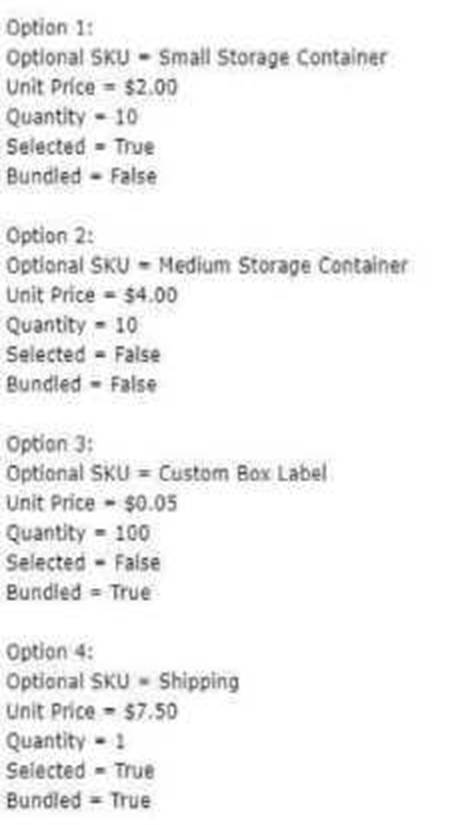
If a user adds this bundle and saves it without making changes to the configuration, what will the Package Total be on the Small Business Bundle parent product Quote Line?
- A . $17.50
- B . $25.00
- C . $37.50
- D . $5.00
B
Explanation:
Bundle Configuration:
Small Storage Container (Option 1): $2.00 × 10 = $20.00
Shipping (Option 4): $7.50 (bundled).
Other Options (Option 2 and Option 3):
Medium Storage Container: Not selected.
Custom Box Label: Not selected.
Calculation:
Bundle Parent Product Price: $5.00
Total Price: $5.00 (bundle) + $20.00 (Option 1) + $7.50 (Option 4) = $25.00
Why Other Answers Are Incorrect:
A: Ignores bundled Option 4 price.
C: Includes non-selected options in the total.
D: Excludes all Option prices, which is inaccurate. Salesforce CPQ
Reference: Bundling logic and pricing are covered under Bundle Configuration Guidelines .