
Practice Free PL-600 Exam Online Questions
DRAG DROP
A new customer asks you to design a solution for a Power Apps app that uses Microsoft Dataverse.
The customer wants to keep the service process simple and save on both licensing and development time.
You need to recommend solutions for the customer.
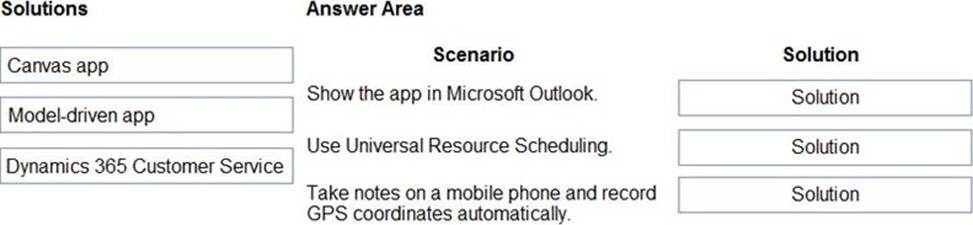
What should you recommend? To answer, drag the appropriate setting to the correct drop targets. Each source may be used once, more than once, or not at all. You may need to drag the split bar between panes or scroll to view content. NOTE: Each correct selection is worth one point.
Explanation:
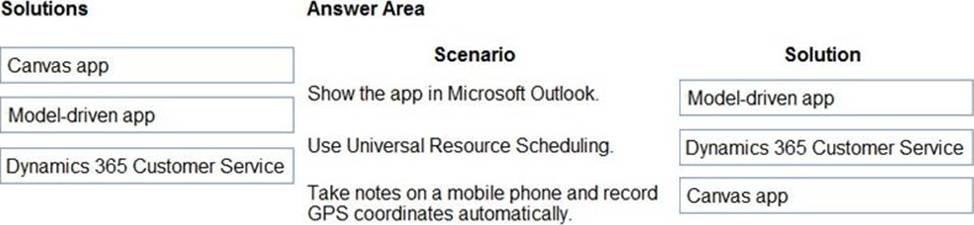
Box 1: Model-drive app
Integration with Microsoft Outlook requires a Model-driven app.
Box 2: Dynamics 365 Customer Service
Schedule anything in Dynamics 365 using Universal Resource Scheduling. You can enable scheduling for any entity in Dynamics 365 Sales, Field Service, Customer Service, and Project Service Automation, including custom entities.
Box 3: Canvas app
Reference: https://docs.microsoft.com/en-us/dynamics365/common-scheduler/schedule-anything-with-universal-resource-scheduling
You need to resolve the deployment plan issue.
What should you request?
- A . the IT manager adds a responsibility matrix
- B . the project manager adds a risk assessment
- C . the IT manager adds a data migration strategy
- D . the project manager adds a testing plan
You need to create an Agent security role.
Which three actions should you recommend? Each correct answer presents part of the solution. NOTE: Each correct selection is worth one point.
- A . Add security to the seat entity and assign users to the Agents role.
- B . Add security to the Core Records and assign users to the Customer Service Representative role.
- C . Copy the Microsoft Dataverse Basic User role.
- D . Rename the Customer Service Representative role to Agents.
- E . Copy the Customer Service Representative role.
- F . Name the new role Agents.
BEF
Explanation:
Scenario: The security rule for agents must contain the privileges in the default Customer Service
Representative security role.
Create a security role by Copy Role:
Step 1 (E): Copy the Customer Service Representative role.
Step 2 (F): Select the New Role Name.
Step 3: (B): When Copying Role is complete, navigate to each tab, ie Core Records, Business
Management, Customization, etc.
Set the privileges on each tab.
Reference: https://docs.microsoft.com/en-us/power-platform/admin/create-edit-security-role
HOTSPOT
A nationwide retailer is streamlining its warehouse operations by using a custom Microsoft Power Platform solution. The retailer plans to migrate its existing data to Microsoft Dataverse.
The retailer provides the following data solution requirements:
• Dispatchers are responsible for the storage, handling, and transportation of goods to and from the warehouses.
• Dispatchers will own order records and any associated order lines after an order ships.
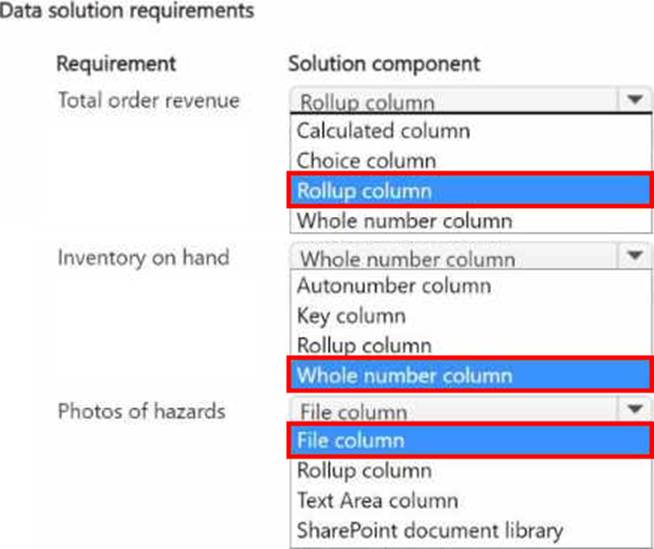
• The floor manager requires a consolidated view of the total order revenue for each order.
• The remaining inventory on hand must be available on each order line for the shipped product.
• All staff must take photos if they observe a hazard in a warehouse.
These photos must be added to a folder and shared with regional managers.
You need to design the data solution.
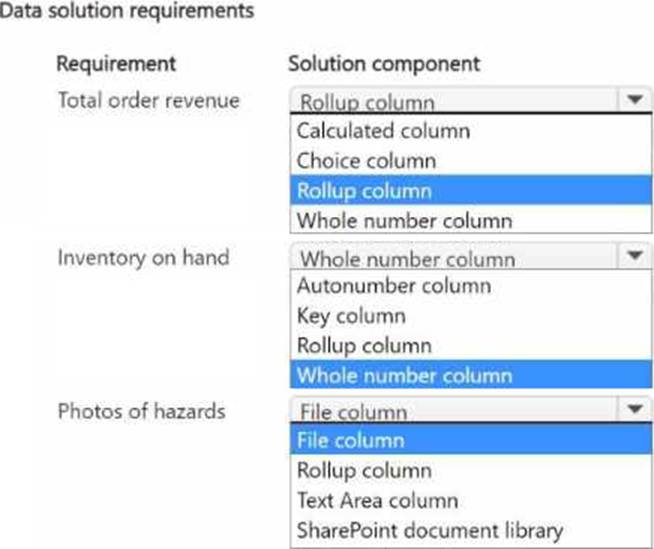
Which data solution component should you use for each requirement? To answer, select the appropriate options in the answer area. NOTE: Each correct selection is worth one point.
An engineering company is implementing Dynamics 365 Sales. The company has a custom connector to an ERP system.
The company plans to use the connector to view data in the app while also avoiding any data migration.
You need to evaluate the requirements and recommend an approach.
Which approach should you recommend?
- A . Install an industry accelerator.
- B . Create an on-demand Power Automate flow and use the connector to access the data.
- C . Build a canvas app and embed it in the Dynamics 365 Sales app.
- D . Connect the connector directly to the Dynamics 365 Sales app and view the data.
You are designing a Microsoft Power Platform solution.
The solution requires Microsoft Power Platform components and custom coding.
You need to describe the benefits of using Microsoft AppSource.
Which are three benefits of AppSource? Each correct answer presents a complete solution. NOTE: Each correct selection is worth one point.
- A . Microsoft Entra ID federated single sign-on (SSO).
- B . Reduced coding efforts because anyone can publish in AppSource.
- C . Microsoft standardized license agreement and privacy policy.
- D . App uptime of at least 99.9 percent.
- E . Free trial before committing to any additional costs.
You need to select an appropriate app for Relecloud.
Which app should you recommend?
- A . Dynamics 365 Field Service
- B . Dynamics 365 Sales
- C . Dynamics 365 Project Operations
- D . Dynamics 365 Customer Service
D
Explanation:
Microsoft Dynamics 365 Customer Service is a module for customer service automation that streamlines case and knowledge management, enables personalized customer service with a 360-degree customer view, and provides visibility into customer service department performance with dashboards and reports.
Reference: https://docs.microsoft.com/en-us/dynamics365/customer-service/overview
You are a Microsoft Power Platform architect supporting the go-live phase of a canvas app. The canvas app accesses data on-premises and in the cloud.
Users are reporting the app is very slow to respond, especially upon initial launch.
You need to optimize the performance of the app.
Which three actions should you complete? Each correct answer presents part of the solution. NOTE: Each correct selection is worth one point.
- A . Move data calls from the OnStart event to the Onload event.
- B . Reduce data row limits.
- C . Increase data row limits.
- D . Move data calls from the Onload event to the OnStart event.
- E . Review the settings of the data gateway for on-premises data sources.
HOTSPOT
An organization is optimizing its Microsoft Power Platform solution architecture.
The optimization needs to address the following:
✑ Label names for option sets and multiselect option sets should be added as separate fields for reporting.
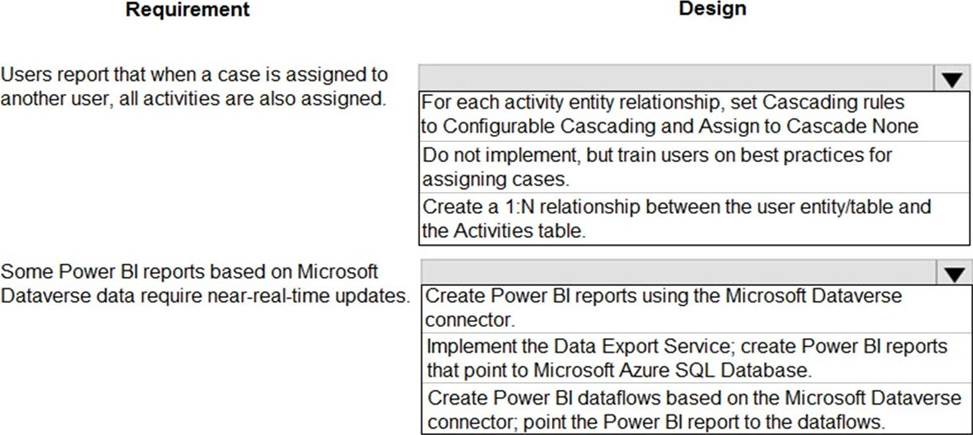
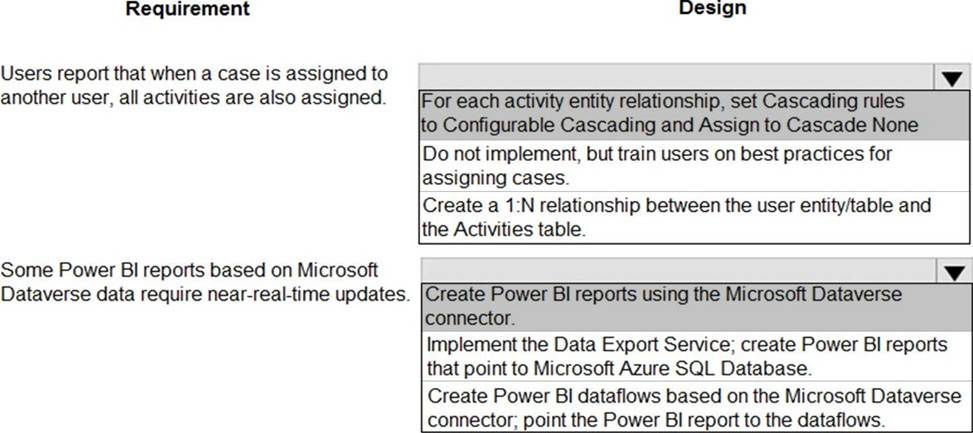
✑ Users complain that when a case is assigned to another user, all the activities are also assigned.
✑ Some Power BI reports based on Microsoft Dataverse data need near-real-time updating.
You need to recommend a design solution to meet these requirements.
What should you recommend? To answer, select the appropriate option in the answer area. NOTE: Each correct selection is worth one point.
Explanation:
Reference:
https://docs.microsoft.com/en-us/powerapps/developer/data-platform/configure-entity-relationship-cascading-behavior
https://docs.microsoft.com/en-us/powerapps/maker/data-platform/data-platform-powerbi-connector
A company is struggling to gather insights from won and lost opportunities.
Users must be able to access the company’s solution from mobile and desktop devices.
The solution must meet the following requirements:
✑ context of other related data.
✑ Display data to users as charts and tables and provide drill-through capabilities.
You need to recommend a Power Platform tool to help the client visualize the data.
Which two technologies should you recommend? Each correct answer presents a complete solution. NOTE: Each correct selection is worth one point.
- A . Power Bl
- B . Power Automate
- C . Power Virtual Agents
- D . Power Apps
AD
Explanation:
A: Power BI is a business analytics service by Microsoft. It aims to provide interactive visualizations and business intelligence capabilities with an interface simple enough for end users to create their own reports and dashboards. It is part of the Microsoft Power Platform.
D: Power BI Apps are an easy way for designers to share different types of content at one time. App designers create the dashboards and reports and bundle them together into an app. The designers then share or publish the app to a location where you, the business user, can access it. Because related dashboards and reports are bundled together, it’s easier for you to find and install in both the Power BI service (https://powerbi.com) and on your mobile device. After you install an app, you don’t have to remember the names of a lot of different dashboards or reports because they’re all together in one app, in your browser or on your mobile device.
Reference: https://docs.microsoft.com/en-us/power-bi/consumer/end-user-apps