
Practice Free PL-600 Exam Online Questions
You are designing a Microsoft Power Platform solution to help a company manage sales leads.
The solution has the following requirements:
✑ Ensure that users follow a predefined sales process regardless of the device that employees use to access the app.
✑ Respond to sales events by using organization-defined best practices.
You need to recommend a component for the app.
What should you recommend?
- A . Power Automate cloud flow
- B . Business process flow
- C . Power Automate desktop flow
- D . Playbook
B
Explanation:
You can help ensure that people enter data consistently and follow the same steps every time they work with a customer by creating a business process flow. For example, you might want to create a business process flow to have everyone handle customer service requests the same way, or to require that people get approval for an invoice before submitting an order. Business process flows use the same underlying technology as other processes, but the capabilities that they provide are very different from other features that use processes.
Reference: https://docs.microsoft.com/en-us/power-automate/business-process-flows-overview
You are designing a solution for a national vehicle repair company.
You have the following requirements:
• Customers must search for vehicle issues by using natural language expressions.
• Customers must contact a customer service agent as required.
You need to recommend a solution.
Which two features should you include? Each correct answer presents part of the solution.
- A . Power Virtual Agents
- B . Business process flow
- C . Power Apps portal
- D . Customer Insights
DRAG DROP
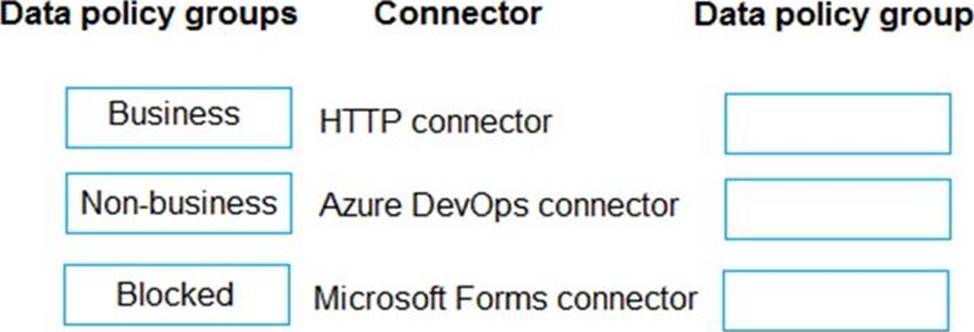
You are designing data loss policies for a Microsoft Power Platform implementation.
You have the following requirements:
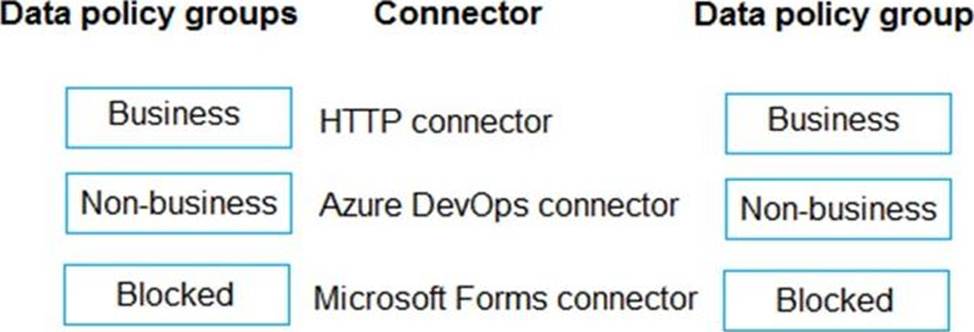
• Solutions that use the HTTP connector must not include any other connectors.
• Prevent the use of the Microsoft Forms connector.
• Allow the use of the Azure DevOps connector.
You need to determine in which data policy group to add each connector.
Explanation:
Box 1: Business
If you put a connector in the Business group, it can only be used with other connectors from that group in any given app or flow.
Box 2: Non-business
DLP policies enforce rules for which connectors can be used together by classifying connectors as either Business or Non-Business.
Box 3: Blocked
Sometimes you might want to block the usage of certain connectors altogether by classifying them as Blocked.
Data policy group Business blocked
Reference: https://docs.microsoft.com/en-us/power-platform/admin/wp-data-loss-prevention
All salespeople at a company manually send meeting summaries to the meeting attendees after a customer meeting. Meeting summaries are sent in a variety of ways. The company requires standardized processes.
You need to learn the existing processes to determine whether opportunities for automation exist What should you do?
- A . Review the request for proposal.
- B . Interview the director of each department
- C . Job shadow salespeople from each department.
Topic 5, Misc. Questions
A company uses two separate unlinked apps to manage sales leads: a Power Apps app and a third-party application.
The client has the following requirements:
✑ Manage all leads by using the Power Apps app.
✑ Create a lead in the Power Apps app when a user creates a lead in the third-party application.
✑ Update leads in the Power Apps app when a user updates a lead in the third-party application.
✑ Connect to the third-party application by using an API.
You need to recommend strategies to integrate the Power Apps app and the third-party application.
Which three options can you use to achieve the goal? Each correct answer presents part of the solution. NOTE: Each correct selection is worth one point.
- A . Dual-write
- B . Custom connector
- C . Dataflow
- D . Power Automate cloud flow
- E . DataService connector
ADE
Explanation:
A: Customers should be able to adopt business applications from Microsoft and expect they speak the same language and seamlessly work together. Dual Write allows our customers to not think about these apps as different systems to write to independently; rather, the underlying infrastructure makes it seamless for these apps to write simultaneously.
D: Use Custom APIs to create your own APIs in Dataverse. With a Custom API you can consolidate a group of operations into an API that you and other developers can call in their code. The Common Data Service (current environment) connector enables calling Custom APIs actions in Power Automate.
E: Common Data Service provides access to the environment database on the Microsoft Common Data Service. It is available for Logic Apps, Power Automate, and Power Apps.
Reference:
https://docs.microsoft.com/en-us/business-applications-release-notes/april19/cdm-data-integration/dual-writelink-common-data-service-apps https://docs.microsoft.com/en-us/connectors/commondataservice/
https://docs.microsoft.com/en-us/powerapps/developer/data-platform/custom-api
A company plans to adopt Microsoft Power Platform. You need to document the current enterprise architecture of the company.
Which two components should you incorporate? Each correct answer presents a complete solution. NOTE: Each correct selection is worth one point. Choose two.
- A . applications used
- B . functional requirements
- C . organizational structure
- D . process diagrams
- E . data locations
A local bank uses Microsoft Power Platform apps to store customer data.
The bank IT director discovers that all employees can see the social security numbers of their customers. The IT team does not understand how field-level security works and needs help with the design.
You need to recommend a solution to the bank that meets the following requirements:
• The system must restrict access to customer social security numbers to the vice president of finance only.
• The vice president of finance must be able to read and update customer social security numbers.
Which two actions should you recommend? Each correct answer presents part of the solution. NOT: Each correct selection is worth one point
- A . Set the values for the read permission and for the update permission for social security number to yet
- B . Enable field-level security for the member table.
- C . Create a held-level security profile.
- D . Enable field-level security for the social security number column.
A, B, D
Explanation:
Field-level security is managed by the security profiles. To implement field-level security, a system administrator performs the following tasks.
Enable field security on one or more fields for a given entity.
Associate one more existing security profiles, or create one or more new security profiles to grant the appropriate access to specific users or teams.
Reference: https://docs.microsoft.com/en-us/power-platform/admin/field-level-security
HOTSPOT
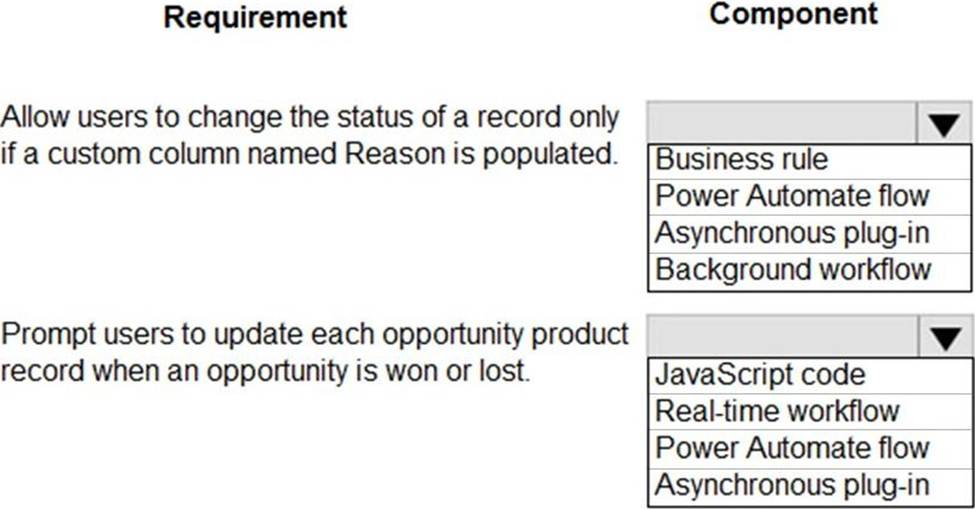
You are designing a Microsoft Power Platform solution for a company.
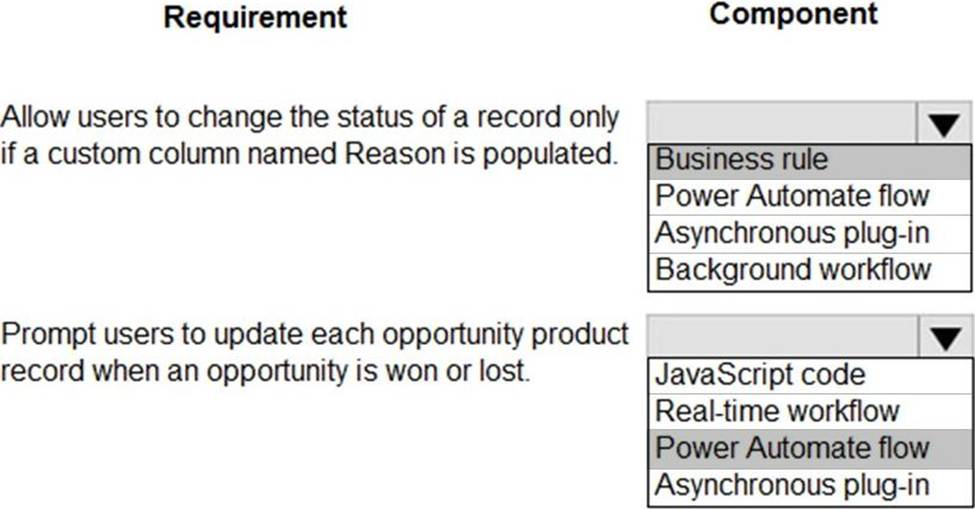
Which components should you recommend? To answer, select the appropriate options in the answer area. NOTE: Each correct selection is worth one point.
Explanation:
Box 1: Business rule
You can create business rules and recommendations to apply logic and validations without writing code or creating plug-ins. Business rules provide a simple interface to implement and maintain fast-changing and commonly used rules.
Box 2: Power Automate flow
Trigger the Power Automate flow with “When a record is updated”, then add a Condition in the flow and configure it with Status Label equals to Won.
Reference:
https://docs.microsoft.com/en-us/powerapps/maker/data-platform/data-platform-create-business-rule
https://www.inogic.com/blog/2021/12/how-to-win-lose-dynamics-365-crm-opportunity-through-power-automate-flow/
A company has a custom web-based API that is hosted on Azure. You design a Microsoft Power Platform solution to provide the company additional capabilities.
You need to integrate the Microsoft Power Platform solution with the API.
- A . Desktop flow
- B . Data gateway
- C . Connection reference
- D . Custom connector
A pharma company uses a proprietary system to manage its chemical experiments. The company uses Microsoft Dynamics 365 Project Operations to manage lab staff and resources.
Employees manually update Project Operations data with data from their proprietary system as needed. Employees are not able to provide a definite schema for their data.
You need to provide a solution that will allow employees to configure their own automatic updates.
Which component should you use?
- A . Dataflows
- B . Custom connectors
- C . Data gateways
- D . Microsoft Power Automate flows