
Practice Free PL-600 Exam Online Questions
DRAG DROP
A company uses a model-driven app to manage ticket requests.
The company has the following data requirements:
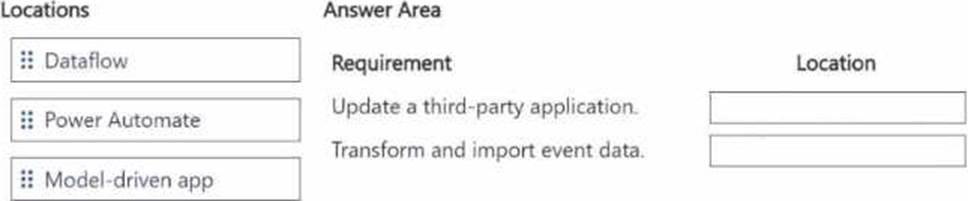
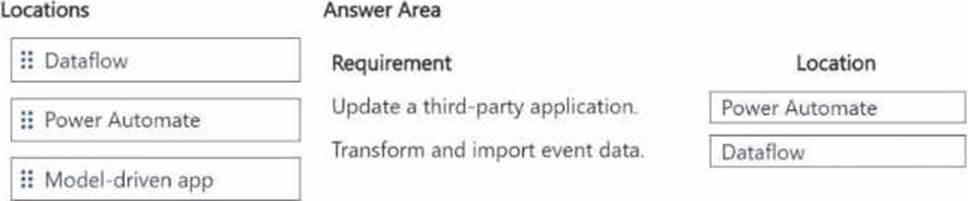
• Update a third-party application when a new ticket request is submitted.
• Transform and import event data nightly from a Microsoft Excel spreadsheet that is stored in a shared location.
You need to recommend a location to create the connection for each requirement.
Which locations should you recommend? To answer, drag the appropriate locations to the correct requirements. Each location may be used once, more than once, or not at all. You may need to drag the split bar between panes or scroll to view content. NOTE: Each correct selection is worth one point.
DRAG DROP
A medium-size company is evaluating Microsoft Power Platform functionality to enhance its business processes. The company currently uses a mix of spreadsheet tools and an outdated CRM system.
The company requires the following business solutions:
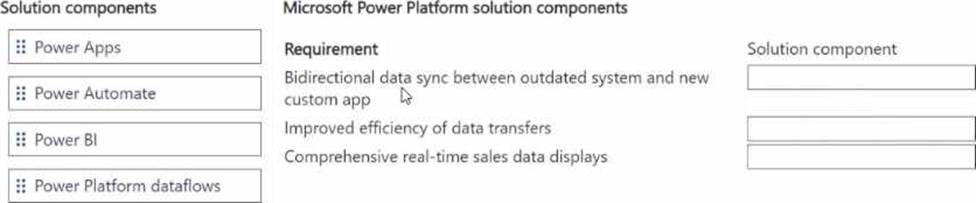
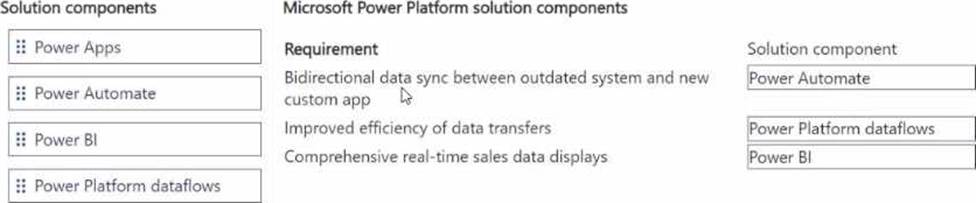
• bidirectional data sync between the outdated system and a new custom app
• improved efficiency of data transfers
• comprehensive real-time sales data displays
You need to configure the solution components for each requirement
Which components should you configure? To answer, move the appropriate solution components to the correct requirements. You may use each solution component once, more than once, or not at all. You may need to move the split bar between panes or scroll to view content. NOTE: Each correct selection is worth one point.
A company is creating a Microsoft Power Platform app to enable employees to log daily time entries. Employee user accounts are in multiple Azure AD tenants and are not located in the tenant that is running the app.
Employees must be added as Azure AD guest accounts within the tenant that will be running the app. Employees must access the model-driven app by being a member of a security team. The security team has been assigned the Employee Security role. Employees must create personal views of records to view within the system.
You need to implement a security solution.
Which privilege should you use?
- A . Direct basic level
- B . Azure AD security group
- C . Team
- D . Shared app access
DRAG DROP
You are a Microsoft Power Platform architect.
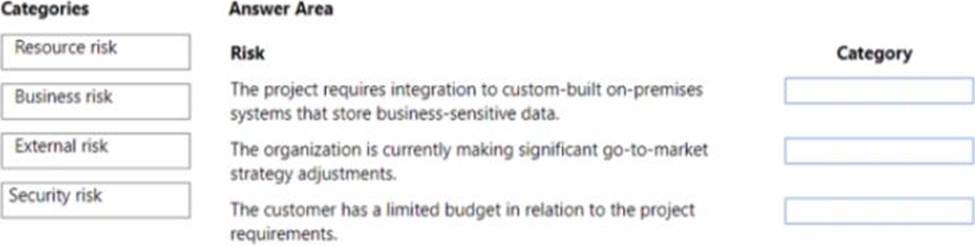
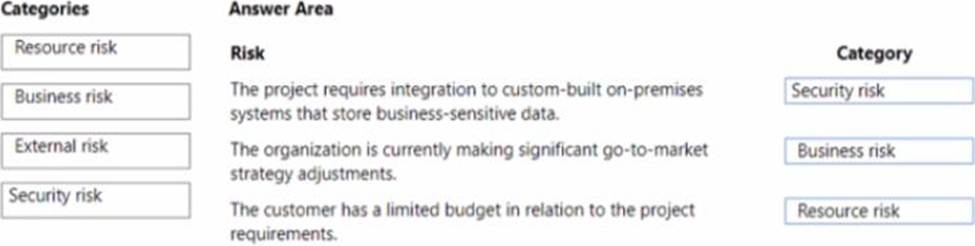
You have identified several project risks.
You need to categorize potential risks that are specific to your customer.
How should you categorize the risks? To answer, drag the appropriate categories to the correct risks. Each category may be used once, more than once, or not at all. You may need to drag the split bar between panes or scroll to view content. NOTE: Each correct selection is worth one point.
HOTSPOT
A company is creating a Power Platform solution to manage employees.
The company has the following requirements:
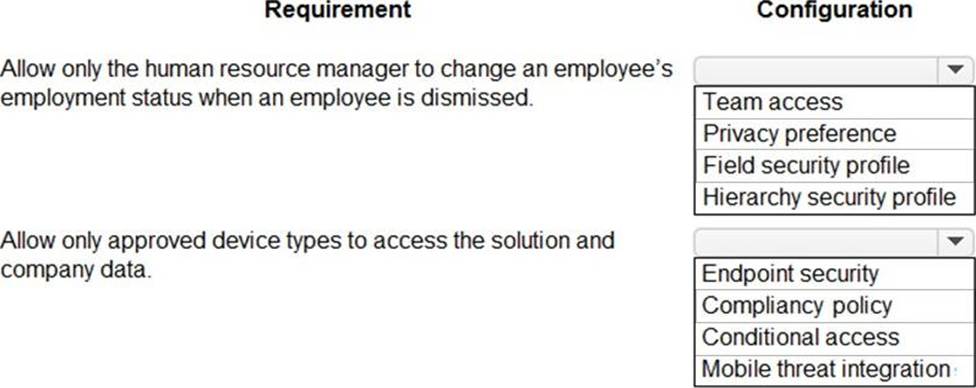
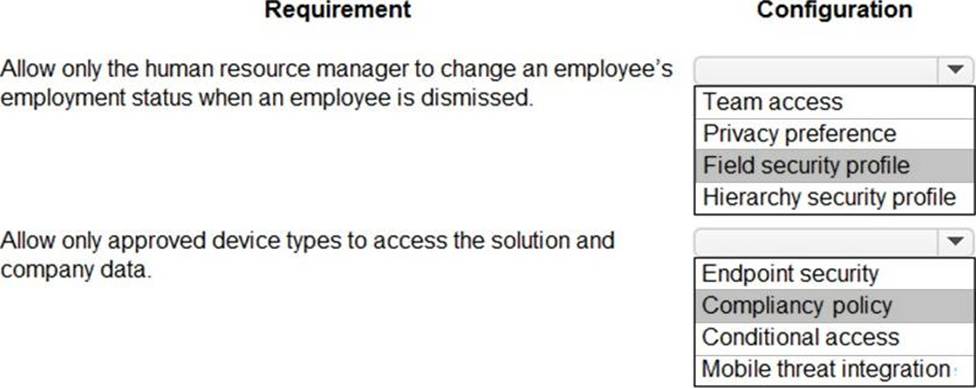
✑ Allow only the human resource manager to change an employee’s employment status when an employee is dismissed.
✑ Allow only approved device types to access the solution and company data.
You need to recommend a solution that meets the requirements.
What should you recommend? To answer, select the appropriate options in the answer area. NOTE: Each correct selection is worth one point.
Explanation:
Box 1: Field security profile
Record-level permissions are granted at the entity level, but you may have certain fields associated
with an entity that contain data that is more sensitive than the other fields. For these situations, you
use field-level security to control access to specific fields.
Field-level security is available for the default fields on most out-of-box entities, custom fields, and custom fields on custom entities. Field-level security is managed by the security profiles.
Box 2: Compliancy policy
Compliance policy settings C Tenant-wide settings that are like a built-in compliance policy that every device receives. Compliance policy settings set a baseline for how compliance policy works in your Intune environment, including whether devices that haven’t received any device compliance policies are compliant or noncompliant.
Note: Mobile device management (MDM) solutions like Intune can help protect organizational data by requiring users and devices to meet some requirements. In Intune, this feature is called
compliance policies.
Compliance policies in Intune:
Define the rules and settings that users and devices must meet to be compliant.
Include actions that apply to devices that are noncompliant. Actions for noncompliance can alert users to the conditions of noncompliance and safeguard data on noncompliant devices.
Can be combined with Conditional Access, which can then block users and devices that don’t meet the rules.
Reference:
https://docs.microsoft.com/en-us/power-platform/admin/field-level-security
https://docs.microsoft.com/en-us/mem/intune/protect/device-compliance-get-started
HOTSPOT
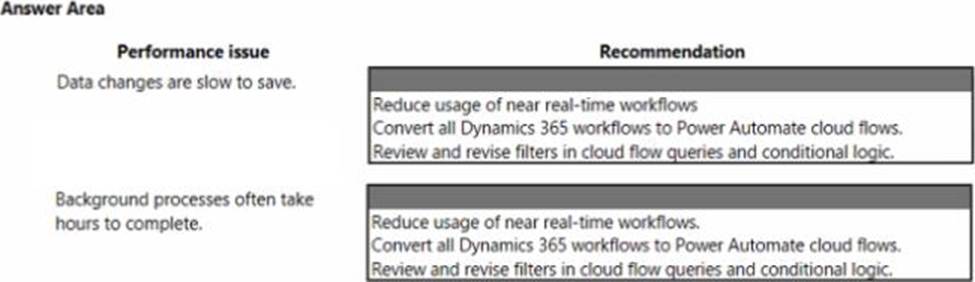
You are conducting performance testing for a Microsoft Power Platform solution. The solution uses Power Automate cloud flows to query and synchronize data across 10 different tables based on various criteria.
You make the following observations:
• Internet speed during testing is fast (500 Mbps).
• There are 50 Dynamics real-time workflows in use.
• There are 63 Dynamics asynchronous workflows in use.
• There are 76 Power Automate cloud flows in use.
You identify the following performance issues;
You need to recommend steps to resolve the performance issues.
What should you recommend? To answer, select the appropriate options m the answer area. NOTE: Each correct selection is worth one point.
Explanation:
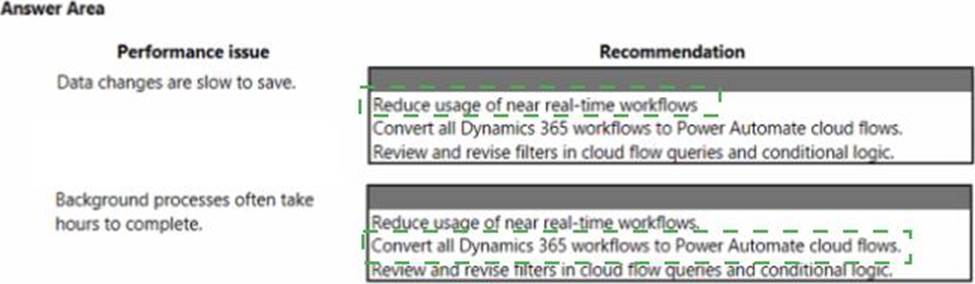
Box 1: Reduce usage of near real-time workflows
A real-time workflow can be converted to asynchronous workflow and back to real-time.
Box 2: Convert all Dynamics 365 workflows to Power Automate cloud flows.
Workflows are limited to Microsoft Dynamics 365/CRM application only.
Power Automate can span across multiple web-based services or applications at the same time.
Dynamics 365 CRM Workflows can be converted to Power Automate flows.
Reference:
https://docs.microsoft.com/en-us/dynamics365/customerengagement/on-premises/developer/create-real-time-workflows
https://rajeevpentyala.com/2019/12/11/d365-switching-from-workflow-to-microsoft-power-automate-flow/
DRAG DROP
You collaborate with a customer to identify requirements.
You identify the following requirements as not feasible:
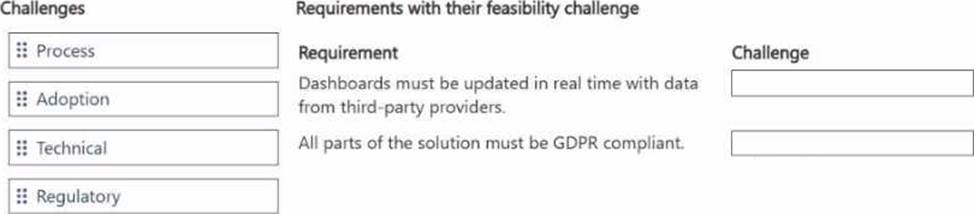
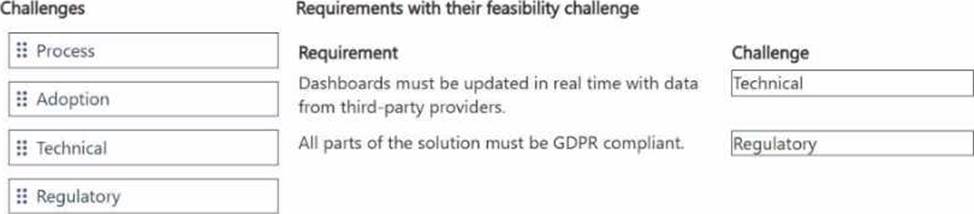
• Dashboards must be updated in real time with data from third-party providers.
• All parts of the solution must be General Data Protection Regulation (GDPR) compliant.
You need to specify the feasibility challenge.
Which feasibility challenge does each requirement pose? To answer, move the appropriate challenges to the correct requirements. You may use each challenge once, more than once, or not at all. You may need to move the split bar between panes or scroll to view content. NOTE: Each correct selection is worth one point.
A company plans to use Microsoft Power Platform. The company gathers business requirements about data.
You need to identify the functional requirements.
Which two requirements about data should you gather? Each correct answer presents a complete solution. NOTE: Each correct selection is worth one point.
- A . Retain for 10 years.
- B . Delete in bulk after seven years.
- C . Store in Microsoft Dataverse.
- D . Go through a specified approval process.
- E . Remain compliant.
A company has a website that contains a form named Contact Us. Data from completed forms is saved to a shared document. An office administrator periodically reviews the document. The office administrator sends new submissions to another employee who creates contacts or updates existing contacts.
You need to recommend a solution to automate the process.
What should you recommend?
- A . Excel Online Connector
- B . Dynamics 365 Customer Insights
- C . Dynamics 365 Customer Service
- D . Dynamics 365 Marketing
D
Explanation:
Microsoft designed Customer Insights to allow organizations to map, match, merge, and enrich customer based data from different sources. A classic scenario would be to merge data from customer service software, like Freshdesk, and online sales, such as Shopware, into one source for reporting and further data analysis.
Reference: https://msdynamicsworld.com/story/microsoft-dynamics-365-customer-insights-overview
HOTSPOT
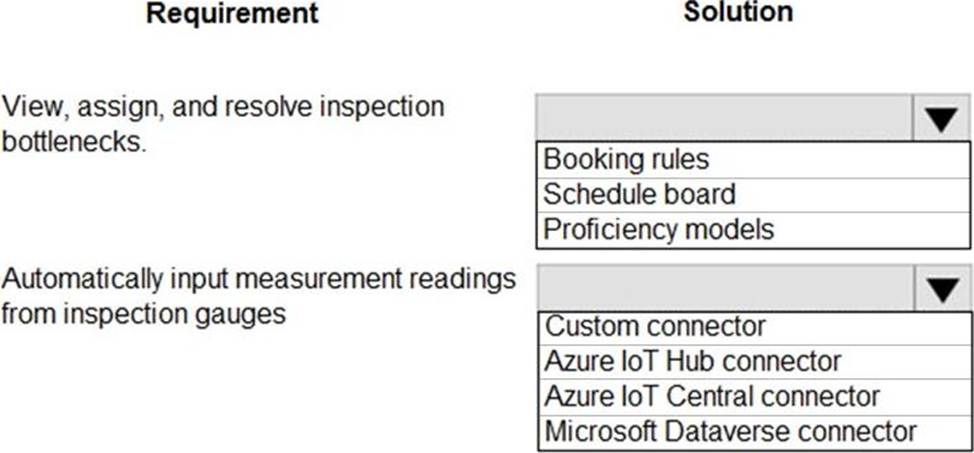
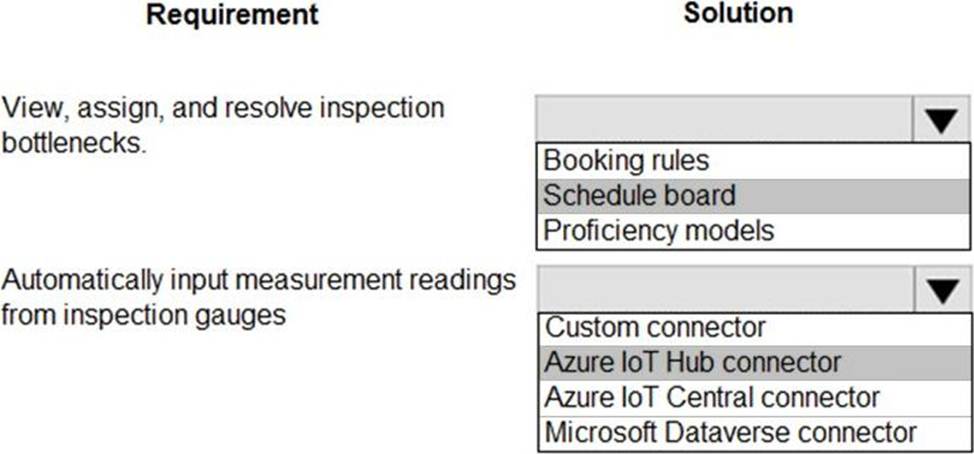
You need to recommend solutions to meet the inspection requirements.
What should you recommend? To answer, select the appropriate options in the answer area. NOTE: Each correct selection is worth one point.
Explanation:
Box 1: Schedule board
The Dynamics 365 Field Service schedule board provides an overview of resource availability and bookings you can make.
Box 2: Azure IoT Central connector
Information about each machine produced must be transferred to Dynamics 365 Field Service.
The difference between IoT hub and IoT central is that IoT is an application platform that simplifies the creation of Internet of Things solutions. IoT central helps to reduce the challenges of implementing IoT development, operations, and management. IoT Central is a fully managed Software as a Service solution.
Note: There are three ways you can use to connect IoT-enabled devices into the Field Service solution:
Connected Field Service for Azure IoT Central
Connected Field Service for Azure IoT Hub
Connected Field Service for non-Azure IoT providers using the extensible IoT provider framework
Reference:
https://vegibit.com/azure-iot-hub-vs-iot-central
https://docs.microsoft.com/en-us/dynamics365/field-service/configure-schedule-board