
Practice Free PK0-005 Exam Online Questions
Which of the following best describes the reason a chat messaging service would be used as the primary form of communication for a project team?
- A . The team is working in different rooms within the same building.
- B . The team is working remotely two days per week.
- C . The team has members distributed around the world in different time zones.
- D . The team is based in the same office but has a large number of members.
C
Explanation:
Chat messaging services are particularly effective for teams that are distributed globally across different time zones. These tools facilitate asynchronous communication, allowing team members to send and receive messages at their convenience, which is crucial when real-time communication is challenging due to time differences. This ensures continuous collaboration and information sharing without the constraints of synchronous meetings.
According to the CompTIA Project+ PK0-005 exam objectives, under Domain 3.2: Compare and contrast various project management productivity tools, chat messaging is highlighted as a key communication tool for distributed teams.
A PM is reviewing objectives for a project in a new industry.
Which of the following items should the PM review first?
- A . Applicable regulations and standards
- B . Relevance to the global environment
- C . Company vision, mission, and values
- D . Impact to the corporate brand
C
Explanation:
When reviewing objectives―especially in a new industry―the PM should start with company vision, mission, and values because they provide the highest-level alignment for why the organization is pursuing the work and how success should support strategic direction. In Project+ terms, objectives should tie back to business goals and the organization’s strategic intent; starting with vision/mission helps ensure the project’s objectives are meaningful, prioritized correctly, and framed in language leadership supports.
After that alignment is established, the PM can translate objectives into industry-specific constraints and success measures―where regulations/standards (A) become critical, especially in regulated industries. “Relevance to the global environment” (B) and “impact to the corporate brand” (D) are important considerations, but they are typically evaluated after the PM anchors the objectives to the organization’s strategic identity and purpose.
So the best first review item is company vision, mission, and values, which sets the “north star” for objectives; then the PM can validate feasibility and compliance via regulations, market/environment considerations, and brand implications.
During project initiation, a project manager is drafting a document that includes an outline of the high-level goals, objectives, milestones, and requirements. This document will be modified and finalized as more information becomes available.
Which of the following best meets the requirements?
- A . Preliminary scope statement
- B . Procurement needs assessment
- C . Project success criteria
- D . Work breakdown structure
A
Explanation:
A Preliminary Scope Statement outlines the initial project objectives, high-level requirements, and milestones. It serves as a foundational document during the initiation phase and is refined as the project progresses.
As per the CompTIA Project+ PK0-005 exam objectives, under Domain 1.1: Compare and contrast different project management roles and responsibilities, developing a preliminary scope statement is a key activity in defining the project’s direction and scope.
Which of the following best describes why a project manager would decide to sign a fixed-price contract with a vendor?
- A . The scope of the project deliverable is clearly defined.
- B . There is a non-disclosure agreement in place.
- C . There are multiple requirements for the product.
- D . The PM wants to simplify the logistics of the required product.
A
Explanation:
A Fixed-Price Contract is most suitable when the project scope, requirements, and deliverables are clearly and thoroughly defined. This contract type sets a predetermined price for the work, regardless of the actual costs incurred, transferring the risk of cost overruns to the vendor. It is advantageous when the project details are well-understood and unlikely to change.
Per the CompTIA Project+ PK0-005 exam objectives, under Domain 1.11: Explain important project procurement and vendor selection concepts, understanding when to use fixed-price contracts is essential, particularly when the project scope is well-defined.
A project team has been assigned to improve the customer service of a retail company. The team has conducted a thorough analysis of the existing process, determined areas of improvement, and identified the desired outcomes of the project.
Which of the following best describes this analysis?
- A . Process improvement
- B . Business objectives
- C . Current state vs. future state
- D . Project success criteria
C
Explanation:
This work is best described as current state vs. future state analysis. The team first examined the existing process (the current state), identified areas of improvement (gaps/pain points), and then defined the desired outcomes (the future/target state). In CompTIA Project+ discovery/concept preparation activities, teams are expected to understand the problem/opportunity clearly before planning the solution; comparing the current state to the desired future state is a standard way to define what must change and what “better” looks like, and it becomes a foundation for scope definition and transition planning.
It’s not “process improvement” as the primary label here because that term typically describes the initiative type or the resulting actions, while the question is asking what the analysis itself is called. It’s also not “business objectives” (those are broader strategic goals), and it’s not “project success criteria” (the measurable conditions used to judge success). Those may come later, derived from the current-vs-future gap, but the described activity is the gap comparison between how things work now and how they should work after the project.
A quality assurance team is based in three different locations To validate the project deliverables, a project manager sent the hardware for testing purposes to the team in each of the locations. Two teams confirmed the hardware arrived, but one group did not receive it because of local customs.
Which of the following ESG factors is the project team facing?
- A . Awareness of the company vision, mission statement, and values
- B . Impact of the project on the company’s brand value
- C . Awareness of applicable regulations and standards
- D . Impact of the project on the local and global environments
Which of the following tools should a project manager use to assess the activities performed, work effort applied, and the productivity of a project?
- A . Project status report
- B . Project evaluation review
- C . Project management software
- D . Requirements traceability matrix
B
Explanation:
A project evaluation review is a tool that helps a project manager assess the activities performed, work effort applied, and the productivity of a project. It involves collecting and analyzing data on the project’s performance, outcomes, and impacts. It also provides feedback and recommendations for improvement and learning. A project evaluation review can be done at different stages of the project life cycle, such as during or after completion.
References = CompTIA Project+ PK0-005 Certification Study Guide, Chapter 14: Project Evaluation and Assessment; CompTIA Project+ Certification Exam Objectives, Domain 4: Project Closure, Objective 4.1: Conduct project closure activities.
During a brainstorming session, a project team is elaborating on what caused the unexpected crash of the website that the team was developing. Given the following:
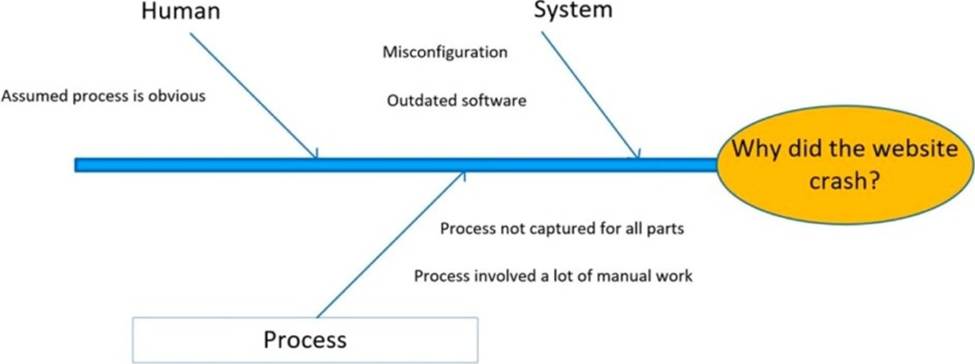
Which of the following was the initial cause of the issue?
- A . Inadequate memory
- B . Incorrect configuration
- C . Lack of infrastructure
- D . Inadequate instructions
B
Explanation:
Incorrect configuration was the initial cause of the issue that caused the unexpected crash of the website that the team was developing. The diagram given is an example of a fishbone diagram or a cause-and-effect diagram that shows the possible causes of a problem or effect. The diagram has four main categories: people, process, technology, and environment. Each category has subcategories that list specific factors that may contribute to the problem or effect. The diagram shows that incorrect configuration under technology was marked as an initial cause of website crash.
Which of the following should be the PRIMARY basis for establishing metrics that measure the effectiveness of an information security program?
- A . Residual risk
- B . Regulatory requirements
- C . Risk tolerance
- D . Control objectives
D
Explanation:
Control objectives are the desired outcomes or goals of implementing security controls to mitigate risks and protect information assets. Control objectives should be the primary basis for establishing metrics that measure the effectiveness of an information security program, as they align with the business objectives, requirements, and expectations of the organization and its stakeholders. Metrics based on control objectives can help to evaluate the performance, efficiency, and maturity of the security program, and to identify gaps, issues, and areas for improvement.
The other options are not correct because:
Residual risk is the remaining risk after applying security controls. Residual risk is not a basis for establishing metrics, but rather a result of measuring the effectiveness of security controls. Residual risk should be monitored and reported, but it does not define the desired outcomes or goals of the security program.
Regulatory requirements are the external standards, laws, and regulations that the organization must comply with to avoid legal or financial penalties. Regulatory requirements are not a basis for establishing metrics, but rather a constraint or a driver for the security program. Metrics based on regulatory requirements can help to demonstrate compliance, but they may not reflect the actual effectiveness or efficiency of the security program.
Risk tolerance is the level of risk that the organization is willing to accept or bear. Risk tolerance is not a basis for establishing metrics, but rather a factor or an input for the security program. Metrics based on risk tolerance can help to prioritize and allocate resources, but they may not measure the actual outcomes or goals of the security program.
References = Key Performance Indicators for Security Governance, Part 1; 14 Cybersecurity Metrics + KPIs You Must Track in 2023; KPIs in Information Security: The 10 Most Important Security Metrics; Why metrics are crucial to proving cybersecurity programs’ value; Implementing and Maintaining Security Program Metrics
A project team that handles sensitive data analysis recently onboarded three new employees.
Which of the following should the PM do first?
- A . Check employee security clearance
- B . Allow access to the internet on corporate computers
- C . Train the new employees to handle sensitive data
- D . Execute an analysis of the sensitive data
A
Explanation:
When onboarding new staff who will handle sensitive data, the PM must first verify their security clearance or authorization. Only authorized personnel should access sensitive systems or datasets. Training follows after confirming clearance. Data analysis itself should never begin until security requirements are validated.
Reference: CompTIA Project+ PK0-005 C Security & Compliance in Projects;