
Practice Free PEGACPRSA22V1 Exam Online Questions
In an automation that contains an ExcelRange component, you make a change to the data within the range, and you want to save those changes to the Excel file on disk.
Which of the following statements is valid?
- A . Call the Commit method of ExcelRange component and then Save on the ExcelConnector.
- B . The changes save to the Excel file automatically.
- C . Call the Commit method of the ExcelConnector and reload the Excel file.
- D . Call the Save method of ExcelConnector and reset the state of Excel file.
You must configure an application to store encrypted login credentials in the user’s local profile. You also need to automate the login using the encrypted credentials.
How do you fulfill this requirement without creating an automation?
- A . Create a robot activity that performs the application login.
- B . Set the necessary application credential properties before interrogating the target controls.
- C . Interrogate the target controls and set the necessary application credential properties.
- D . Interrogate the target controls and create a script to perform the login functionality.
C
Explanation:
Comprehensive and Detailed Explanation From Pega Robotics System Exact Extract:
In Pega Robot Studio, the Credential Manager is designed to securely store user credentials (such as usernames and passwords) in an encrypted form within the user’s local profile. When properly configured, Pega Robotics can automatically log in to target applications without creating a separate automation.
From the Pega Robotics System Design and Implementation Guide (Application Configuration and Credential Management section):
“When an application requires credential-based authentication, developers can configure the application’s login controls during interrogation and assign the appropriate credential properties (Username and Password).
Once defined, credentials are stored securely in the user’s local profile and automatically retrieved and decrypted during runtime to perform the login without explicit automation logic.”
Detailed Reasoning:
During interrogation, the login controls (such as username and password fields) are identified and linked to the credential properties of the application object.
Pega Robotics automatically handles the retrieval and secure decryption of credentials stored in the local user profile at runtime.
This eliminates the need for any manual automation steps or scripts for logging in.
Option Analysis:
Which two statements are valid for the given automation? (Choose two.)

- A . The automation is initiated when the value of the NearestStore changes.
- B . Assign Main|b|NearestStore with the new value only if the value changed belongs to an active key.
- C . Assign Main|b|NearestStore with the new value when the value of the NearestStore changes.
- D . The value of the NearestStore changes when the automation is initiated.
You are designing an automation that adds new customers to an online insurance web site. If a customer exists, a pop-up window is displayed with an error message, which closes automatically after 35 seconds.
While debugging the automation, you notice that you are receiving a control not created exception message in the Add Customer procedure after a page navigation occurs.
How do you resolve the exception?
- A . Add a missing created event in the Add Customer procedure.
- B . Ensure the waitForCreate timeout is longer than 35 seconds in the Add Customer procedure.
- C . Ensure the isCreated timeout is longer than 35 seconds in the Add Customer procedure.
- D . Add a missing waitForEvent.Exists method in the Add Customer procedure.
You have completed your development for the DisputeTransaction.pega project. The enterprise installs the Pega Robot Runtime software on the agent’s desktop.
The enterprise is ready to unit test your solution but wants the Runtime executable to automatically launch the new project.
What do you configure to fulfill this request?
- A . Edit the setting in the PegaStudioConfig.xml by setting the value to the file location of the .pega file.
- B . Edit the setting in the PegaRuntimeConfig.xml by setting the value to the file location of the .pega file.
- C . Edit the setting in the CommonConfig.xml by setting the value to the file location of the .pega file.
- D . Edit the setting in the DisputeTransaction.pega by setting the value to the file location of the .pega file.
B
Explanation:
Comprehensive and Detailed Explanation From Pega Robotics System Exact Extract:
The PegaRuntimeConfig.xml file defines environment-specific configurations for the Pega Robot Runtime application.
To automatically launch a robotic solution (.pega file) when Runtime starts, you must configure the Startup Project path inside this XML file.
According to the Pega Robotics System Design and Implementation Guide, section “Configuring Pega Robot Runtime for Automatic Project Launch”:
“To make Pega Robot Runtime automatically load and execute a robotic solution at startup, modify the PegaRuntimeConfig.xml file.
Within this file, specify the absolute path of the solution’s .pega file under the <StartupProject> element.
When Pega Robot Runtime is launched, it reads this configuration and automatically opens the specified project.”
Detailed Reasoning:
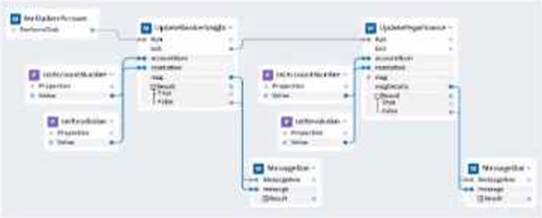
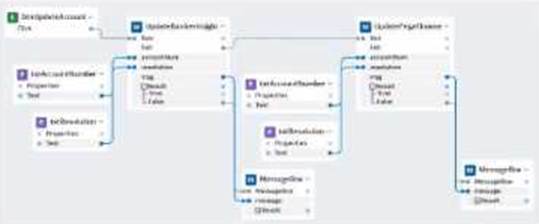
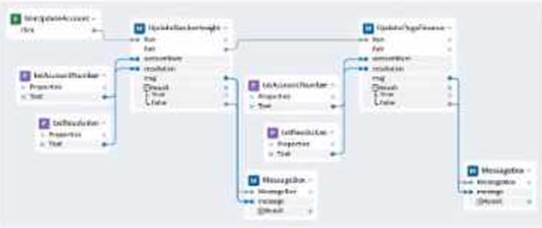
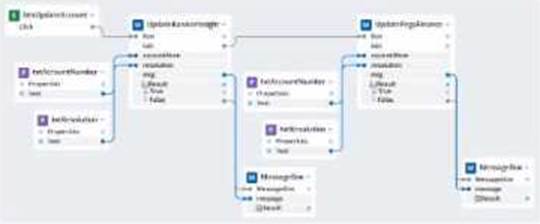
our project for a customer service department contains a Windows form with a btnUpdateAccount button. Users click btnUpdateAccount to automate the updates of other customer account systems at the end of the call. You create the UpdateAccount automation to ensure that the Windows form is still accessible after clicking the button.
Which option represents the UpdateAccount automation with this requirement?
A)
B)
C)
D)
- A . Option A
- B . Option B
- C . Option D
- D . Option D
B
Explanation:
Pega Robotics Studio C Automation Design Concepts (Events and UI Responsiveness)
“Automations started from a Windows Form Click event run on the UI thread. To keep the form responsive, long-running work should be started by calling other automations asynchronously. When an automation is executed synchronously, the UI thread is blocked until the call completes. Executing the child automation asynchronously allows users to continue interacting with the form.”
Pega Robotics Studio C Calling Automations (Run method)
“The Run method includes a synchronous parameter.
True C the caller waits for completion (blocks the UI).
False C the automation starts asynchronously and control returns immediately to the caller (UI remains available).
Default follows the project setting.”
Pega Robotics Studio C Windows Form Controls (Avoid self-triggering)
“Invoking PerformClick from within an automation that is already handling the button’s click should be avoided. It re-triggers the button click and can lead to reentrancy or recursion and does not improve UI responsiveness.”
Pega Robotics Studio C Message Dialogs
“Displaying a MessageDialog during processing is modal and prevents interaction with the form until the dialog is closed. Use only for completion or error notifications, not while long-running work is executing.”
Why Option B is correct:
Option B starts from the btnUpdateAccount.Click event (so no self-trigger via PerformClick).
It launches the downstream automations (UpdateBankerInsight and UpdatePegasFinance) using Run with the synchronous parameter set to False (asynchronous), which keeps the Windows form responsive and accessible to the user while updates run.
It does not introduce a modal MessageBox before or during the updates (dialogs are only used for completion/notification), so it avoids blocking the UI.
Why the other options are not correct:
Option A: Uses PerformClick on the button, which re-triggers the click and can lead to recursion without improving responsiveness.
Option C: Inserts a MessageDialog during the middle of processing, which is modal and blocks the form.
Option D: Calls the update automations synchronously (or leaves them at the blocking default), which holds the UI thread until completion and makes the form inaccessible during the run.
our project for a customer service department contains a Windows form with a btnUpdateAccount button. Users click btnUpdateAccount to automate the updates of other customer account systems at the end of the call. You create the UpdateAccount automation to ensure that the Windows form is still accessible after clicking the button.
Which option represents the UpdateAccount automation with this requirement?
A)
B)
C)
D)
- A . Option A
- B . Option B
- C . Option D
- D . Option D
B
Explanation:
Pega Robotics Studio C Automation Design Concepts (Events and UI Responsiveness)
“Automations started from a Windows Form Click event run on the UI thread. To keep the form responsive, long-running work should be started by calling other automations asynchronously. When an automation is executed synchronously, the UI thread is blocked until the call completes. Executing the child automation asynchronously allows users to continue interacting with the form.”
Pega Robotics Studio C Calling Automations (Run method)
“The Run method includes a synchronous parameter.
True C the caller waits for completion (blocks the UI).
False C the automation starts asynchronously and control returns immediately to the caller (UI remains available).
Default follows the project setting.”
Pega Robotics Studio C Windows Form Controls (Avoid self-triggering)
“Invoking PerformClick from within an automation that is already handling the button’s click should be avoided. It re-triggers the button click and can lead to reentrancy or recursion and does not improve UI responsiveness.”
Pega Robotics Studio C Message Dialogs
“Displaying a MessageDialog during processing is modal and prevents interaction with the form until the dialog is closed. Use only for completion or error notifications, not while long-running work is executing.”
Why Option B is correct:
Option B starts from the btnUpdateAccount.Click event (so no self-trigger via PerformClick).
It launches the downstream automations (UpdateBankerInsight and UpdatePegasFinance) using Run with the synchronous parameter set to False (asynchronous), which keeps the Windows form responsive and accessible to the user while updates run.
It does not introduce a modal MessageBox before or during the updates (dialogs are only used for completion/notification), so it avoids blocking the UI.
Why the other options are not correct:
Option A: Uses PerformClick on the button, which re-triggers the click and can lead to recursion without improving responsiveness.
Option C: Inserts a MessageDialog during the middle of processing, which is modal and blocks the form.
Option D: Calls the update automations synchronously (or leaves them at the blocking default), which holds the UI thread until completion and makes the form inaccessible during the run.
Which of the following controls cannot be added to the Windows form?
- A . ComboBox
- B . ProgressBar
- C . Pointer
- D . PictureBox
You are designing an attended project for a banking customer. This project requires you to import new customers from a text file to a lookup table.
Which steps do you take to gain access to the ImportDelimitedFile method of the lookup table within an automation?
- A . Select the ImportDelimitedFile method in a design form of the user interface to open the Select
action window. - B . Drag the lookup table from the Locals section of the Palette to the automation surface to open the Select action window, and then filter for the ImportDelimitedFile method.
- C . Open the Globals tab, filter for the ImportDelimitedFile method, and then drag it to the design surface.
- D . Drag the lookup table from the Globals section of the Palette to the automation surface to open the Select action window, and then filter for the ImportDelimitedFile method.
D
Explanation:
Comprehensive and Detailed Explanation From Pega Robotics System Exact Extract:
The Lookup Table is a global component in Pega Robot Studio that can be accessed from multiple automations within a project.
To use its methods―such as ImportDelimitedFile, FindRecord, or AddRecord―you must drag the lookup table instance from the Globals section to the automation surface.
According to the Pega Robotics System Design and Implementation Guide, section “Using Lookup Tables in Automations”:
“Lookup tables are global components that store data used across automations.
To call lookup table methods, drag the table from the Globals section of the Palette to the automation design surface.
The Select Action dialog box will open, allowing you to filter and select from available methods such as ImportDelimitedFile, FindRecord, and ClearTable.”
Detailed Reasoning:
Which two statements about Label/Jump To functionality are true? (Choose Two)
- A . It allows you to pass variables to different parts or workflows of the same automation.
- B . It allows you to keep automations organized and aids in debugging.
- C . It allows you to pass variables to different automations of the same project.
- D . It allows you to have multiple Exit points in an automation.
- E . It allows you to connect with other automations in the project.
B, D
Explanation:
Comprehensive and Detailed Explanation From Pega Robotics System Exact Extract:
The Label/Jump To functionality in Pega Robot Studio is used to improve automation organization and logical control flow.
Labels act as named anchor points within a single automation, and Jump To links can redirect the execution flow to these labeled points.
According to the Pega Robotics System Design and Implementation Guide, section “Using Labels and
Jump To Blocks in Automations”:
“The Label/Jump To functionality enables structured flow management within a single automation.
Labels define points in the automation to which the execution flow can jump.
Jump To blocks redirect execution to a corresponding label, allowing developers to organize complex automations into manageable sections.
This feature is particularly useful for debugging, error handling, and implementing multiple exit paths within a single automation.”
Detailed Reasoning: