
Practice Free PEGACPDC25V1 Exam Online Questions
MyCo, a mobile company, uses Pega Customer Decision Hub’" to display offers to customers on its website. The company wants to present more relevant offers to customers based on customer behavior. The following diagram is the action hierarchy in the Next-Best-Action Designer.
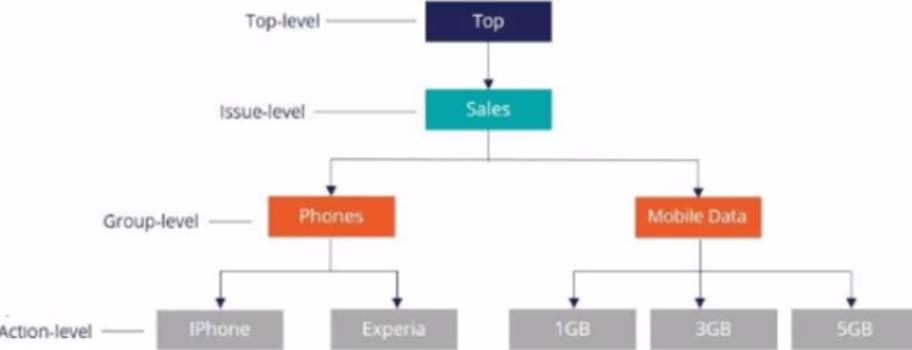
The company wants to present offers from both the groups and arbitrate across the two groups to select the best offer based on customer behavior.
As a decisioning architect, what must you do to present offers from the two groups’
- A . Map a real-time container to the Top-level or Issue-level.
- B . Enable an engagement policy for the second group.
- C . Set contact limits for both the groups.
- D . Create a decision strategy at the Issue-level.
MyCo, a telecom company, wants to use Pega Customer Decision Hub™ to send the MyFone Pro offer through email to qualified customers. In preparation, the marketing team created an action, a treatment, and an action flow. As a decisioning architect, you verify the settings in the Channel tab of Next-Best-Action Designer to enable email communication.
To implement this requirement, the completion of which two tasks do you verify in the Channel tab of Next-Best-Action Designer? (Choose Two)
- A . Enable the email channel.
- B . Configure the starting population to run an outbound schedule.
- C . Map a real-time container to a business structure level.
- D . Add contact policy rules.
A telecommunications company is promoting IPhone upgrades with unlimited data plans. The marketing team notices that a customer explicitly stated in a recent survey that they are not interested in iPhone products. The company wants to apply appropriate engagement policy conditions to respect customer preferences.
Which engagement policy condition type should you use to prevent iPhone offers for customers who express disinterest?
- A . Arbitration rules to deprioritize the customer segment.
- B . Suitability condition for customer empathy considerations.
- C . Applicability condition to respect customer preferences.
- D . Eligibility condition based on customer survey responses.
U+ Bank implemented multiple customer journeys for Its customers. The goal of the bank Is to present the most relevant action for the customer to increase the chance of a positive outcome. U+ Bank is sure that customers see the next best action, regardless of the current journey that they are in.
Which statement is true about customer journeys in Pega Customer Decision Hub?
- A . Active customer journeys become inactive when Pega AI detects a better action outside the journey.
- B . Actions outside a customer journey are upweighted to ensure that the system also takes them into consideration.
- C . Customers can participate in multiple customer journeys simultaneously.
- D . Customers are placed in all available customer journeys from the start to ensure that the system takes all actions into consideration.
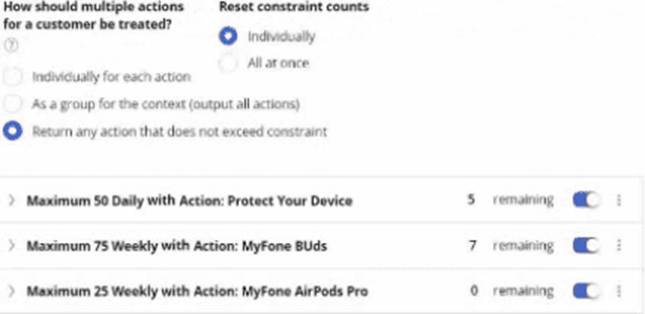
Maximum 25 Daily with Action: MyFone AirPods Pro, 0 remaining
A customer, CUST-01, qualifies for all the three actions.
Given this scenario, how many actions does the system select for CUST-01 in the outbound run?
- A . 3
- B . 0
- C . 2
- D . 1
As a decisioning architect, you have built a decision strategy that selects actions that are below the average printing cost. The decision strategy contains ‘Black Label’, ‘Red Label,’ and ‘Blue Label" Proposition components. The printing cost of the Proposition components are calculated based on the ‘BaseCost’ and ‘LetterCount*.
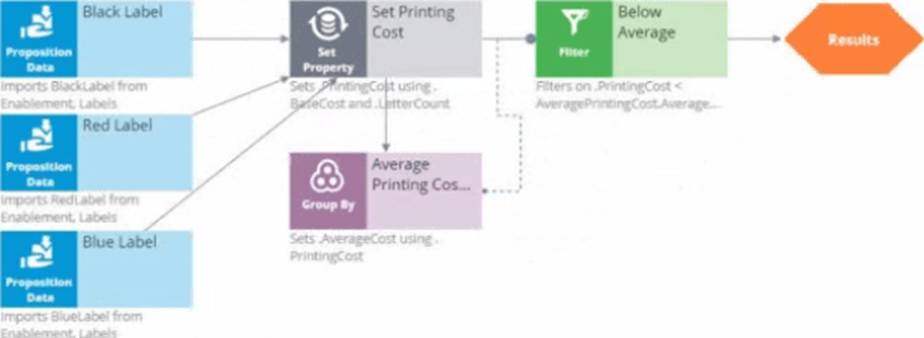
The details of the proposition components are provided in the following table:

Which propositions does the strategy output?
- A . Black Label and Blue Label
- B . Black Label
- C . Red Label
- D . Black Label and Red Label
As a Customer Service Representative, you present an offer to a customer who called to learn more about a new product. The customer rejects the offer.
What is the next step that Pega Customer Decision Hub takes?
- A . Stops presenting offers to the customer
- B . Adds the customer to the potential churn list
- C . Reevaluates the Next-Best-Action
- D . Sends a detailed email about the offer
C
Explanation:
Pega Customer Decision Hub is a dynamic and adaptive system that constantly reevaluates the Next-Best-Action for each customer based on their interactions and feedback. If a customer rejects an offer, the system will update the customer profile and the offer performance, and then reapply the Next-Best-Action strategy to select and prioritize another offer that is more relevant and valuable for
the customer.
Verified Reference: [Pega Decisioning Consultant | Pega Academy]
MyCo, a mobile company, uses Pega Customer Decision Hub™ to display offers to customers on its website. The company wants to present more relevant offers to customers based on customer behavior.
The following diagram is the action hierarchy in the Next-Best-Action Designer.
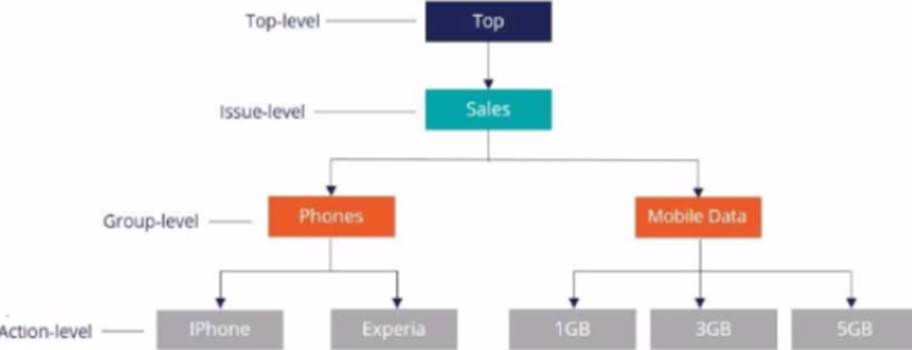
The company wants to present offers from both the groups and arbitrate across the two groups to select the best offer based on customer behavior.
As a decisioning architect, what must you do to present offers from the two groups?
- A . Enable an engagement policy for the second group.
- B . Map a real-time container to the Top-level or Issue-level.
- C . Set contact limits for both the groups.
- D . Create a decision strategy at the Issue-level
B
Explanation:
To present offers from the two groups, you must map a real-time container to the Top-level or Issue-level. A real-time container is a configuration that defines how to deliver offers and treatments to a specific channel, such as a website or a mobile app. By mapping a real-time container to the Top-level or Issue-level, you can enable all the offers under that level to be available for delivery through that channel.
Verified Reference: Pega Academy – Decisioning Consultant – Configuring real-time containers
l)+ Bank uses Pega Customer Decision Hub™ to approve credit card limit changes requested by customers automatically. A scorecard model determines the customer credit score. The automatic approval of credit card limits are processed based on the following criteria set by the bank.
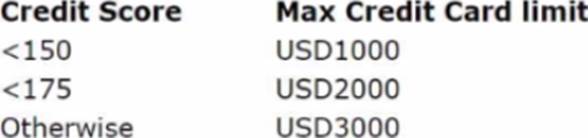
The bank wants to change the threshold value for the USD2000 credit limit from <175 to <200.
How do you implement this change?
- A . Change the cutoff value in the Results tab of the scorecard decision component.
- B . Change in the strategy the condition from .pxSegment <=175 to .pxSegment <=200.
- C . Map the score value in the decision strategy to <=200.
- D . Change the cutoff value in the Results tab of the scorecard model.
D
Explanation:
The scorecard model determines the customer credit score based on various factors, such as income, expenses, assets, liabilities, etc. The scorecard model has a Results tab where you can define the cutoff values for different segments based on the credit score. To change the threshold value for the USD2000 credit limit from <175 to <200, you need to change the cutoff value in the Results tab of the scorecard model. Changing the cutoff value in the scorecard decision component, changing the condition in the strategy, or mapping the score value in the decision strategy will not affect the credit score calculation or segmentation.
l)+ Bank uses Pega Customer Decision Hub™ to approve credit card limit changes requested by customers automatically. A scorecard model determines the customer credit score. The automatic approval of credit card limits are processed based on the following criteria set by the bank.
The bank wants to change the threshold value for the USD2000 credit limit from <175 to <200.
How do you implement this change?
- A . Change the cutoff value in the Results tab of the scorecard decision component.
- B . Change in the strategy the condition from .pxSegment <=175 to .pxSegment <=200.
- C . Map the score value in the decision strategy to <=200.
- D . Change the cutoff value in the Results tab of the scorecard model.
D
Explanation:
The scorecard model determines the customer credit score based on various factors, such as income, expenses, assets, liabilities, etc. The scorecard model has a Results tab where you can define the cutoff values for different segments based on the credit score. To change the threshold value for the USD2000 credit limit from <175 to <200, you need to change the cutoff value in the Results tab of the scorecard model. Changing the cutoff value in the scorecard decision component, changing the condition in the strategy, or mapping the score value in the decision strategy will not affect the credit score calculation or segmentation.