
Practice Free PEGACPDC25V1 Exam Online Questions
U+ Bank, a retail bank, introduced a new mortgage refinance offer in the eastern region of the country. They want to advertise this offer on their website by using a banner, targeting the customers who live in that area.
What do you configure in Next-Best-Action Designer to implement this requirement?
- A . An audience
- B . A customer segment
- C . Applicability rules
- D . A prioritization formula
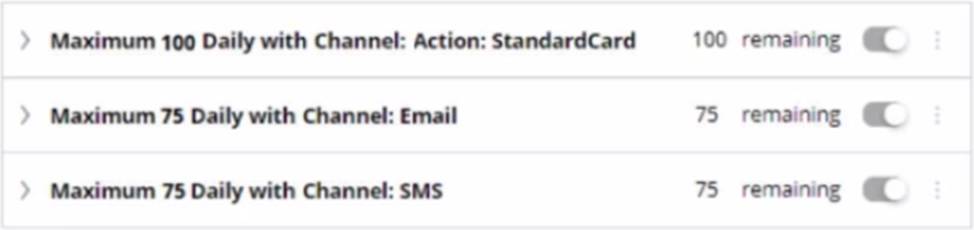
An outbound run identifies 150 Standard card offers, 75 on email, and 75 on the SMS channel.
If the following volume constraint Is applied, how many actions are delivered by the outbound run?
- A . 75 emails 25 SMSes
- B . 100
- C . 75 SMSes and 25 emails
- D . 150
HOTSPOT
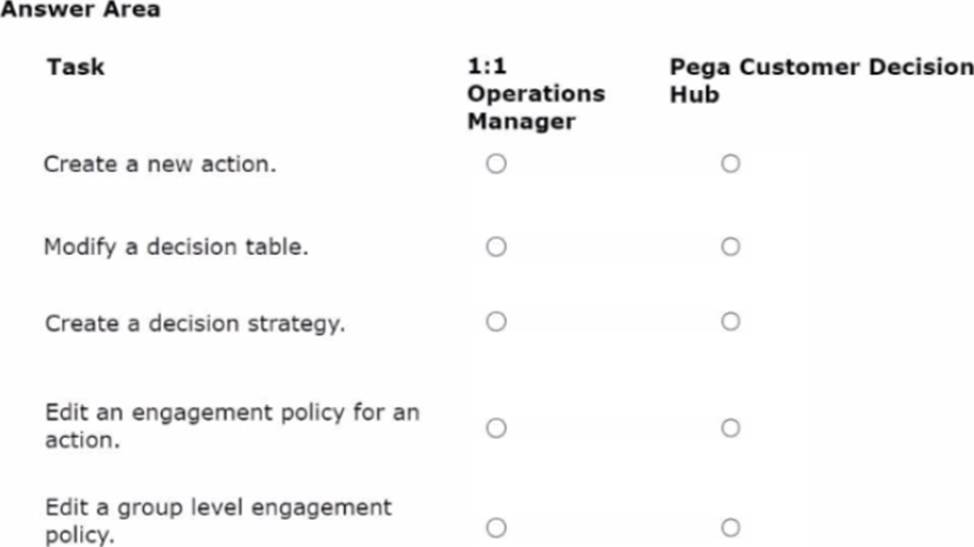
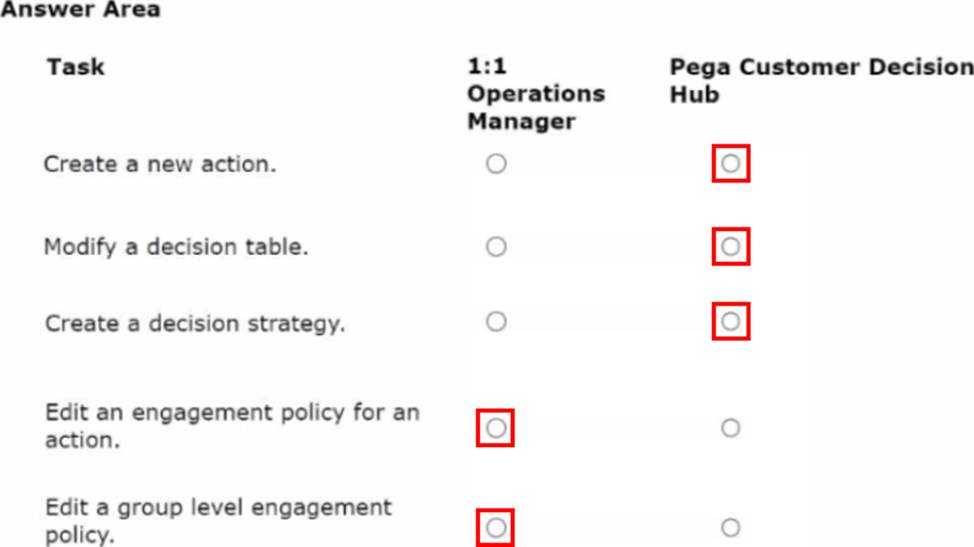
U+ Bank, a retail bank, uses the Business Operations Environment to perform its business changes. The bank carries out these changes in the Pega Customer Decision Hub portal by using revision management features or the 1:1 Operations Manager portal.
For each task, select the correct portal in which you initiate the change request based on best practices.
You are the decisioning architect on an Al-powered one-to-one customer engagement implementation project. You are asked to design the next-best-action prioritization expression that balances the customer needs with the business objectives.
What factor do you consider in the prioritization expression?
- A . Predicted customer behavior
- B . Offer eligibility
- C . Customer contact policy
- D . Offer relevancy
A
Explanation:
The prioritization expression is a formula that calculates the priority score of each offer for each customer, based on various factors that reflect the customer needs and the business objectives. One of the most important factors is the predicted customer behavior, which is measured by the propensity. The propensity is a value that indicates how likely a customer is to accept an offer, based on their attributes and behaviors. The propensity is calculated by using predictive analytics models that learn from historical data and feedback. The higher the propensity, the higher the priority score, making the offer more relevant and valuable for the customer.
Verified Reference: [Pega Decisioning Consultant | Pega Academy]
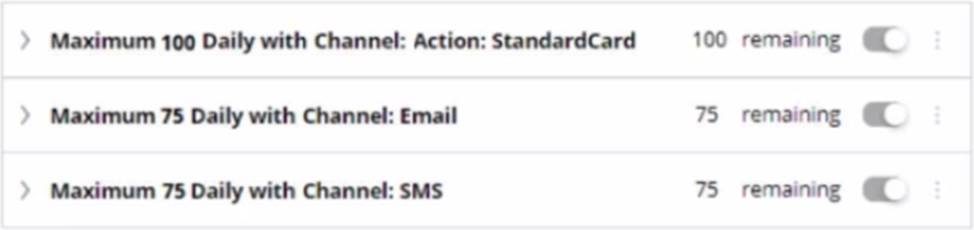
An outbound run identifies 150 Standard card offers, 75 on email, and 75 on the SMS channel.
If the following volume constraint is applied, how many actions are delivered by the outbound run?
- A . 150
- B . 75 emails 25 SMSes
- C . 75 SMSes and 25 emails
- D . 100
B
Explanation:
The outbound run delivers 75 emails and 25 SMSes for the Standard card offer because the volume constraint is set to limit the number of actions per channel per day. The email channel has a limit of 75 actions per day, so all 75 email offers are delivered. The SMS channel has a limit of 25 actions per day, so only 25 SMS offers are delivered. The remaining 50 SMS offers are not delivered because they exceed the volume constraint.
MyCo, a telecom company, notices that when customers call to check on bill status, 80% of the time, they received the wrong offer promotion, leading to customer dissatisfaction. The company decides to boost customers’ needs in the prioritization formula, to Improve sales in the current quarter.
Which arbitration factor do you configure to implement the requirement?
- A . Context weighting
- B . Business value
- C . Propensity
- D . Business weighting
U+ Bank wants to send promotional emails related to credit card offers to their qualified customers. The business intends to use the same action flow template with the desired flow pattern for all the credit card actions.
What do you configure to implement this requirement?
- A . File template
- B . Dynamic template
- C . Output template
- D . Email treatment
B
Explanation:
To implement this requirement, you need to configure a dynamic template in Customer Decision Hub. A dynamic template is a type of template that allows you to define a common action flow pattern for a group of actions that share similar characteristics, such as channel, issue, or group. You can specify which properties and components are required for each action in the group, and how they are mapped to the action flow template. This way, you can reuse the same action flow template for all the credit card actions, while still allowing some variations in their content and configuration.
Verified Reference: Pega Academy – Decisioning Consultant – Creating dynamic templates
U+ Bank’s marketing department currently promotes various home loan offers to qualified customers. Now, the bank does not want to show offers on a customer’s account page if the customer has already received three home loan offers in the last two weeks.
What do you need to define to implement the business requirement?
- A . Applicability rules
- B . Customer contact limits
- C . Suppression policy
- D . Volume constraints
C
Explanation:
A suppression policy allows you to define conditions that prevent customers from receiving an action or a group of actions. You can use a suppression policy to implement the requirement that customers do not see home loan offers on their account page if they have already received three home loan offers in the last two weeks. You can configure the suppression policy to suppress the home loan group based on the number of times the customer received any action from that group in the past 14 days. Applicability rules are used to determine whether an action is relevant for a customer based on their profile or context, not based on the number of times they received an action. Customer contact limits are used to limit the number of times a customer can be contacted per channel per time period, not based on the number of times they received an action. Volume constraints are used to limit the number of times an action is presented to customers across one or more channels, not based on the number of times they received an action.
Verified Reference: [Certified Pega Decisioning Consultant | Pega Academy], Suppression policies
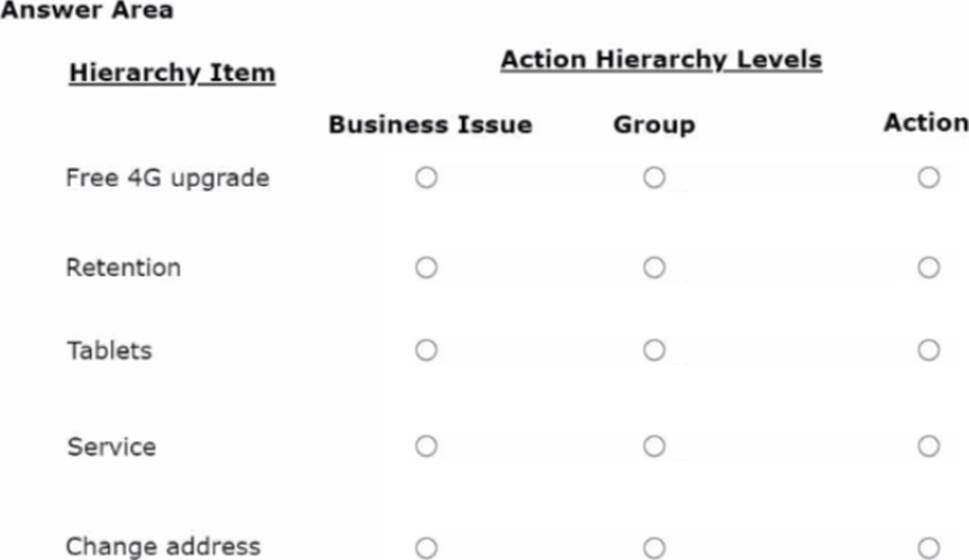
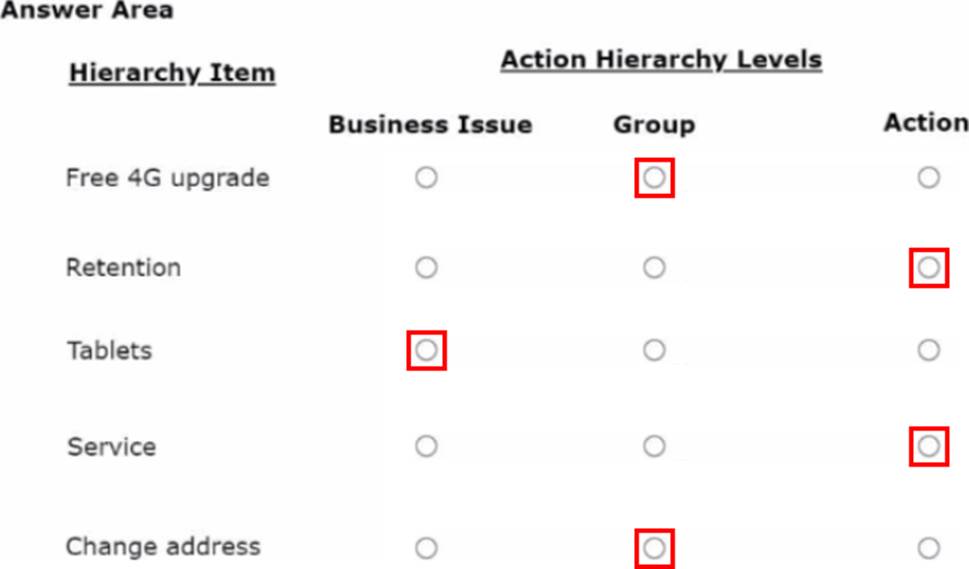
HOTSPOT
As a decisioning architect, you are setting up the action hierarchy for MyCo. Select the correct action hierarchy level for each of the hierarchy items identified.
MyCo, a mobile company, uses Pega Customer Decision Hub™ to display offers to customers on its website. The company wants to present more relevant offers to customers based on customer behavior. The following diagram is the action hierarchy in the Next-Best-Action Designer.
The company wants to present offers from both the groups and arbitrate across the two groups to select the best offer based on customer behavior.
The company wants to present offers from both the groups and arbitrate across the two groups to select the best offer based on customer behavior.
As a decisioning architect, what do you configure to select the best offer from both groups based on customer behavior?
- A . Enable a business value in the prioritization formula.
- B . Create an adaptive model rule at the Issue-level.
- C . Ensure that the propensity is enabled in Arbitration tab.
- D . Create a prioritization decision strategy at the Group-level.
C
Explanation:
To select the best offer from both groups based on customer behavior, you need to ensure that the propensity is enabled in Arbitration tab. Propensity is a measure of how likely a customer is to accept an offer, based on their past behavior and profile. By enabling propensity in Arbitration tab, you can compare the propensities of different offers across groups and select the one with the highest propensity as the next best action.
Verified Reference: Pega Academy – Decisioning Consultant – Arbitrating actions