
Practice Free OGBA-101 Exam Online Questions
Which of the following is guidance for creating value streams?
- A . Create an initial set of value streams that provide a one-to-one mapping to existing capabilities.
- B . Identify the top-level value streams from components of capabilities.
- C . Clearly define the triggering stakeholder.
- D . Include operational levels of detail.
C
Explanation:
Value streams represent the series of steps an organization takes to deliver value to a customer or stakeholder. A key principle in defining value streams is clarity about who initiates the value stream and what triggers it.
This is essential for several reasons:
Understanding customer needs: Identifying the triggering stakeholder helps to understand their specific needs and expectations, which drives the design and optimization of the value stream. Defining scope and boundaries: Knowing the trigger helps to define the starting and ending points of the value stream, ensuring that it encompasses all the necessary activities to deliver the desired value.
Measuring effectiveness: With a clear trigger, it becomes possible to measure the effectiveness of the value stream by tracking how well it meets the needs of the triggering stakeholder.
Which approach to model, measure, and analyze business value is primarily concerned with identifying the participants involved in creating and delivering value?
- A . Value chains
- B . Value networks
- C . Lean value streams
- D . Value streams
B
Explanation:
Value networks are an approach to model, measure, and analyze business value that is primarily concerned with identifying the participants involved in creating and delivering value3. Value networks focus on the relationships and interactions among the participants, such as customers, suppliers, partners, employees, and other stakeholders3. Value networks can help to understand how value flows through the network and how it can be improved or optimized.
Value networks emphasize the interconnectedness of various entities involved in creating and delivering value. This approach goes beyond the linear view of a value chain and recognizes the complex relationships and interactions between:
Internal participants: Different departments, teams, and individuals within the organization.
External participants: Suppliers, partners, customers, and other stakeholders outside the organization.
By identifying and analyzing these participants, value networks help to:
Understand the ecosystem: Gain a holistic view of how value is created and delivered within a
broader network of relationships.
Identify key dependencies: Recognize how different participants rely on each other and how their actions affect the overall value creation process.
Optimize collaboration: Improve coordination and collaboration between participants to enhance efficiency and value delivery.
Identify potential risks and opportunities: Assess the impact of changes or disruptions within the network on value creation
Consider the following statements:
Groups of countries, governments, or governmental organizations (such as militaries) working together to create common or shareable deliverables or infrastructures
Partnerships and alliances of businesses working together, such as a consortium or supply chain.
What are those examples of according to the TOGAF Standard?
- A . Business Units
- B . Organizations
- C . Enterprises
- D . Architectures Scopes
C
Explanation:
TOGAF defines an “Enterprise” as any collection of organizations or alliances working toward shared goals, such as in consortiums or partnerships. This scope allows the architecture to address cross-organization processes and infrastructures for collaborative endeavors.
Reference: TOGAF Standard, Definition of an Enterprise.
TOGAF defines an Enterprise as any collection of organizations that has a common set of goals. This definition is intentionally broad and can encompass various types of entities, including: Single organizations: A traditional company or corporation with a unified structure and goals.
Groups of organizations: This could include:
Public sector: Government agencies, military branches, or international collaborations like the United Nations.
Private sector: Consortiums, industry alliances, supply chains, or joint ventures where multiple businesses work together towards shared objectives.
The key characteristic of an enterprise is the shared set of goals that drives its activities and architecture.
Which of the following best describes the need for the ADM process to be governed?
- A . To enable a fast response to market changes.
- B . To verify that the method is being applied correctly.
- C . To enable development of reference architectures.
- D . To permit the architecture domains to be integrated.
Which of the following describes how the Enterprise Continuum is used when developing an enterprise architecture?
- A . To identify and understand business requirements
- B . To describe how an architecture addresses stakeholder concerns
- C . To classify architecture and solution assets
- D . To coordinate with the other management frameworks in use
C
Explanation:
The Enterprise Continuum is a tool within the TOGAF framework that provides methods for classifying architecture and solution assets. The continuum is a view of the Architecture Repository that provides methods for classifying, storing, and managing the various architecture assets. These assets include architectures, architectural patterns, architecture descriptions, and other related artifacts. The Enterprise Continuum enables architects to organize the repository in a way that is consistent and understandable, facilitating the reuse of these assets across various architecture development initiatives.
Which ADM Phases match the following purpose descriptions?

- A . 1 Phase D – 2 Phase B – 3 Phase G – 4 Phase A
- B . 1 Phase C – 2 Phase E – 1 Phase H – 4 Phase C
- C . 1 Phase C – 2 Phase F – 3 Phase H – 4 Phase B
- D . 1 Phase C – 2 Phase F – 3 Phase G- 4 Phase D
D
Explanation:
The ADM Phases that match the purpose descriptions provided are: Phase C for the development of Information Systems Architectures to support the agreed Architecture Vision, Phase F for addressing the move from the Baseline to the Target Architectures by finalizing a detailed Implementation and Migration Plan, Phase G for providing architectural oversight of the implementation, and Phase D for describing the development of the Technology Architecture to support the agreed Architecture Vision.
In TOGAF, which phase focuses on the realization of the developed architecture?
- A . Phase E
- B . Phase F
- C . Phase G
- D . Phase H
Complete the sentence. The classification model of the Architecture Landscape is divided Into levels known as________________
- A . Segment. Strategic, and Capability Architectures
- B . Transitional. Complete, and Incremental Architectures
- C . Baseline. Transition, and To Be Architectures
- D . Gaps, Plateaus, and Target Architectures
Complete the sentence. The architecture domains that are considered by the TOGAF standard as subsets of an overall enterprise architecture are Business, Technology,
- A . Logical and Physical
- B . Information and Data
- C . Capability and Segment
- D . Application and Data
D
Explanation:
In the TOGAF framework, the architecture domains considered as subsets of an overall enterprise architecture are Business, Technology, Application, and Data.
Here ’ s a detailed explanation: TOGAF Architecture Domains:
Business Architecture: Describes the business strategy, governance, organization, and key business processes.
Data Architecture: Defines the structure of an organization’s logical and physical data assets and data management resources.
Application Architecture: Provides a blueprint for the individual applications to be deployed, their interactions, and their relationships to the core business processes of the organization. Technology Architecture: Describes the logical software and hardware capabilities that are required to support the deployment of business, data, and application services. Importance of Each Domain:
Business Architecture: Aligns the architecture with the business strategy and goals.
Data Architecture: Ensures that data is structured and managed to support business processes and decisions.
Application Architecture: Ensures that applications are designed and integrated to support business processes.
Technology Architecture: Provides the technology infrastructure needed to support applications and
data management.
TOGAF
Reference: Phase B: Business Architecture: Focuses on developing the Business Architecture.
Phase C: Information Systems Architectures: This phase includes both Data Architecture and Application Architecture.
Phase D: Technology Architecture: Focuses on developing the Technology Architecture.
In summary, the TOGAF standard considers Business, Technology, Application, and Data as the architecture domains that are subsets of an overall enterprise architecture.
Refer to the table below:
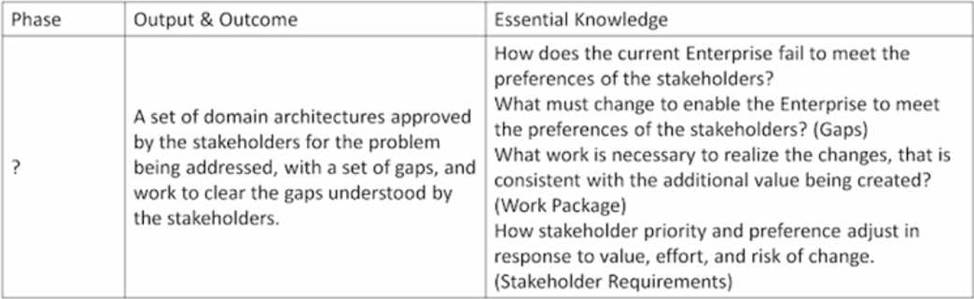
Which ADM Phase(s) does this describe?
- A . Preliminary Phase
- B . Phase B
- C . Phase
- D . C and D
- E . Phase E
C
Explanation:
The table describes the steps involved in Phase B (Business Architecture), Phase C (Information Systems Architectures), and Phase D (Technology Architecture) of the TOGAF ADM5. These phases are responsible for developing the target architectures for each domain and identifying the gaps between the baseline and target architectures. The table shows the outputs and outcomes of each phase, as well as the essential knowledge required for each phase.
The table describes the iterative cycle of defining requirements, identifying gaps, and creating solutions that occurs throughout the architecture development phases of the TOGAF ADM.
This cycle is most prominent in:
Phase B (Business Architecture):
Develop the Business Architecture, identifying gaps between the baseline and desired business capabilities, processes, and information flows.
Define work packages to address these gaps and realize the target business architecture.
Phase C (Information Systems Architectures):
Develop the Data and Application Architectures to support the Business Architecture.
Identify gaps between the baseline and target information systems architectures.
Define work packages to address these gaps and realize the target data and application architectures.
Phase D (Technology Architecture):
Develop the Technology Architecture to support the Data and Application Architectures.
Identify gaps between the baseline and target technology architectures.
Define work packages to address these gaps and realize the target technology architecture.