
Practice Free Mule-Arch-202 Exam Online Questions
An organization has used a Center for Enablement (C4E) to help teach its various business groups best practices for building a large and mature application network.
What is a key performance indicator (KPI) to measure the success of the C4E in teaching the organization’s various business groups how to build an application network?
- A . The number of each business group’s APIs that connect with C4E-documented APIs
- B . The number of end user or consumer requests per day to C4E-deployed API instances
- C . The number of each C4E-managed business group’s Anypoint Platform user requests to the CloudHub Shared Load Balancer service
- D . The number of C4E-documented code snippets used by Mule apps deployed by the C4E to each environment in each network region
A company uses CloudHub for API application deployment so that experience APIs and/or API proxies are publicly exposed using custom mTLS. The company’s InfoSec team requires isolated, restricted access that is limited internally to system APIs deployed to CloudHub and the company’s data center.
What are the minimum infrastructure, component, connection, and software requirements to meet the company’s goal and the InfoSec team’s requirements?
- A . Virtual Private Cloud
Two Dedicated Load Balancers for access to public APIs and internal APIs using IP Allowlist rules
Two-way custom TLS
VPN IPSec tunneling to connect the VPC to the company’s on-premises data center - B . Virtual Private Cloud
One Shared Load Balancer and One Dedicated Load Balancer for access to public APIs and internal APIs, respectively, using IP Allowlist rules
Two-way custom TLS
VPN IPSec tunneling to connect the VPC to the company’s on-premises data center - C . Virtual Private Cloud
One Shared Load Balancer and One Dedicated Load Balancer for access to public APIs and internal APIs, respectively, using IP Allowlist rules
One-way custom TLS
VPN IPSec tunneling to connect the VPC to the company’s on-premises data center - D . Virtual Private Cloud
Two Shared Load Balancers for access to public APIs and internal APIs using IP Allowlist rules
Two-way custom TLS
VPN IPSec tunneling to connect the VPC to the company’s on-premises data center
How do non-functional requirements impact the selection of Anypoint Platform features for designing APIs? (Choose Three)
- A . Influence the choice of security features
- B . Determine the API’s response time and efficiency
- C . Dictate the programming languages used
- D . Affect decisions on API lifecycle management tools
- E . Control the choice of deployment locations
A software company is creating a Mule application that will be deployed to CloudHub. The Mule application has a property named dbPassword that stores a database user’s password. The organization’s security standards indicate that the dbPassword property must be hidden from every Anypoint Platform user after the value is set in the Runtime Manager Properties tab.
Which configuration in the Mule application helps hide the dbPassword property value in Runtime Manager?
- A . Use secure::dbPassword as the property placeholder name and store the cleartext (unencrypted) value in a secure properties placeholder file
- B . Add the dbPassword property to the secureProperties section of the mule-artifact.json file
- C . Store the encrypted dbPassword value in a secure properties placeholder file
- D . Add the dbPassword property to the secureProperties section of the pom.xml file
When should Mule runtime domains and shared configurations be chosen? (Choose Two)
- A . When there is a need to isolate applications from one another.
- B . When multiple applications share common components and resources.
- C . When the application requires a unique runtime environment.
- D . When there is a need to reduce overall memory footprint.
How do VM queues support the persistence requirements of Mule applications in hybrid deployment scenarios?
- A . By ensuring data is only stored in the cloud component of the deployment
- B . By providing an interface for external database integration
- C . By enabling seamless message queuing across on-premises and cloud components
- D . By automating the migration of processing tasks to the cloud
What is a best practice when designing Mule applications for high performance with large data volumes?
- A . Always store data in memory for faster access.
- B . Minimize data transformation and enrichment operations.
- C . Use a single-thread model for simplicity.
- D . Increase the timeout settings for all operations.
How can audit logging capabilities of the Anypoint Platform help in enhancing security?
- A . By providing real-time performance analytics.
- B . By tracking user activities and changes within the platform.
- C . By automatically correcting any misconfigurations.
- D . By limiting data storage to encrypted formats only.
Refer to the exhibit.
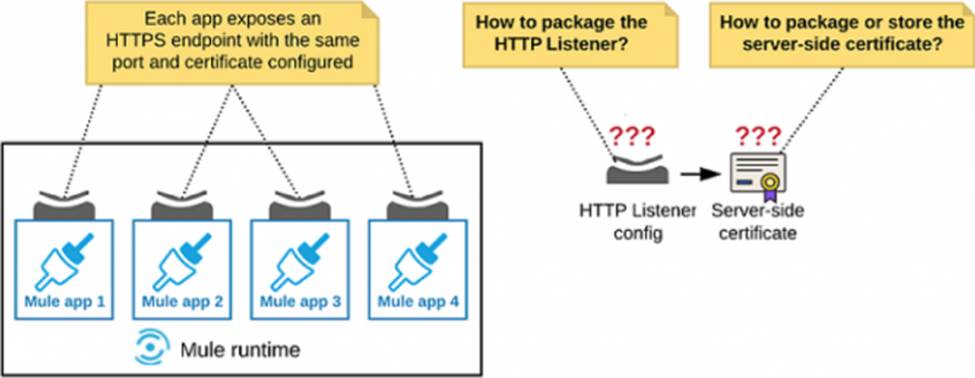
An organization deploys multiple Mule applications to the same customer-hosted Mule runtime. Many of these Mule applications must expose an HTTPS endpoint on the same port, using a server-side certificate that rotates often.
When deploying these Mule applications, what is the most effective way to package the HTTP Listener configuration and package or store the server-side certificate in order to minimize the disruption caused by periodic certificate rotation?
- A . Package the HTTP Listener configuration in a Mule domain project, referencing it from all Mule applications that must expose an HTTPS endpoint.
Store the server-side certificate in a shared file system location in the Mule runtime’s classpath, outside of the Mule domain project or any Mule application. - B . Package the HTTP Listener configuration in a Mule domain project, referencing it from all Mule applications that must expose an HTTPS endpoint.
Package the server-side certificate in the same Mule domain project. - C . Package the HTTP Listener configuration in all Mule applications that must expose an HTTPS endpoint.
Package the server-side certificate in a new Mule domain project. - D . Package the HTTP Listener configuration in a Mule domain project, referencing it from all Mule applications that must expose an HTTPS endpoint.
Package the server-side certificate in all Mule applications that must expose an HTTPS endpoint.
Which statement accurately summarizes the value proposition of MuleSoft Catalyst?
- A . It provides a basic toolkit for API management.
- B . It serves as a foundational framework supporting businesses in achieving outcomes using MuleSoft solutions.
- C . It is primarily a data analytics tool.
- D . It is used for hardware integration within networks.