
Practice Free JN0-460 Exam Online Questions
Which of the following is a critical factor to consider when choosing deployment options for wired assurance in a multinational corporation?
- A . Language support in network devices
- B . The physical size of network devices
- C . Compliance with international data protection regulations
- D . Color schemes of the user interface
Which statement is correct about the VXLAN data plane?
- A . The data plane learns the IP addresses of end-user devices.
- B . The data plane advertises the MAC addresses of end-user devices.
- C . The data plane encapsulates the traffic.
- D . The data plane learns the MAC addresses of end-user devices.
C
Explanation:
VXLAN (Virtual Extensible LAN) uses an overlay encapsulation method to carry Layer-2 frames over an IP underlay. This functionality is part of the data plane, which is responsible for packet forwarding and encapsulation/decapsulation.
“In an EVPN-VXLAN fabric, the control plane (via BGP EVPN) learns and advertises MAC and IP information, while the data plane encapsulates and forwards traffic using VXLAN tunnels between VTEPs.”
Option A is incorrect: IP learning happens in the control plane, not the data plane.
Option B is incorrect: MAC advertisement is done in the control plane through EVPN route types.
Option D is incorrect: MAC learning is handled by EVPN control plane, not the VXLAN data plane.
Option C is correct: the VXLAN data plane encapsulates the traffic in UDP tunnels between VTEPs.
Reference: Juniper Mist AI for Wired C EVPN-VXLAN Overview
Juniper Validated Design C EVPN-VXLAN Control and Data Plane Separation
Junos OS EVPN-VXLAN Deployment Guide
Referring to the exhibit, what is the purpose of the Save button in the upper-right corner of the Mist dashboard?
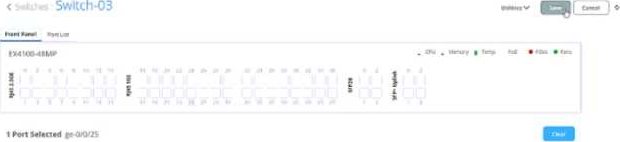
- A . It generates a backup of the current port configuration.
- B . It resets the port configuration to its default settings.
- C . It previews the impact of the port configuration changes before applying them.
- D . It applies the port configuration changes to the switch.
D
Explanation:
In the Juniper Mist AI for Wired dashboard, administrators can select one or more switch ports (as shown in the exhibit, e.g., port ge-0/0/25 on an EX4100-48MP). Once configuration changes are made ― such as VLAN assignment, port profiles, PoE settings, or administrative state ― the Save button must be clicked to confirm and apply those changes to the device.
“When making configuration changes in the Mist switch interface, the Save button must be used to confirm the modifications. Clicking Save applies the selected port settings to the switch through Mist Cloud.”
Option A is incorrect: saving does not create a backup. Backups and snapshots are handled through Mist’s configuration archive, not via the Save button.
Option B is incorrect: Save does not reset configuration; instead, it commits changes.
Option C is incorrect: there is no preview function tied to Save.
Option D is correct: the Save button is explicitly for applying configuration changes to the selected
switch or port(s).
Reference: Juniper Mist AI for Wired C Switch Port Configuration Guide Juniper Mist AI for Wired C Wired Assurance Administration Guide Juniper Mist Documentation C Managing Switch Interfaces
What is the main purpose of policies in EVPN?
- A . To restrict the types of devices that can connect to the network
- B . To define the behavior of route distribution and acceptance
- C . To physically separate different network segments
- D . To standardize network configurations across all devices
What are two classifiers under the wired Throughput SLE? (Choose two)
- A . interface anonalies
- B . storm control
- C . latency
- D . packet loss
Which two statements are correct about switch adoption? (Choose two.)
- A . Greenfield switch adoption requires cloud-enabled switches with a claim or activation code.
- B . Switch adoption uses SSH over TCP port 443.
- C . Switch adoption requires Mist AP.
- D . Brownfield switch adoption requires manual adoption and is used for switches that do not have a claim or activation code.
A, D
Explanation:
In Juniper Mist, Greenfield adoption applies to new, cloud-ready switches (such as EX4100, EX4400, and QFX series) using a claim or activation code to securely connect to the Mist cloud.
Brownfield adoption, however, supports switches already deployed or not factory-fresh. These are manually onboarded by configuring outbound management connectivity and adopting them through the Mist portal.
This distinction enables both new and legacy EX/QFX environments to be cloud-managed under Wired Assurance.
Reference: Juniper Networks Day 0 Mist with EX Switches Deployment Guide
A company is planning to deploy a Juniper Mist campus fabric and wants to implement group-based policy (GBP) for microsegmentation.
Which statement is correct in this scenario?
- A . GBP requires access switches to be EX4100 or EX4400 switches.
- B . GBP configuration should be repeated on every individual switch in the fabric.
- C . GBP configuration must be applied to each individual switch in the fabric using the CLI.
- D . GBP can be implemented on any Juniper Networks switch that supports EVPN-VXLAN.
A
Explanation:
Group-Based Policy (GBP) is a Juniper EVPN-VXLAN feature that enables microsegmentation without requiring multiple VRFs or VLANs. It is implemented within Juniper Mist’s Wired Assurance and Campus Fabric frameworks.
“GBP provides scalable, identity-based segmentation for campus fabrics and is supported on EX4100 and EX4400 Series switches operating in EVPN-VXLAN mode under Mist management.”
The feature requires hardware and software support for EVPN-VXLAN and GBP tagging, which is currently available on specific EX models managed by Mist Cloud.
Option A: Correct ― GBP requires compatible access switches, specifically EX4100 and EX4400 models.
Option B: Incorrect ― GBP is centrally managed through Mist Cloud, not configured per switch.
Option C: Incorrect ― GBP is provisioned via Mist Cloud, not the CLI.
Option D: Incorrect ― GBP is not supported on all EVPN-capable switches; only on defined platforms
(EX4100/EX4400).
Reference: Juniper Mist AI for Wired C Group-Based Policy (GBP) Configuration Guide Juniper Validated Design C GBP in Campus Fabric EVPN-VXLAN Juniper EX Series Feature Support Matrix
A switch is claimed in a Mist organization using the activation code.
What are two possible device states that the switch will have in this scenario? (Choose two.)
- A . Connected
- B . Inactive
- C . Active
- D . Unassigned
A, D
Explanation:
When a switch is claimed into a Mist organization, it appears in one of several states depending on connectivity and site assignment.
“After claiming, switches initially appear as Unassigned if they are not yet linked to a site. Once online and connected to Mist Cloud, they transition to Connected status and begin receiving configurations and telemetry.”
Option A (Connected): Correct ― indicates the switch is online and communicating with Mist Cloud.
Option B (Inactive): Incorrect ― not a valid device state in Mist.
Option C (Active): Incorrect ― “Active” is not a device state label in Mist.
Option D (Unassigned): Correct ― indicates the switch has been claimed but not yet assigned to a site.
Reference: Juniper Mist AI for Wired C Device Claiming and State Management Guide Juniper Mist Cloud C Switch Onboarding Workflow Juniper Mist Wired Assurance C Device Status Descriptions
Which control plane protocol does Juniper recommend when deploying VXLAN?
- A . EVPN
- B . OVSDB
- C . PIM
- D . IGMP
Which two features are included with the wired assurance subscription? (Choose two.)
- A . Wired Service Level Expectations
- B . vBLE engagement
- C . Switch Templates
- D . Marvis Actions