
Practice Free JN0-351 Exam Online Questions
You are configuring a router as a new Level 1 router in an existing Level 1 area. The NET address for an existing Level 1 router is 49.0011.1111.2222.3333.00. The new router must form a Level 1 adjacency with the existing router.
What should be the area ID in this scenario?
- A . 49
- B . 00
- C . 3333
- D . 0011
You have configured a GRE tunnel. To reduce the risk of dropping traffic, you have configured a keepalive OAM probe to monitor the state of the tunnel; however, traffic drops are still occurring.
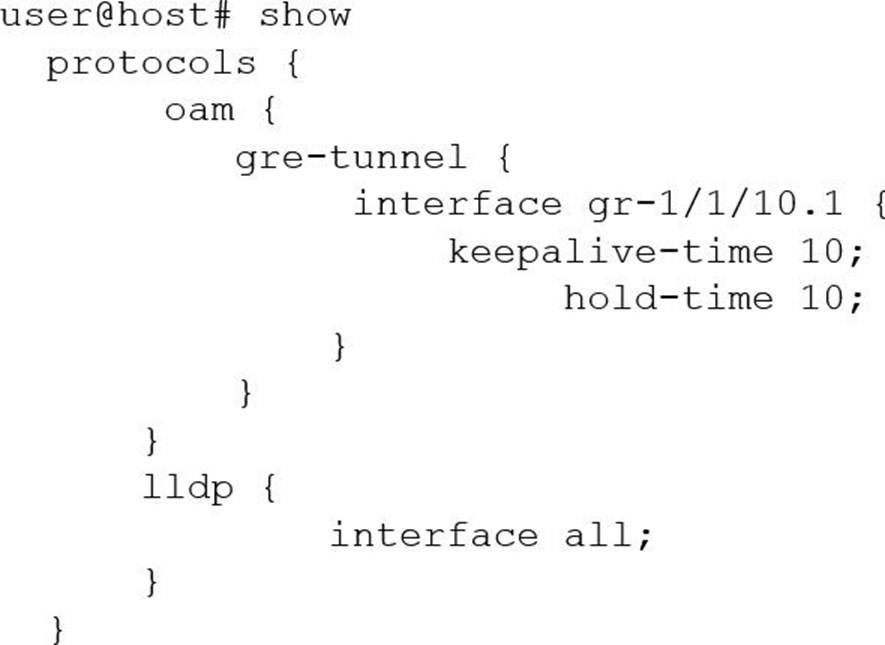
Referring to the exhibit, what is the problem?
- A . For GRE tunnels, the OAM protocol requires that the BFD protocols also be used.
- B . The "event link-adjacency-loss" option must be set
- C . LLDP needs to be removed from the gr-1/1/10.1 interface.
- D . The hold time value must be two times the keepalive-time value
Which two statements are correct about generated routes? (Choose two.)
- A . Generated routes require a contributing route.
- B . Generated routes show a next hop in the routing table.
- C . Generated routes appear in the routing table as static routes.
- D . Generated routes cannot be redistributed into dynamic routing protocols.
You are combining two existing interfaces into a single LAG interface, but you do not see the LAG interface being created.
Which two actions are required to solve this problem? (Choose two.)
- A . Ensure that the first LAG interface name is ae1.
- B . Ensure that LAG is enabled on the chassis.
- C . Ensure that LAG is enabled on each member interface.
- D . Ensure that the first LAG interface name is ae0.
Which two statements about BGP facilitate the prevention of routing loops within an autonomous system? (Choose two.)
- A . Routes learned from IBGP neighbors are only advertised to other IBGP neighbors.
- B . Routes learned from IBGP neighbors are not readvertised to other IBGP neighbors.
- C . IBGP sessions must be configured as a logical full mesh.
- D . IBGP sessions must be configured as a physical full mesh.
You want to enable redundancy for the EBGP peering between the two routers shown in the exhibit.
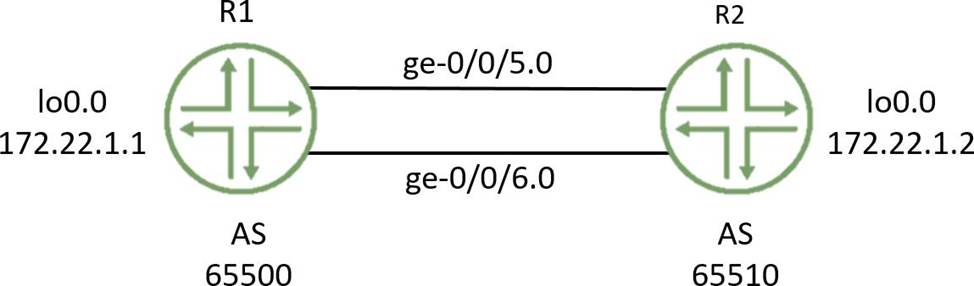
Which three actions will you perform in this scenario? (Choose three.)
- A . Configure BGP multihop.
- B . Configure loopback interface peering.
- C . Configure routes for the peer loopback interface IP addresses.
- D . Configure an MD5 peer authentication.
- E . Configure a cluster ID.
Which statement is correct about graceful Routing Engine switchover (GRES)?
- A . The PFE restarts and the kernel and interface information is lost.
- B . GRES has a helper mode and are starting mode.
- C . When combined with NSR, routing is preserved and the new master RE does not restart rpd.
- D . With no other high availability features enabled, routing is preserved and the new master RE does not restart rpd.
Referring to the exhibit, which three statements are correct? (Choose three.) 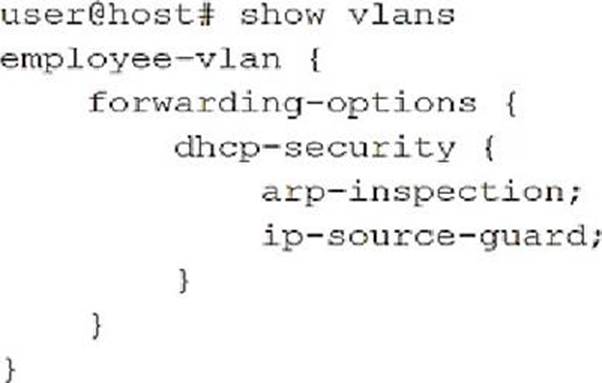
- A . The IP source guard is enabled.
- B . Dynamic ARP inspection is enabled.
- C . DHCP snooping is enabled.
- D . The DHCP snooping database is protected.
- E . DHCP snooping is enabled for IPv6 traffic.
Referring to the exhibit, which statement is correct?
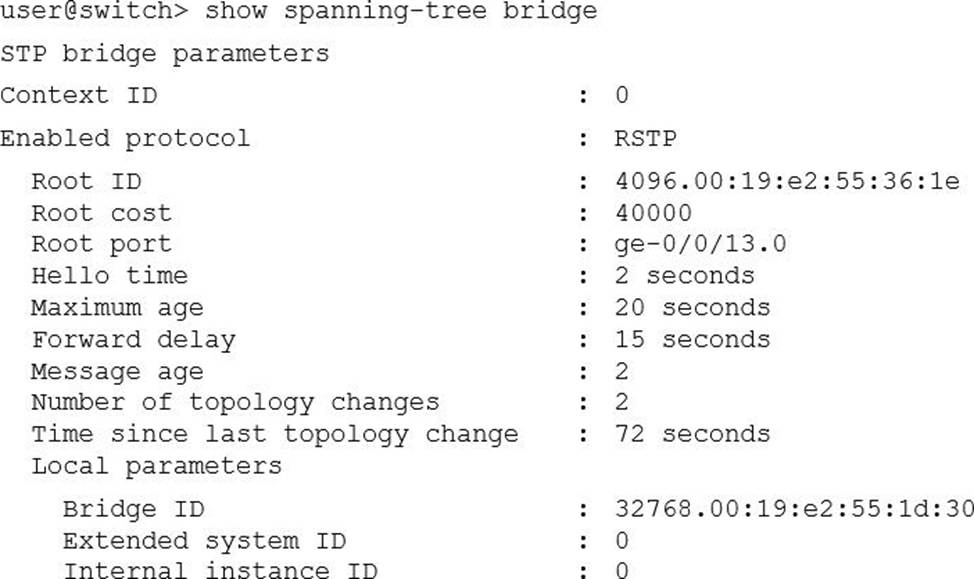
- A . The local device is using a bridge priority of 4k.
- B . The root bridge is using a bridge priority of 4k.
- C . The root bridge has not been elected for this RSTP topology
- D . The local device is the root bridge for this RSTP topology.
Which three actions are required for filter-based forwarding? (Choose three.)
- A . Create routing policies for source addresses.
- B . Create routing instances for individual destinations.
- C . Create a firewall filter to match desired traffic.
- D . Create a forwarding option for load balancing.
- E . Create a RIB group for next-hop entries.