
Practice Free JN0-253 Exam Online Questions
Which Juniper Mist product enables the onboard Bluetooth Low Energy (BLE) antenna array for listen-only mode?
- A . Access Assurance
- B . Wi-Fi Management and Assurance
- C . vBLE Engagement
- D . Asset Visibility
D
Explanation:
In Juniper Mist’s Location-Based Services, the Asset Visibility service utilizes the built-in Bluetooth Low Energy (BLE) antenna array within Mist Access Points to track BLE tags and devices in listen-only mode. This allows the APs to receive BLE signals emitted by assets and compute their real-time location using angle-of-arrival (AoA) and RSSI-based triangulation.
According to the Juniper Mist Asset Visibility and Location Services Guide:
“When operating in Asset Visibility mode, the vBLE antenna array in Mist Access Points functions in listen-only mode, collecting BLE chirps from asset tags and relaying this data to the Mist Cloud for
location determination.”
This configuration differs from vBLE Engagement, where APs transmit BLE beacons to interact with mobile apps. In Asset Visibility, the BLE array passively listens to track tagged assets (e.g., equipment, IoT devices) across a defined floor map.
Therefore, the correct answer is D. Asset Visibility.
Reference:
C Juniper Mist Asset Visibility and Location-Based Services Configuration Guide
C Juniper Mist vBLE Architecture Overview
C Juniper Mist Cloud Location Services Documentation
What is the sampling method used in supervised learning?
- A . labeled dataset
- B . regression
- C . decision tree
- D . random forest
A
Explanation:
The fundamental sampling method used in supervised learning is a labeled dataset. As described in Juniper Mist AI and machine learning application guides, supervised learning algorithms are trained using datasets in which each sample is paired with a known output (label). The model is fed examples comprising input data and the correct answer, learning patterns to map new inputs to their target outputs. While regression, decision tree, and random forest are techniques within supervised learning, the process fundamentally relies on having a labeled dataset for both training and validation phases. “Supervised machine learning models are built on labeled data, with each input paired to a target value or classification.” This allows for accurate model training and evaluation.
Reference: Juniper Mist AI Explainable AI Reference, Machine Learning in Juniper Mist
Exhibit:
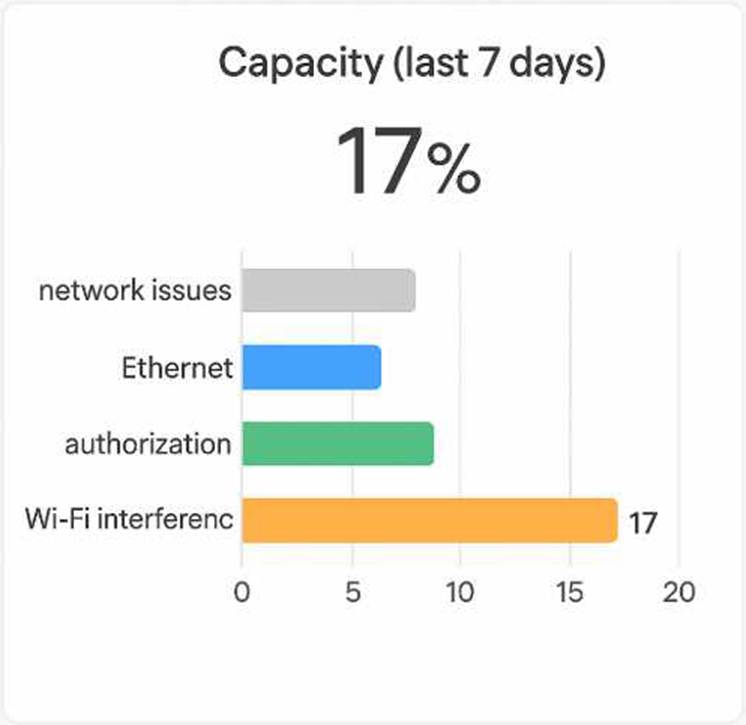
Referring to the exhibit, which classifier was the largest contributor to 17% of the capacity issues?
- A . Network Issues
- B . Ethernet
- C . Authorization
- D . Wi-Fi Interference
D
Explanation:
Within the Juniper Mist Wireless Assurance dashboard, the Capacity SLE (Service Level Expectation) provides visibility into how well the network can handle concurrent users and traffic loads. It identifies the contributing factors, or classifiers, responsible for degraded capacity performance such as Wi-Fi interference, network issues, Ethernet problems, or authorization delays.
According to the Juniper Mist AI Operations and SLE Analytics Guide, the platform:
“Uses classifiers to break down SLE metrics and identify which network factors most heavily contribute to sub-threshold performance.”
In the exhibit, the Wi-Fi interference classifier has the longest bar reaching the full 17%, clearly showing it as the largest contributor to capacity degradation. Wi-Fi interference occurs when multiple APs or nearby wireless networks overlap on the same channel, resulting in increased contention, collisions, and reduced airtime availability ― all of which impact overall capacity.
Therefore, the correct answer is D. Wi-Fi Interference.
Reference:
C Juniper Mist Wireless Assurance SLE and Classifier Documentation
C Juniper Mist AI Operations and Analytics Guide
C Juniper Mist Dashboard and Troubleshooting Insights Overview
In the Mist UI, what should you do to support mobile device engagement?
- A . Enable vBLE
- B . Use Wi-Fi 6
- C . Enable Local Status Page
- D . Use ESL
A
Explanation:
To support mobile device engagement within the Juniper Mist Cloud UI, you must enable virtual Bluetooth Low Energy (vBLE). The vBLE functionality allows Mist Access Points (APs) to transmit Bluetooth beacons that interact with mobile devices running location-aware applications. This capability is essential for user engagement services such as indoor navigation, proximity notifications, and personalized customer interactions.
According to the Juniper Mist Location-Based Services Configuration Guide, the process is defined as follows:
“To enable mobile engagement and location-based experiences, the vBLE feature must be activated on supported Mist Access Points. Once enabled, APs transmit programmable BLE signals that communicate with mobile devices through the Mist SDK.”
Enabling vBLE allows administrators to:
Provide wayfinding and push notification services within indoor environments.
Support mobile app integration through the Mist Location SDK.
Customize engagement campaigns via virtual beacons without requiring physical beacon hardware.
Other options are incorrect because:
Wi-Fi 6 improves wireless efficiency but is unrelated to BLE-based engagement.
Local Status Page is used for AP health monitoring, not engagement.
ESL (Electronic Shelf Labels) applies to retail price display systems, not user interaction.
Therefore, the correct answer is A. Enable vBLE.
Reference:
C Juniper Mist Location-Based Services Configuration and Deployment Guide
C Juniper Mist vBLE and Mobile Engagement Overview
C Juniper Mist Cloud User Engagement and SDK Integration Documentation
What is the purpose of Audit Logs in Juniper Mist?
- A . to record key performance events
- B . to record security alerts
- C . to record administrative activities
- D . to record SLE violations
C
Explanation:
The purpose of Audit Logs in Juniper Mist is to record administrative activities within the Mist dashboard. According to the official Juniper Mist documentation: "Audit Logs provide a detailed chronological record of each configuration change, administrative action, and user activity within the Mist Cloud portal. These logs include information such as the action performed (e.g., adding or removing sites, devices, or users), the timestamp, and the user who performed the action. Audit Logs are critical for accountability, compliance, and troubleshooting, enabling administrators to trace changes and ensure that only authorized users are making modifications to their network settings.
Mist stores audit log records securely and makes them accessible for review by organization administrators from the dashboard’s Organization > Audit Logs section."
This directly aligns with option C, as the logs primarily track configuration changes and administrative actions―not performance events, security alerts, or SLE violations. Such activities include site creation, modification, device assignment, role changes, and other user or configuration updates.
Reference: Juniper Mist Documentation ― Audit Logs and Organization Management, Mist AI Study Guide.
What are three features of Juniper Mist? (Choose three.)
- A . Controller firmware updates
- B . Automatic feature updates
- C . Wireless Assurance
- D . Asset tracking
- E . Perpetual Access Point licenses
B, C, D
Explanation:
Juniper Mist delivers Automatic Feature Updates, Wireless Assurance, and Asset Tracking as core platform features.
Automatic feature updates: As part of its cloud architecture, Juniper Mist provides bi-weekly, hitless automatic updates for features and security, delivered seamlessly from the cloud without service interruption or manual intervention. Mist documentation states, "New features, security patches, and updates are automatically added on a bi-weekly basis without interruptions or service downtime. This dramatically simplifies and improves service operations for network IT administrators."
Wireless Assurance: Wireless Assurance is Mist’s flagship cloud service that leverages AI and machine learning to automate wireless network operations, delivering predictable, reliable, and measurable Wi-Fi experiences. It provides deep visibility into client states, sets service level expectations (SLEs), and uses Marvis actions and AI-driven recommendations to ensure root-cause identification and proactive troubleshooting―"Mist Wi-Fi Assurance is a cloud service based on machine learning (ML) and driven by Mist AI… designed for the smart device era."
Asset tracking: Asset Visibility/Tracking uses vBLE technology and Wi-Fi to track and locate assets and IoT devices within an organization, integrating with Juniper Mist Cloud for real-time and historical analytics. According to the Asset Visibility datasheet: "Mist Asset Visibility is a cloud service that enables real-time tracking and historical location analytics of people, assets, and IoT devices."
Controller firmware updates and perpetual AP licenses are not listed features of the Mist cloud architecture; Mist uses a cloud-based control plane and subscription-based licensing for its platform.
Reference: Juniper Mist Wireless Overview, Asset Visibility Datasheet, Mist Platform Solution Brief, Mist AI Update Release Notes, Mist Feature Compariso
What are device-specific WAN Edge templates used for in an SD-WAN configuration?
- A . To automate the WLAN template process
- B . To automatically generate configuration elements specific to device models
- C . To perform traffic inspection for WAN edge devices
- D . To monitor network events and stop attacks
B
Explanation:
In the Juniper Mist SD-WAN solution, device-specific WAN Edge templates are used to streamline the deployment and configuration of Juniper SRX or SSR (Session Smart Router) devices serving as WAN Edge nodes. These templates ensure consistent and accurate configurations across a distributed WAN environment while accounting for differences in hardware models and interface types.
According to the Juniper Mist WAN Assurance and SD-WAN Configuration Guide, device-specific templates:
“Automatically generate configuration elements tailored to the hardware platform, including interfaces, ports, and device capabilities.”
They are part of Mist’s cloud-managed SD-WAN automation framework, which combines WAN Assurance and AI-driven insights to manage branch connectivity. The templates simplify provisioning by populating device-level parameters such as:
Interface naming and mapping based on the device model.
Hardware-specific configurations like tunnel endpoints, IP addressing, and routing settings.
Security and performance policies consistent with the organization’s SD-WAN design.
Options A, C, and D are incorrect because:
A (WLAN template automation) pertains to wireless network configuration, not WAN edge devices.
C (traffic inspection) relates to firewall or security policies handled by SRX’s UTM features, not templates.
D (monitoring and attack prevention) falls under Mist’s security or analytics capabilities, not the template function.
Therefore, the correct answer is B. To automatically generate configuration elements specific to device models.
Reference:
C Juniper Mist WAN Assurance and SD-WAN Configuration Guide
C Juniper Mist Cloud Device Template Management Documentation
C Juniper Mist AI-Driven SD-WAN Deployment Overview
Which two Juniper devices are used in Juniper Mist WAN Assurance? (Choose two.)
- A . SRX Series Firewalls
- B . EX Series Switches
- C . Session Smart Routers
- D . QFX Series Switches
A, C
Explanation:
Juniper Mist WAN Assurance is a cloud-based service that extends Mist AI capabilities to the WAN edge, providing visibility, automation, and AI-driven analytics for WAN devices. It focuses on ensuring end-to-end service assurance for users and applications across distributed networks.
According to the Juniper Mist WAN Assurance and SD-WAN Deployment Guide, the supported devices include:
“Juniper SRX Series Firewalls and Session Smart Routers (SSR) are integrated with Mist WAN Assurance for telemetry collection, service-level monitoring, and AI-driven troubleshooting.”
SRX Series Firewalls (A): Provide secure WAN connectivity and send real-time telemetry (including throughput, latency, and packet loss metrics) to Mist Cloud.
Session Smart Routers (C): Power the AI-driven SD-WAN solution with application-aware routing and session intelligence, fully integrated into Mist Cloud for advanced visibility and analytics.
EX and QFX switches are used with Wired Assurance, not WAN Assurance.
Therefore, the correct answers are
Your organization has a Marvis subscription. You have an issue with an access point (AP) that does not power on. You decide to open a support ticket.
In this scenario, what does Marvis do while you are filling in the details on the New Ticket screen?
- A . Marvis creates the support tickets.
- B . Marvis sends an e-mail to [email protected] on your behalf.
- C . Marvis provides links to Internet resources about AP power problems.
- D . Marvis provides possible solutions to AP power problems from the Juniper Mist documentation.
D
Explanation:
When an administrator begins to open a support ticket within the Juniper Mist portal, the Marvis Virtual Network Assistant proactively assists by presenting relevant, AI-driven recommendations and documentation.
According to the Juniper Mist Marvis Virtual Network Assistant Guide, this process is described as:
“While an administrator creates a support case, Marvis automatically searches the Mist knowledge base and presents probable causes and recommended solutions based on the detected issue type.”
If the issue involves an AP that does not power on, Marvis retrieves contextual data such as PoE status, switch port state, and recent telemetry logs, then provides automated guidance―for example, checking PoE configurations or cable connectivity.
Thus, while the administrator fills in the “New Ticket” details, Marvis provides potential solutions directly from Juniper Mist’s documentation, potentially resolving the issue before a support case is even submitted.
The correct answer is D. Marvis provides possible solutions to AP power problems from the Juniper Mist documentation.
Reference:
C Juniper Mist Marvis Virtual Network Assistant User Guide
C Juniper Mist AI Operations and Support Automation Documentation
C Juniper Mist Cloud Case Creation and Marvis Integration Overview
Which Juniper Mist role has limited access for a specified grace period?
- A . Super Observer
- B . Installer
- C . Observer
- D . Helpdesk
B
Explanation:
The Installer role in the Juniper Mist Cloud is a temporary, limited-access account type used for onboarding network devices―typically Access Points (APs)―during initial deployment. It provides restricted visibility and configuration rights necessary for installation tasks but expires automatically after a defined grace period to maintain network security and access control.
According to the Juniper Mist Cloud Administration and User Management Guide:
“The Installer role provides temporary access to add, claim, and verify devices at a site. This access expires automatically after the predefined installation grace period.”
This role is ideal for field engineers or contractors performing device installations without granting them long-term administrative privileges. The grace period is typically seven days, after which the Installer account loses access to the organization automatically.
Other roles differ as follows:
Super Observer: Read-only access across the entire organization.
Observer: Read-only access limited to assigned sites.
Helpdesk: Focused on monitoring and basic troubleshooting tasks, not installation.
Therefore, the correct answer is B. Installer.
Reference:
C Juniper Mist Cloud Administration and Role Management Guide
C Juniper Mist Cloud User Access and Privilege Documentation
C Juniper Mist Organization and Role-Based Access Control Overview