
Practice Free JN0-253 Exam Online Questions
What is required for Marvis Minis to operate?
- A . WAN Assurance subscription
- B . Premium Analytics subscription
- C . Minimum AP firmware
- D . WLAN template
C
Explanation:
Marvis Minis is an advanced feature within the Juniper Mist AI ecosystem designed to perform autonomous, synthetic network testing. It uses Mist Access Points (APs) to simulate client behavior― such as association, authentication, DHCP, DNS, and application reachability―to proactively detect service issues before real users are affected.
According to the Juniper Mist Marvis Minis Deployment Guide and Marvis AI documentation, the key requirement for enabling Marvis Minis is that all participating access points must be running a minimum supported firmware version that includes the Minis agent functionality.
The documentation specifies:
“Marvis Minis requires APs running the minimum firmware version that supports synthetic testing. APs on earlier versions will not be capable of running Minis tests or reporting results to the Mist Cloud.”
Additional subscriptions such as WAN Assurance, Premium Analytics, or WLAN templates are not prerequisites for operation. While Marvis licensing must be active, the feature itself relies primarily on compatible firmware within the Mist-managed APs.
Therefore, the correct answer is C. Minimum AP firmware ― ensuring the APs are on a supported firmware release is essential for Marvis Minis functionality.
Reference:
C Juniper Mist Marvis Minis Deployment and Configuration Guide
C Juniper Mist AI Operations and Troubleshooting Documentation
C Juniper Mist Wireless Assurance and Firmware Management Guide
Exhibit:
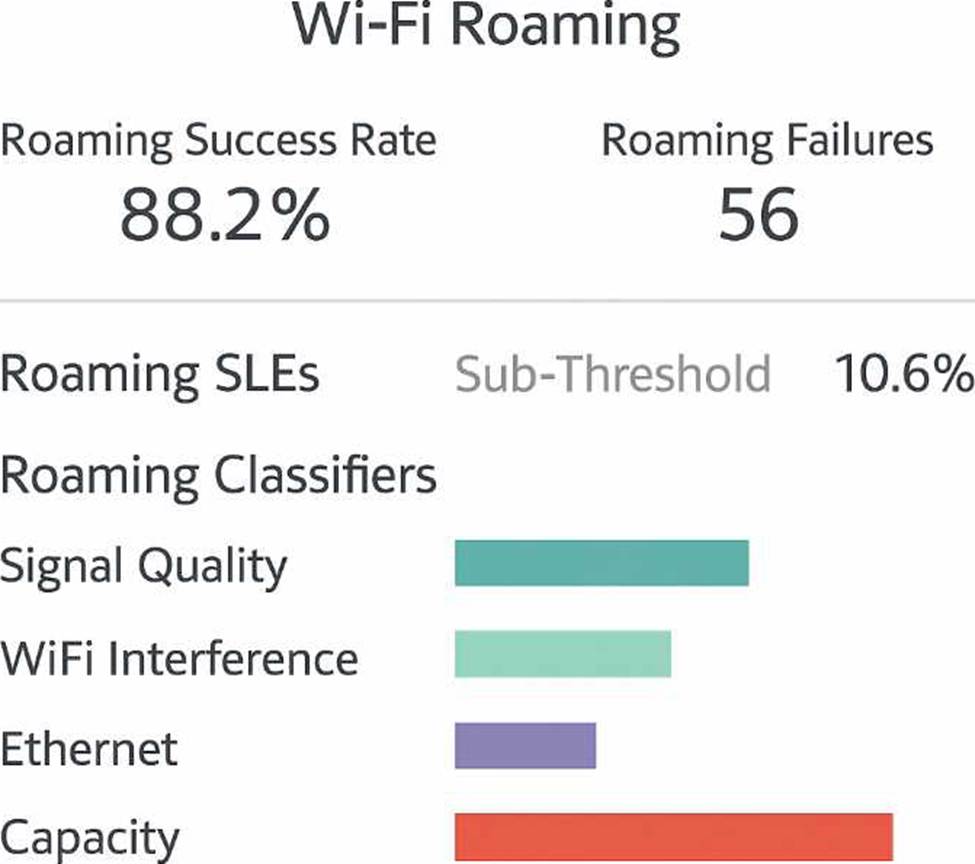
Referring to the exhibit, which Roaming Classifier is responsible for the sub-threshold SLEs?
- A . Signal Quality
- B . WiFi Interference
- C . Ethernet
- D . Capacity
D
Explanation:
In the Juniper Mist dashboard, Service Level Expectations (SLEs) are metrics that measure user experience in key areas such as connection, throughput, and roaming. Each SLE is composed of classifiers, which help identify the underlying cause of degraded performance or sub-threshold scores.
According to the Juniper Mist AI documentation, the Roaming SLE tracks client transitions between access points and evaluates the quality of those roaming events. The contributing classifiers typically include Signal Quality, Wi-Fi Interference, Ethernet, and Capacity.
In this exhibit, the bar for Capacity is the longest under the “Roaming Classifiers” section, indicating that it has the most significant impact on the Sub-Threshold SLE value (10.6%). This means roaming performance is primarily being limited by insufficient capacity ― often due to AP radio congestion or a high number of concurrent clients impacting handoff efficiency.
Hence, the Capacity classifier is responsible for the sub-threshold SLEs.
Reference:
C Juniper Mist AI Service Level Expectations (SLE) Overview
C Juniper Mist Dashboard Analytics and SLE Classifiers Guide
C Juniper Mist Wi-Fi Assurance Documentation
What are two ways that Marvis Minis validates network configurations? (Choose two.)
- A . Marvis Minis uses unsupervised machine learning.
- B . Marvis Minis requires additional hardware for validation.
- C . Marvis Minis validates configurations automatically.
- D . Marvis Minis uses supervised machine learning.
C, D
Explanation:
Marvis Minis validates network configurations automatically and uses supervised machine learning. As stated in the Juniper Mist AI documentation, “Marvis Minis runs validations automatically at regular intervals and can be triggered manually by administrators. Minis use network digital twin technology and supervised machine learning to simulate and validate real-world user connectivity events.” The system automatically creates patterns, triggers tests, and correlates real user and simulated network behaviors with the learned models. The validation covers critical network services―such as DHCP, DNS, ARP, and application reachability―and does so across various scopes (site, AP, VLAN, and switch). There is no requirement for additional hardware, as the digital twin reuses existing network infrastructure and existing APs.
Reference: Marvis Minis Documentation ― Marvis Minis Overview; Marvis Minis Configuration and Operation Manual
When a Juniper Mist managed switch is powered on, which event must be completed prior to the Zero-Touch Provisioning (ZTP) process moving forward?
- A . All user accounts must be configured on the switch.
- B . A DHCP lease must be obtained by the switch.
- C . NETCONF must be configured on the switch.
- D . The switch’s clock must be synchronized with an NTP server.
B
Explanation:
A DHCP lease must be obtained by the switch before the ZTP process proceeds. Juniper documentation clarifies: "Ensure that a DHCP server is reachable. In addition to providing an IP address to the switch, your DHCP server must provide the following information: a default gateway, an NTP server, and a DNS server address…" The initial event in the ZTP workflow is the switch receiving a valid IP address via DHCP. Only after obtaining an address can the switch connect to the Mist cloud and proceed with zero-touch provisioning. Other requirements, such as user account, NETCONF, or NTP sync, occur later or are handled automatically via cloud policy after onboarding.
Reference: Juniper Mist Wired Assurance Configuration Guide, Cloud-Ready EX and QFX Switches with Mist Manual, Ports to enable on your firewall – Mist.
You are creating a new site in the UI.
What are three required configuration settings in this scenario? (Choose three.)
- A . Country
- B . Location
- C . RF Template
- D . Active Hours
- E . Site Name
A, B, E
Explanation:
When creating a new site in the Juniper Mist User Interface, the three required configuration settings are Site Name, Country, and Location. According to Juniper Mist’s official configuration guides: "At a minimum, enter the name, time zone, and location…" The ‘Information’ section of site setup requires the Site Name (a descriptive name to identify the site), Country (which sets regulatory and RF domain requirements), and Location (address or geo-coordinates for the site). These form the basis of the site identity in the Mist cloud and are mandatory for dashboard visibility, compliance, and baseline RF configuration. An RF Template, though critical for wireless tuning, is optional and can be assigned post-site creation. Active Hours are not required for the default site setup and are related to scheduling analytics or location-based services, not to the core creation workflow.
Reference: Juniper Mist Configure a Site, Site Configuration Settings Guide, Mist Management Guide
How does Marvis detect a bad cable problem?
- A . Marvis constantly sends ping packets to remote end hosts to determine whether there is a failure in the path.
- B . Marvis randomly performs packet captures on various APs to find bad cables in your network.
- C . Marvis randomly performs cable tests on every cable in your network.
- D . Marvis analyzes metrics, such as interface errors, that match a bad cable pattern.
D
Explanation:
Marvis, the AI-driven Virtual Network Assistant in Juniper Mist, uses continuous telemetry analysis and AI correlation to identify bad cable conditions. It does this by examining interface-level statistics gathered from switches and access points through Wired Assurance.
According to the Juniper Mist Marvis Operations and Troubleshooting Guide:
“Marvis detects bad cable issues by analyzing telemetry patterns such as CRC errors, FCS errors, packet drops, and link flaps that collectively match a known cable fault signature.”
When such patterns are detected, Marvis automatically generates an AI Action indicating a Bad Cable issue and identifies whether the problem is with the port or the cable. This proactive detection allows administrators to replace faulty hardware before it impacts network users.
Options A, B, and C are incorrect because Marvis does not perform active pinging, random packet captures, or random cable testing. Its detection is entirely AI and telemetry-based.
Therefore, the correct answer is D. Marvis analyzes metrics, such as interface errors, that match a bad cable pattern.
Reference:
C Juniper Mist Marvis AI Operations Guide
C Juniper Mist Wired Assurance and Telemetry Analytics Documentation
C Juniper Mist AI Troubleshooting and Automation Overview
What is the purpose of assigning roles to switches?
- A . To configure WLANs
- B . To manage user accounts
- C . To assign configurations at scale
- D . To monitor network traffic
C
Explanation:
In Juniper Mist Wired Assurance, assigning roles to switches is a key configuration mechanism for deploying consistent network policies across multiple devices. Switch roles act as logical identifiers that bind devices to specific configuration templates or policy profiles, ensuring standardized setup and reducing manual configuration overhead.
According to the Juniper Mist Wired Assurance Configuration and Template Management Guide:
“Switch roles are used to group devices based on function or location and automatically apply predefined configuration templates and policies at scale.”
This enables administrators to:
Automatically assign VLANs, port profiles, and policies to multiple switches simultaneously.
Simplify deployment for large organizations with multiple sites.
Ensure uniform compliance with enterprise configuration standards.
Roles are not used to configure WLANs (wireless function), manage users, or directly monitor traffic
― those tasks are handled through other Mist AI services. Therefore, the correct answer is C. To assign configurations at scale.
Reference:
C Juniper Mist Wired Assurance Configuration and Template Management Guide
C Juniper Mist Cloud Administration Guide
C Juniper Mist Wired Assurance Operations Documentation
What are three methods for requesting authentication in the Juniper Mist API? (Choose three.)
- A . Enable MFA with Okta Verify.
- B . Use an HTTPS login with a user name and password.
- C . Use OAuth2 linked to an OAuth provider.
- D . Enable basic authentication with a token.
- E . Use RADIUS certificates.
B, C, D
Explanation:
The three valid methods for requesting authentication with the Juniper Mist API are:
Use an HTTPS login with a user name and password: The Mist API accepts HTTPS requests where credentials are provided directly for session/token generation and user administration.
Use OAuth2 linked to an OAuth provider: "Juniper Mist APIs offer authentication via OAuth2 with various OAuth-compatible identity providers, such as Okta, for secure and federated access."
Enable basic authentication with a token: Mist APIs accept programmatic requests using tokens (API tokens or bearer tokens) for automation, scripting, and integration―each token mapping to specific scopes and user permissions.
Enabling MFA with Okta Verify enhances user portal security but is not an API authentication mechanism. RADIUS certificates are used for infrastructure 802.1X authentication, not for API access.
Reference: Juniper Mist API Authentication Mechanisms
You are asked to create a real time visualization dashboard which displays clients on a map.
Which two Juniper Mist functions would you use in this scenario? (Choose two.)
- A . Live View
- B . WebSocket
- C . webhooks
- D . RESTful API
A, B
Explanation:
To create a real-time visualization dashboard that displays clients on a map, use Live View and WebSocket APIs. The "Live View" feature in Juniper Mist provides a graphical, interactive map view of clients (devices) and assets as they move through a site, with location data updated in real time. The Juniper Mist WebSocket API enables developers and integrators to subscribe to client location topics and stream position data directly to custom dashboards. According to the documentation: "WebSockets open a bidirectional communication session for sending and receiving real-time event-driven responses… Useful in circumstances where you want to avoid browser refreshes and display real-time location data." Combining these allows you to build a dashboard showing live client positioning, as seen in sample dashboards and integration guides for Mist.
Reference: WebSocket API Overview | Mist
Juniper Mist Automation and Integration Guid
What are two components of WiFi Management and Assurance? (Choose two.)
- A . Dynamic Packet Capture
- B . wayfinding
- C . Marvis Actions
- D . Radio Resource Management
A, D
Explanation:
Dynamic Packet Capture and Radio Resource Management (RRM) are two key components of WiFi Management and Assurance in Juniper Mist. According to official documentation: "Dynamic packet capture allows capturing wireless packets between clients and an access point to diagnose root-cause wireless issues. For example, when a major issue is detected, such as an authorization failure, packet captures facilitate quick troubleshooting and root-cause analysis." RRM, driven by Mist’s AI, proactively analyzes network conditions and client experiences to automatically adjust channel and power settings for optimal performance: "AI-driven RRM uses data science and cumulative SLE performance to learn and optimize radio settings, helping RF planning to continue to improve and adapt in the changing environments…"
Marvis Actions is an AI-powered troubleshooting feature, but it is a separate component enabled by the Marvis subscription, not by base WiFi Management and Assurance. Wayfinding is part of the vBLE Engagement or location services.
Reference: Juniper Mist Wi-Fi Assurance | UK&I, Mist Management Guide, Platform Wi-Fi Assurance – NetworkScreen.com