
Practice Free HPE7-A08 Exam Online Questions
Refer to the exhibit:
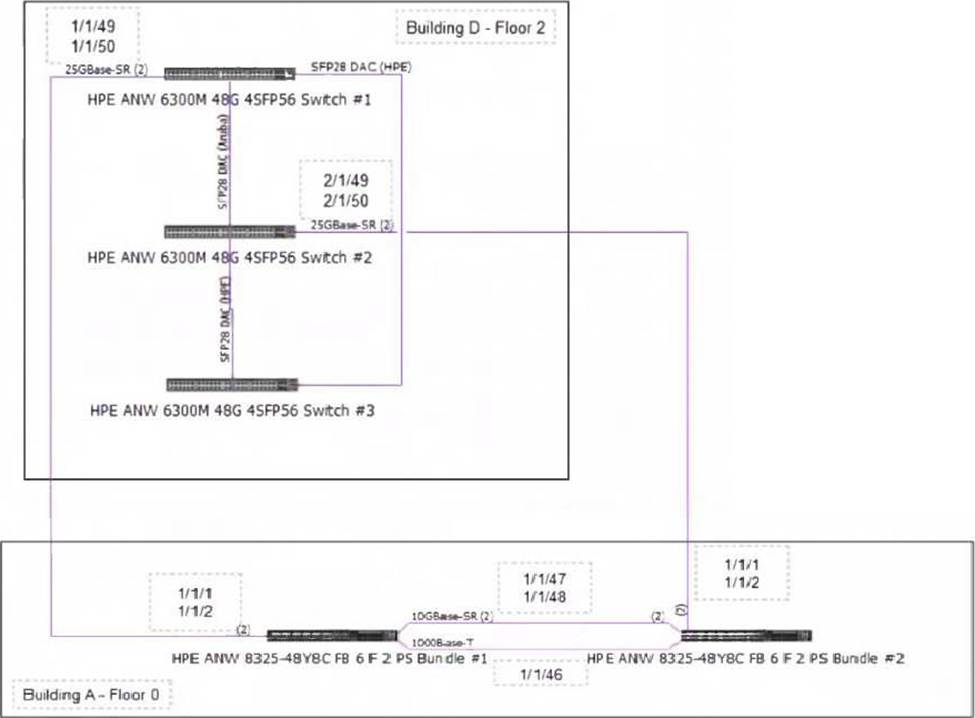
According to the HPE Aruba Networking VSX best practices, what would need to be changed on the configuration?
- A . Replace the CX8325 1/1/47 and 1/1/48 ports with SFP28 connectivity.
- B . Replace the CX8325 1/1/47 and 1/1/48 ports with SFP56 connectivity.
- C . Replace the CX6300[1-2]/1/49 and [1-2]/1/50 ports with QSFP28 connectivity.
- D . Replace the CX6300 [1-2]/1/49 and [1-2]/1/50 ports with SPF56 connectivity.
Refer to the exhibit.
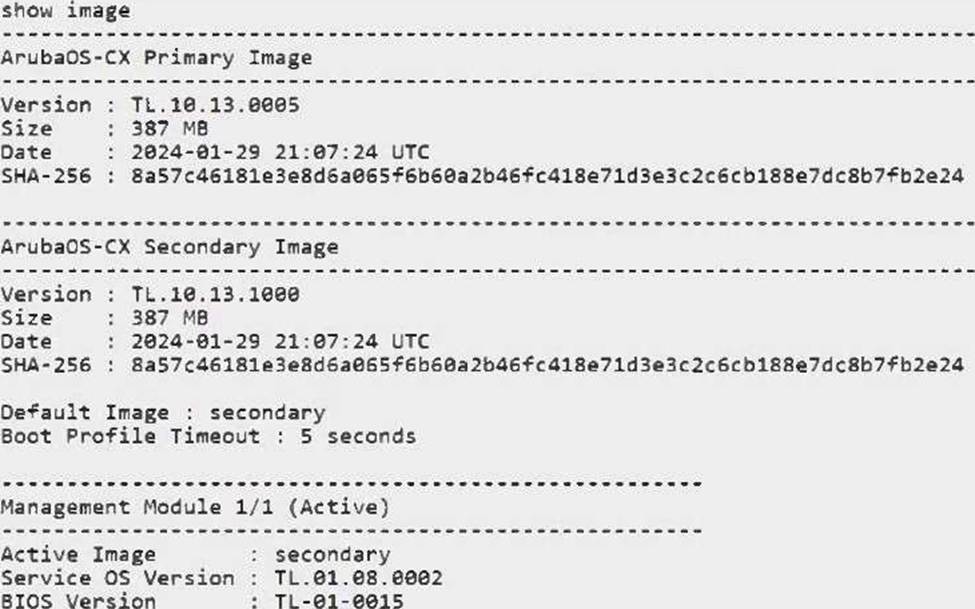
Given the current software running on an HPE Aruba Networking CX 8320 VSX, what is the best way to upgrade the VSX cluster with minimal downtime? (Choose two.)
- A . Upload new image to the secondary boot-bank on both switches.
- B . Use vsx update-software boot-bank secondary.
- C . Use vsx update-software boot-bank primary.
- D . Use issu update-software confirm.
You have added a switch with existing configuration to an existing group in HPE Aruba Networking Central but the configuration is not synchronizing.
What could cause this?
- A . The switch is configured in a VSX pair, which HPE Aruba Networking Central does not support.
- B . Only switches with factory default config can be added to a group with existing config.
- C . Configuration auto-commit has been disabled for the group in HPE Aruba Networking Central.
- D . The switch is still pending authorization on the organization settings page.
While troubleshooting a scenario in which the customer has created a new VLAN on a primary HPE Aruba Networking CX 8100 VSX switch, only part of the traffic from the connected access switch over a LAG is working.
Which troubleshooting methodology should you use to isolate the problem?
- A . Replace the configuration using the previous checkpoint on the primary VSX.
- B . Divide and conquer by rebooting the secondary VSX switch.
- C . Follow the path and check the connectivity from the access to the primary VSX.
- D . Spot the difference by comparing the VSX switch configurations.
You have applied the following OSPF configuration but are not seeing any output from the command below.
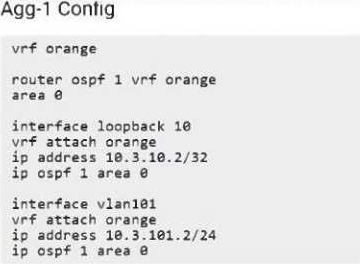
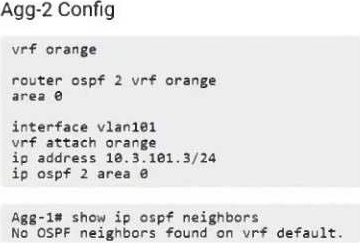
What is the reason for this?
- A . A loopback interface hasn’t been configured on Agg-2.
- B . A VRF wasn’t specified in the show command.
- C . OSPF interfaces are passive by default.
- D . A different OSPF process ID is used on each switch.
OSPF peering is configured between HPE Aruba Networking CX 6300 switches utilizing bfd.
With the given configuration on switch A and switch В in its default settings:
(config-if)# bfd min-transmit-interval=1000
(config-if)# bfd-min-echo-receive-interval=1000
(config-if)# bfd detect-multiplier=5
If a link goes down, how long It takes to bring down the relationship?
- A . After 1000ms
- B . After 500ms
- C . After 5000ms
- D . After 1500ms
Refer to the exhibit:
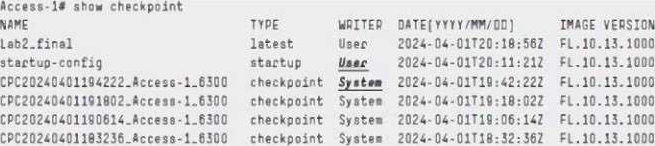
The current startup configuration on the HPE Aruba Networking CX 6300 switch no longer includes a device profile that was created on the previous day .
Based on the exhibit, how can you validate if the configuration was removed without changing the current configuration?
- A . Use show checkpoint to see the changes created between the available checkpoints.
- B . Use checkpoint diff to check for differences between the startup-config and available checkpoints.
- C . Use copy startup-config checkpoint <checkpoint-name> to see the changes created between the available checkpoints.
- D . Use checkpoint rollback to see the changes created between the available checkpoints.
A customer has connected a server to VLAN 100 on a 6300 switch which is streaming video using multicast group 224.0.0.100. This stream would need to be received by the clients in VLANs 200 and 300, routed on the same CX switch.
What needs to be done to enable the requirement?
- A . The multicast group address needs to be changed to a routable subnet.
- B . The multicast group address needs to be changed to other 224.0.0x non-overlapping address
- C . The igmp-snooping needs to be enabled on SVIs 100, 200, and 300
- D . The igmp needs to be enabled on the SVIs 100, 200, and 300
After configuring NTP and the time zone on your switch and configuring a matching time zone in your browser, you notice an error message in the NAE dashboard saying, “Switch time and browser time are not in sync.”.
What should you do to resolve the issue? (Choose two.)
- A . Use iburst on your switch NTP configuration
- B . Clear NAE data from the switch CLI.
- C . Configure NTP sync on your browser.
- D . Clear the web client browser cache.
- E . Disable NTP from the switch CLI.
Your customer’s CISO would like to deploy colorless ports across the network.
Which will you need to configure to meet this requirement?
- A . Port-security
- B . MAC Auth
- C . Sticky MAC
- D . Virtual MAC