
Practice Free HPE7-A03 Exam Online Questions
ACME retail has 38 locations spread out across Ave US states and two provinces in Canada. They are looking to grow 20% over the next two years. They have an HO with a staff of 200 employees. The organization has eight Regional Managers and two VPs who work from home and the road. Stores typically have 17 employees on average per location.
The two warehouses have a remote loading system and 20 employees each to load the trucks and fulfill the online orders. The warehouse has 40-foot ceilings and large metal racks to store inventory. The main location is 240K sq ft (22300 st) m) and the Canadian warehouse Is 130K sq ft (12100 sq ml. The forkllfts on the loading docks are equipped with a wireless tablet on board.
A typical store Is reportedly about 60.000 sq ft (5575 sqm) and smaller stores are planned at 25.000
sq ft ‘2320 sq mi. The locations need to expand the abilities to vendors that need to add setup displays or Interactive kiosks in the stores. The current Infrastructure was installed In 2015 and used wireless N technology in a coverage model. The wiring is CatS. and they are unsure of the fiber connections. The inventory is all placed on the floor when it is delivered to the local store. Inventory control is handled through Zebra barcode scanners, and they have had a lot of issues in getting signals throughout the stores and this makes monthly inventory difficult. The organization has a small help desk to troubleshoot issues that happen at the retail locations and PC support for the office. The company is looking to upgrade away from the current pbx system later this year. With the need to grow and cut costs, they are interested in moving the data to the cloud but need to get almost real-time inventory control for the online service to function.
The network has all been wired over the last ten years, but with the new systems being all wireless, they have seen the trend to offer wireless to all the vendors for their needs but also would like to allow employees, guests, and contractors all to use it. With the new IT director starting next week, the project has been set by the CTO of the company. The marketing group has asked how they can interact with the customers and get more info, while the IT support desk needs to cut staff in halt. The. office has an MDF and two IDFs located on floors one and two. The HOF is in the basement, and you have multiple WAN circuits for the HO links. Each store has a local handoff from the cable company (ethernet) In the middle of the store in the office, so distance for the wiring is not an issue. The customer has budget concerns but does want something that could last 7+ years.
The customer would like to host all the applications at the HO Data Center.
Which design would meet the customer’s requirements?
- A . Aruba SO-Branch Architecture
- B . Aruba 10K switch with Pensando
- C . Aruba Instant OS access points
- D . Aruba UXI Sensors
- E . HPE Comware switches
A
Explanation:
For ACME Retail, which aims to host all applications at the HO Data Center and has multiple locations spread across different geographical areas, the Aruba SD-Branch Architecture would be the most suitable design to meet their requirements. This architecture provides a simplified, integrated branch networking solution combining SD-WAN, LAN, and security features. It enables centralized management and control, allowing ACME Retail to efficiently route traffic from branch locations to the HO Data Center, ensuring secure and reliable access to applications. The SD-Branch solution can accommodate the company’s growth and adapt to changing network demands, making it an ideal choice for a scalable and flexible network infrastructure that supports ACME Retail’s business objectives.
What are the advantages of using a vSX-pair instead of two discrete switches to connect servers, storage, firewalls, and other workloads?
- A . The setup is much easier since both switches are sharing the same configuration.
- B . You can save hall the number of licenses needed tor AFC.
- C . Both members in a VSX-pair can be upgraded without any downtime for the workload.
- D . VMWare-Most can be connected with or without using LACP. regardless of their license.
C
Explanation:
One of the key advantages of using a Virtual Switching Extension (VSX) pair instead of two discrete switches for connecting servers, storage, firewalls, and other workloads is that both members in a VSX pair can be upgraded without any downtime for the workload (Option C). VSX technology provides advanced high availability features that allow for non-disruptive software upgrades, meaning that one switch in the VSX pair can be upgraded while the other continues to handle network traffic, thereby maintaining continuous operation of the connected workloads. This seamless failover capability ensures that there is no interruption to the critical services running on the network, making VSX an ideal solution for environments where uptime is paramount.
A global furniture retail company called ‘No-Stair Inc.’ requests you design their new WLAN infrastructure for a global footprint. Each location of No-Stair Inc.’ has a similar layout: three small manager offices, a warehouse, and a ‘retail’ area. The ‘retail’ area and the warehouse together amount to 95% of the location. The IT department of the company Is minimally engaged In their LAN refresh so the CTO of the company has shared the information below
Current WLAN Infrastructure Is based on the 802.1 In "WlF14Less" access-points series (both model
2013-INT (2.4 only Internal antenna) and model 2019-EXT (dual-band external antenna only)). These AP models are standalone without any centralized management. Last year ‘No-Stair InC ran a project called secure. It’ ensuring that all needed network security was Implemented to be fully compliant with their security standards. During this project, they also upgraded the AAA infrastructure to handle the Increased AAA requests. No additional Wi-Fi or security requirements are listed for this WLAN refresh, which means that ‘No-Stair Inc.’ will continue to use bridged SSIDs. with local breakout into different VLANs.
The CTO of No-Stair Inc.’ understands the need for you to ask additional questions to deliver the design The questions may be sent in written form and will be answered within two weeks.
What additional question needs to be answered in order to collect needed information for tie WLAN design?
- A . What type or fiber connection it used between the core and access layer switches?
- B . Who Is the campus switch vendor?
- C . Is there enough cooling in the MOF?
- D . Does the existing wired network support enough drops for an upgraded Wi-Fi Network?
D
Explanation:
When upgrading a WLAN infrastructure, it’s important to ensure that the existing wired network can support the new wireless access points (APs) in terms of connectivity and power (if using Power over Ethernet, PoE). For ‘No-Stair Inc.,’ which is planning a WLAN refresh without specific changes to the Wi-Fi or security requirements but potentially with new AP models and configurations, verifying the capacity of the wired network is crucial. The question about whether the existing wired network has enough drops (ethernet connections) for the upgraded Wi-Fi network addresses this concern. It’s essential to ensure that there are sufficient ethernet ports available in the right locations to connect the new APs, and that these ports can provide the necessary power and data rates required by modern APs. This information will help in planning the deployment of the new APs, avoiding potential bottlenecks and ensuring that the upgraded WLAN can deliver the desired performance and coverage
The customer recently found out that Aruba OS-CX switches are capable of Application Recognition.
What requirements should be fulfilled in order to do this? (Select two.)
- A . 6400 with Aruba CX Advanced License
- B . 6300F/M with Aruba CX Advanced License
- C . 8360 with Aruba CX Advanced License
- D . 6200F/M with Aruba CX Advanced License
A
Explanation:
Aruba OS-CX switches, specifically the Aruba 6400 and 6300F/M models, are designed to support advanced networking features, including Application Recognition, with the Aruba CX Advanced License. The Advanced License enables enhanced capabilities such as deeper visibility into application flows, advanced routing features, and improved network analytics. Application Recognition allows these switches to identify and classify applications running on the network, enabling more intelligent and dynamic network policies and improving overall network performance and security. The requirement for an Aruba CX Advanced License on these specific models ensures that the necessary software features and support are available to leverage Application Recognition capabilities effectively.
ACME retail has 38 locations spread out across Ave US states and two provinces in Canada. They are looking to grow 20% over the next two years. They have an HO with a staff of 200 employees. The organization has eight Regional Managers and two VPs who work from home and the road. Stores typically have 17 employees on average per location.
The two warehouses have a remote loading system and 20 employees each to load the trucks and fulfill the online orders. The warehouse has 40-foot ceilings and large metal racks to store inventory.
The main location is 240K sq ft (22300 st) m) and the Canadian warehouse Is 130K sq ft (12100 sq ml.
The forkllfts on the loading docks are equipped with a wireless tablet on board.
A typical store Is reportedly about 60.000 sq ft (5575 sqm) and smaller stores are planned at 25.000 sq ft ‘2320 sq mi. The locations need to expand the abilities to vendors that need to add setup displays or Interactive kiosks in the stores. The current Infrastructure was installed In 2015 and used wireless N technology in a coverage model. The wiring is CatS. and they are unsure of the fiber connections. The inventory is all placed on the floor when it is delivered to the local store. Inventory control is handled through Zebra barcode scanners, and they have had a lot of issues in getting signals throughout the stores and this makes monthly inventory difficult. The organization has a small help desk to troubleshoot issues that happen at the retail locations and PC support for the office. The company is looking to upgrade away from the current pbx system later this year. With the need to grow and cut costs, they are interested in moving the data to the cloud but need to get almost real-time inventory control for the online service to function.
The network has all been wired over the last ten years, but with the new systems being all wireless, they have seen the trend to offer wireless to all the vendors for their needs but also would like to allow employees, guests, and contractors all to use it. With the new IT director starting next week, the project has been set by the CTO of the company. The marketing group has asked how they can interact with the customers and get more info, while the IT support desk needs to cut staff in halt. The. office has an MDF and two IDFs located on floors one and two. The HOF is in the basement, and you have multiple WAN circuits for the HO links. Each store has a local handoff from the cable company (ethernet) In the middle of the store in the office, so distance for the wiring is not an issue. The customer has budget concerns but does want something that could last 7+ years.
Based on the best practices and customer requirements, what is the correct WLAN approach?
- A . Aruba OS10 AP and gateway deployment
- B . Instant OS 8 deployment
- C . Aruba OS10 AP only deployment
- D . Aruba OS8 campus deployment
B
Explanation:
For ACME Retail, which has multiple locations and a mix of environments including high-ceiling warehouses and retail spaces, an Aruba Instant OS 8 deployment is a suitable WLAN approach. Aruba Instant OS provides a controller-less architecture, which simplifies the deployment and management of the wireless network, especially across multiple sites. This approach enables ACME Retail to manage their entire wireless network from a single interface without the need for dedicated hardware controllers, reducing costs and complexity. Instant OS also supports advanced features like Adaptive Radio Management and ClientMatch to ensure optimal performance in diverse environments, making it an effective solution for ACME’s varied locations and requirements.
You are responding to the customer’s RFP and are at the point of documenting design decisions that were not specified in the RFP or the RFP questions.
What are valid examples of assumptions made that should be presented to the customer during the response? (Select three)
- A . The customer has technical staff that is capable of implementing the proposed equipment.
- B . Optional monitoring systems (syslog, How collectors) exist.
- C . Vendor equipment availability will meet customer project timelines.
- D . Sufficient space and power exist to rack and turn up the proposed equipment.
- E . Adequate virtual machine resources exist to successfully install required or optional management systems.
- F . The customer budget Is sufficient to afford the proposed solution.
ADE
Explanation:
In the context of responding to an RFP (Request for Proposal), it is common to make certain assumptions about the project environment when specific details are not provided. Answer A is valid because assuming the customer has technically capable staff is essential for the successful implementation of the proposed equipment; if this is not the case, additional training or services may be needed. Answer D is a reasonable assumption as well, given that physical space and power are fundamental requirements for installing new hardware; however, this should be clarified to avoid potential issues during deployment. Answer E is also a valid assumption, especially in modern network environments where management and orchestration systems often reside on virtual machines; assuming there are adequate resources for these systems is critical for the overall solution but should be verified with the customer. These assumptions are important to present to the customer to ensure there are no misunderstandings or gaps in the project planning phase, as highlighted in Aruba Campus Access documentation.
What are the considerations when using existing MMF and upgrading to equipment capable of 10 GbE speeds? (Select two)
- A . length of MMF fiber
- B . type of fiber connector
- C . type of MMF fiber
- D . single fiber tube into cabinet
- E . redundant fiber tube into cabinet
AC
Explanation:
When upgrading existing Multimode Fiber (MMF) infrastructure to accommodate equipment capable of 10 GbE speeds, two primary considerations are the length of the MMF fiber (Option A) and the type of MMF fiber (Option C). The length of the fiber impacts the signal quality and bandwidth capacity, with longer lengths potentially requiring signal conditioning or different types of fiber to support higher speeds. The type of MMF fiber, such as OM1, OM2, OM3, or OM4, significantly affects its bandwidth capabilities and distance limitations at 10 GbE speeds. OM3 and OM4 fibers are designed to support 10 GbE transmissions over longer distances compared to OM1
and OM2, making them more suitable for upgrades to higher speeds. Understanding these factors is crucial to ensure the existing fiber infrastructure can support the desired network performance without extensive modifications or replacements.
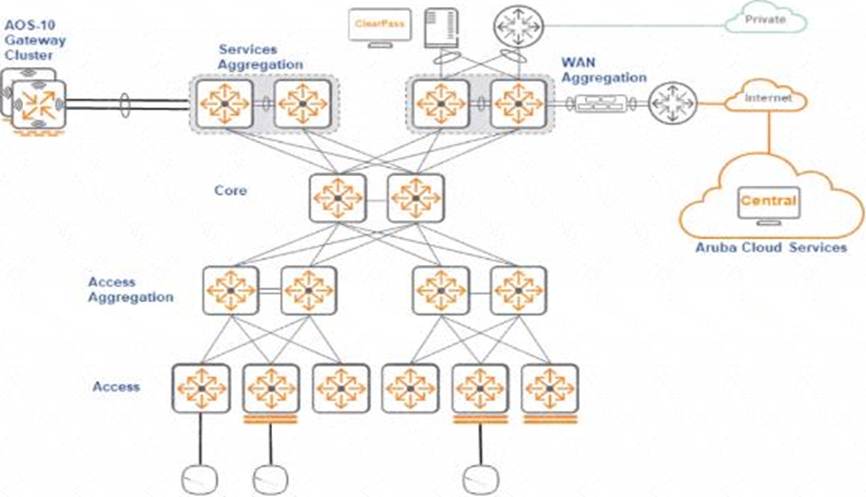
HOTSPOT
Based on this campus design, which layer is the most appropriate to be designed as a Border Persona, considering an EVPN VXLAN Fabric?
A global furniture retail company called ‘No-Stair Inc.’ requests you design their new WLAN infrastructure for a global footprint. Each location of No-Stair Inc.’ has a similar layout: three small manager offices, a warehouse, and a ‘retail’ area. The ‘retail’ area and the warehouse together amount to 95% of the location. The IT department of the company Is minimally engaged In their LAN refresh so the CTO of the company has shared the information below
Current WLAN Infrastructure Is based on the 802.1 In "WlF14Less" access-points series (both model 2013-INT (2.4 only Internal antenna) and model 2019-EXT (dual-band external antenna only)). These AP models are standalone without any centralized management. Last year ‘No-Stair InC ran a project called secure. It’ ensuring that all needed network security was Implemented to be fully compliant with their security standards. During this project, they also upgraded the AAA infrastructure to handle the Increased AAA requests. No additional Wi-Fi or security requirements are listed for this WLAN refresh, which means that ‘No-Stair Inc.’ will continue to use bridged SSIDs. with local breakout into different VLANs.
The CTO of No-Stair Inc.’ understands the need for you to ask additional questions to deliver the design The questions may be sent in written form and will be answered within two weeks.
Which additional question is correct in order to collect needed information for the WLAN design?
- A . Who is the campus switch vendor?
- B . Is there a current RF survey report that you can share?
- C . What type of fiber connection Is used between the core and access layer switches?
- D . IS there enough cooling In the MDF?
B
Explanation:
An RF (Radio Frequency) survey report is crucial for WLAN design as it provides detailed information about the current wireless environment, including signal strengths, interference sources, coverage gaps, and the effectiveness of the existing WLAN infrastructure. For a company like ‘No-Stair Inc.’ that is planning to refresh its WLAN across a global footprint, understanding the current RF conditions in each location is essential. This information helps in designing a WLAN infrastructure that can meet the specific needs of different areas within the locations, such as the retail area and warehouse, ensuring optimal coverage, performance, and user experience. An RF survey report would allow the designer to make informed decisions regarding the placement of new access points, the selection of appropriate antennas, and the configuration of WLAN parameters to improve coverage and capacity while minimizing interference.
A global cruise line company needs to refresh its current fleet. They win refresh the insides’ of the ship to be cost-effective and increase their sustain ability. They Mill replace the complete WLAN/LAN hardware of the ship. In this refresh, the company will not refresh Us current security requirements. The CIO also wants to limit the number of unused ports in the switches. Future expansion will always mean a refresh of hardware. They start with the smallest ship with a maximum of 800 guests
Each ship has a LAN infrastructure consisting of two core switches, up to 10 redundant distribution switches, and up to 500 access switches (400 cabins. 100 technical rooms). The Core switches are located in the MDF of the ship and the distribution switches are located in the IDFs of the ship. Each cabin and technical room gets one single access switch.
The cabling structure of the ship will not be refreshed. Each IDF is connected to the MDF by SMF. of which two pairs are available for the interconnect between the core and distribution. The length of SM fiber between MDF and IDF is less than 300 meters (930 ft) and the type used is 0S1. Each cabin is
connected by a single 0M2 pair to the IDF. the maximum length is 60 meters (200 ft). Each technical room is connected by a single 0M2 pail to the IDF. with lengths between 100 and 150 meters (320 and 500 ft).
For each cabin/technical room the customer is looking to replace their current fan-less 2530/2540 without changing the requirements, except they need to upgrade the uplink to distribution switch to 10GbEto handle the increased network traffic, and the technical rooms need redundant power.
The WLAN infrastructure will be 1:1 refreshed without new cabling or new AP locations. Their WLAN Infrastructure is based on the 200/300 series Indoor and outdoor APs running instantOS (less than 300 APs). the customer has no change in WLAN requirements.
The cruise line company will replace its current Internet connection before the LAN/WLAN refresh. The new Internet connection will provide a 99.8% uptime, which is needed to ensure the paid guest Wi-Fi is always operational. With this new internet connection, the CIO of the cruise line wants to base the design on the ESP architecture from Aruba because Internet connection is guaranteed.
Based on the best practices and customer requirements, what is the correct WUN approach?
- A . ArubaOS10 AP only deployment_____________
- B . Aruba OSS campus deployment
- C . Instant OS 6 deployment
- D . Aruba 0510 AP and gateway deployment
C
Explanation:
Given the customer’s specific requirements to refresh their WLAN infrastructure without changing the cabling or AP locations and their existing infrastructure based on the 200/300 series Indoor and outdoor APs running InstantOS, the most appropriate WLAN approach is an Instant OS 6 deployment. This choice aligns with the need to upgrade without significant changes to the existing WLAN setup. InstantOS is specifically designed for Aruba Instant APs, offering a streamlined, controller-less architecture that is ideal for the customer’s scenario, ensuring ease of deployment, management, and scalability. This approach supports the customer’s objectives for a cost-effective and sustainable refresh, providing robust and reliable wireless connectivity for guests while adhering to the current security requirements and infrastructure constraints.