
Practice Free HPE7-A03 Exam Online Questions
A large multinational financial institution has contracted you to design a new full-stack wired and wireless network for their new 6-story regional office building. The bottom two floors of this facility will be retail space for a large banking branch. The upper floors will be carpeted office space for corporate users, each floor being approximately 100.000 sq ft (9290 sqm). Data centers are all off site and will be out of scope for this project. The customer is underserved by its existing L2-based network infrastructure and would like to take advantage of modern best practices in the new design. The network should be fully resilient and fault-tolerant, with dynamic segmentation at the edge. The retail space will include public guest Wi-Fi access. Retail associates will have corporate tablets for customer service, and there will be a mix of wired and wireless devices throughout the retail floors. The corporate users will primarily use wireless for connectivity, but several wired clients, printers, and hard VoIP phones will be in use.
The customer is also planning on renovating the corporate office space in order to take advantage of "smart office’ technology. These improvements will drive blue-dot wayfinding. presence analytics, and other location-based services
The client is looking to utilize lower-cost Aruba OS-CX switches in their wiring closets. They calculate that each closet will need a stack or qty 6 POE (AT) and qty 0 Gigabit Ethernet switches stacked with low-cost OACs.
Which series switch should you recommend?
- A . Aruba CX 6100
- B . Aruba CX 6000
- C . ArubaCX6300F
- D . Aruba CX6200H
C
Explanation:
The Aruba CX 6300F series is a suitable recommendation for the described scenario due to its performance, PoE capabilities, and cost-effectiveness for wiring closet deployments. The CX 6300F series offers the flexibility and scalability needed for modern network environments, supporting both wired and wireless connectivity demands. It provides advanced features such as stackability, high-density PoE options, and the capability to support dynamic segmentation, which is essential for separating and securing different types of network traffic, such as corporate data and guest Wi-Fi access. This series is designed to meet the needs of a full-stack wired and wireless network in a large, multi-story office building, providing the necessary infrastructure for both current and future network requirements.
A large multinational financial institution has contracted you to design a new full-stack wired and wireless network for their new 6-story regional office building. The bottom two floors of this facility will be retail space for a large banking branch. The upper floors will be carpeted office space for corporate users, each floor being approximately 100.000 sq ft (9290 sqm). Data centers are all off site and will be out of scope for this project. The customer is underserved by its existing L2-based network infrastructure and would like to take advantage of modern best practices in the new design. The network should be fully resilient and fault-tolerant, with dynamic segmentation at the edge. The retail space will include public guest Wi-Fi access. Retail associates will have corporate tablets for customer service, and there will be a mix of wired and wireless devices throughout the retail floors. The corporate users will primarily use wireless for connectivity, but several wired clients, printers, and hard VoIP phones will be in use.
The customer is also planning on renovating the corporate office space in order to take advantage of "smart office’ technology. These improvements will drive blue-dot wayfinding. presence analytics, and other location-based services
The client would like to ensure full wireless coverage in its 40 m x 40 m i 130 ft x 130 ft) auditorium during company functions while maintaining the fewest APs for aesthetic purposes WI-FI6 APs are a minimum requirement.
Which AP series would you use In the auditorium’s 1.000 seats with a maximum take rate of 80%?
- A . AP577
- B . AP515
- C . AP635
- D . AP555
C
Explanation:
The Aruba AP-635 is a Wi-Fi 6 (802.11ax) access point, designed for high-density environments such as auditoriums. It is capable of providing high throughput and efficient airtime fairness to a large number of clients, which makes it suitable for an auditorium setting with 1,000 seats and a high take rate. The AP-635’s advanced capabilities, including OFDMA and MU-MIMO, allow it to handle multiple simultaneous connections efficiently, ensuring robust wireless coverage and performance during company functions, all while keeping the number of APs to a minimum to satisfy aesthetic concerns.
Which alternative source is best suited for site surveys or simul-ations if no floor plans are available?
- A . blank sheet of paper
- B . Google Maps
- C . simple wall drawings
- D . tire escape plan
D
Explanation:
When floor plans are not available for site surveys or simulations, the best alternative source to use is the fire escape plan (Option D). Fire escape plans are typically available in most buildings and provide a simplified layout of the premises, including walls, doors, and sometimes the location of permanent fixtures. While not as detailed as architectural floor plans, fire escape plans can offer enough information for initial site survey estimations and RF planning. They allow network designers to understand the basic layout and potential RF obstacles or coverage areas, making them a practical tool for preliminary wireless network planning and simulations in the absence of more detailed floor plans.
Which alternative source is best suited for site surveys or simul-ations if no floor plans are available?
- A . blank sheet of paper
- B . Google Maps
- C . simple wall drawings
- D . tire escape plan
D
Explanation:
When floor plans are not available for site surveys or simulations, the best alternative source to use is the fire escape plan (Option D). Fire escape plans are typically available in most buildings and provide a simplified layout of the premises, including walls, doors, and sometimes the location of permanent fixtures. While not as detailed as architectural floor plans, fire escape plans can offer enough information for initial site survey estimations and RF planning. They allow network designers to understand the basic layout and potential RF obstacles or coverage areas, making them a practical tool for preliminary wireless network planning and simulations in the absence of more detailed floor plans.
What is the simple difference between a main distribution framework (MOF) closet and an intermediate distribution framework (IDF) closet?
- A . MOF is the point where traffic egresses the campus network, and IDFs distribute that connectivity throughout the building.
- B . MDFs always have larger rooms than IDFs.
- C . MDFs only connect to other MDFs. and IDFs only connect to other IDFs.
- D . MDF Is a term used in Europe whereas the Americas refer to all network closets as IDFs in their documentation.
A
Explanation:
In network design, the Main Distribution Frame (MDF) and Intermediate Distribution Frame (IDF) are critical components of the network infrastructure. The MDF is the primary hub of the network, often where services from outside the campus or building enter and get distributed. It acts as a central point for network distribution. On the other hand, IDFs are secondary hubs situated throughout the building or campus, extending connectivity provided by the MDF to various endpoints or areas within the building. The simple difference between them lies in their roles within the network infrastructure: the MDF serves as the main point of network ingress and egress, while IDFs are used to further distribute the network to specific locations or floors within the building.
The clients existing network is experiencing trouble with voice occasionally dropping out on phone calls between office locations, it Is determined that no packet loss is occurring and QOS is likely the cause.
With what phenomenon Is the client currently experiencing issues?
A)

B)

C)

- A . Option A
- B . Option B
- C . Option C
B
Explanation:
The client is experiencing issues with Jitter, as depicted in Option B. Jitter refers to the variation in time between packets arriving, caused by network congestion, timing drift, or route changes. In voice communications, jitter can manifest as the occasional dropping out of voice on phone calls because the variable delay can affect the steady stream of voice packets needed for a clear conversation. Even when there is no packet loss, high levels of jitter can significantly impact the quality of Voice over IP (VoIP) calls. Quality of Service (QoS) settings are essential in managing jitter, as they can prioritize voice traffic over other types of data, ensuring that voice packets are delivered consistently and in the correct order to minimize delays and prevent call quality degradation. Aruba Campus Access solutions would typically include QoS features to manage and mitigate jitter on the network.
DRAG DROP
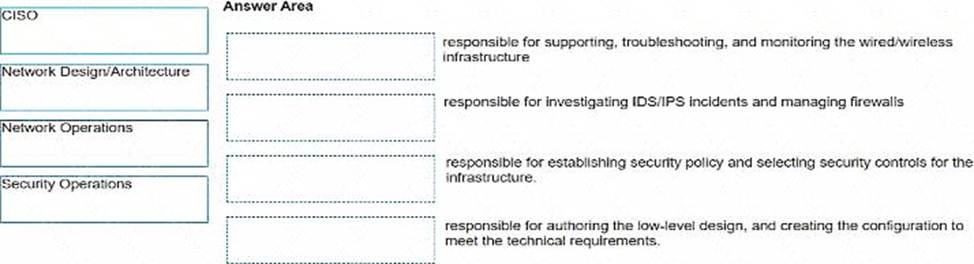
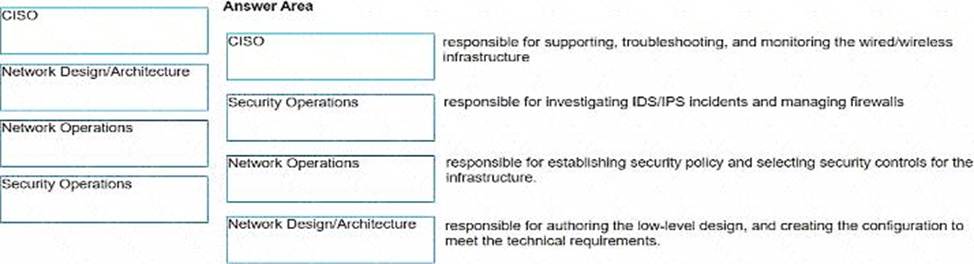
You hired a junior engineer to assist you with a large-scale network infrastructure project. The engineer has never worked on such a complex project ‘ants to better understand the role that each role that each stakeholder will play in the project.
March the stakeholder title to the responsibilities that would most likely apply to their role.
Explanation:
CISO: responsible for establishing security policy and selecting security controls for the infrastructure.
Network Design/Architecture: responsible for authoring the low-level design, and creating the configuration to meet the technical requirements.
Network Operations: responsible for supporting, troubleshooting, and monitoring the wired/wireless infrastructure.
Security Operations: responsible for investigating IDS/IPS incidents and managing firewalls.
A large multinational financial institution has contracted you to design a new full-stack wired and wireless network for their new 6-story regional office building. The bottom two floors of this facility will be retail space for a large banking branch. The upper floors will be carpeted office space for corporate users, each floor being approximately 100.000 sq ft (9290 sqm). Data centers are all off site and will be out of scope for this project. The customer is underserved by its existing L2-based network infrastructure and would like to take advantage of modern best practices in the new design. The network should be fully resilient and fault-tolerant, with dynamic segmentation at the edge. The retail space will include public guest Wi-Fi access. Retail associates will have corporate tablets for customer service, and there will be a mix of wired and wireless devices throughout the retail floors. The corporate users will primarily use wireless for connectivity, but several wired clients, printers, and hard VoIP phones will be in use.
The customer is also planning on renovating the corporate office space in order to take advantage of "smart office’ technology. These improvements will drive blue-dot wayfinding. presence analytics, and other location-based services
The client decides that they would like for all of their exposed printer, conference room, and VoIP phone
connections to be controlled by a stateful firewall
What could be planned to ensure that these ports will meet the customer’s requirements?
- A . Tunneled Node
- B . Multi-Zone
- C . Airgroup
- D . Web Portal
A
Explanation:
To control exposed printer, conference room, and VoIP phone connections with a stateful firewall, utilizing Tunneled Node functionality would be effective. Tunneled Node allows for the encapsulation of wired Ethernet traffic into a user-based tunnel, similar to how wireless traffic is handled. This means that traffic from these devices can be sent through a centralized controller where stateful firewall policies can be applied. This setup ensures that the specific ports used by these devices are subjected to the same level of security scrutiny and policy enforcement as wireless traffic, aligning with the client’s requirements for a secure and controlled network environment.
DRAG DROP
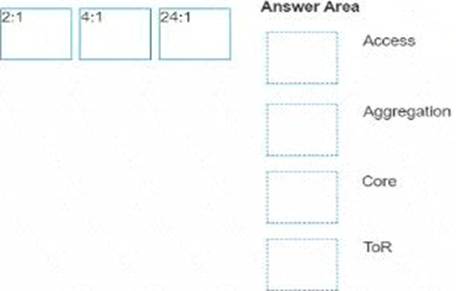
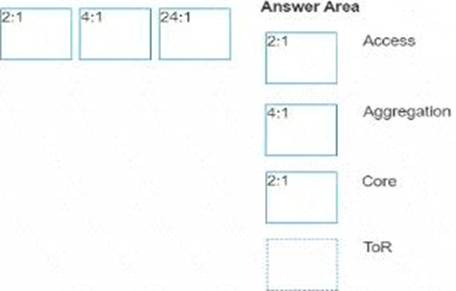
You are going with a 3-tier design and need to calculate the oversubscription ratio on the Access. Distribution. Core, and ToR Layer.
What is a suitable oversubscription ratio for each layer?
Explanation:
Access – 20:1
Aggregation – 4:1
Core – 2:1
ToR – Not typically applicable in a 3-tier design; however, if ToR were used, it could be 24:1 or better
depending on the specific design and requirements.
A large multinational financial institution has contracted you to design a new full-stack wired and wireless network for their new 6-story regional office building. The bottom two floors of this facility will be retail space for a large banking branch. The upper floors will be carpeted office space for corporate users, each floor being approximately 100.000 sq ft (9290 sqm). Data centers are all off site and will be out of scope for this project. The customer is underserved by its existing L2-based network infrastructure and would like to take advantage of modern best practices in the new design. The network should be fully resilient and fault-tolerant, with dynamic segmentation at the edge. The retail space will include public guest Wi-Fi access. Retail associates will have corporate tablets for customer service, and there will be a mix of wired and wireless devices throughout the retail floors. The corporate users will primarily use wireless for connectivity, but several wired clients, printers, and hard VoIP phones will be in use.
The customer is also planning on renovating the corporate office space in order to take advantage of "smart office’ technology. These improvements will drive blue-dot wayfinding. presence analytics, and other location-based services
The client decided that they would like to manage two wiring closets as a single stack with a total of 10 switches and a minimum transport speed or 25Gbps over OM4 MM fiber They would also like to keep the stacking cabling cost to a minimum.
Which stacking components would be required to meet the customer’s requirements in the most cost-effective way if the closets were 190 m (620 ft) apart? (Select two.)
- A . 50GDAC cables
- B . SFP56 transceivers
- C . 25GDAC cables
- D . SFP28 transceivers
BD
Explanation:
To meet the customer’s requirement of managing two wiring closets as a single stack with a minimum transport speed of 25Gbps over OM4 MM fiber, especially when the closets are 190m apart, the most cost-effective solution would involve using SFP transceivers. SFP28 transceivers can support speeds up to 25Gbps, aligning with the customer’s minimum speed requirement. For higher speeds or future-proofing, SFP56 transceivers, which can support speeds up to 50Gbps, could also be considered. Both types are compatible with OM4 multimode fiber, which is capable of supporting these high speeds over the distance specified. DAC (Direct Attach Cable) solutions like options A and C would not be feasible due to the 190m distance between the closets, as DAC cables are typically used for much shorter distances.