
Practice Free DP-420 Exam Online Questions
HOTSPOT
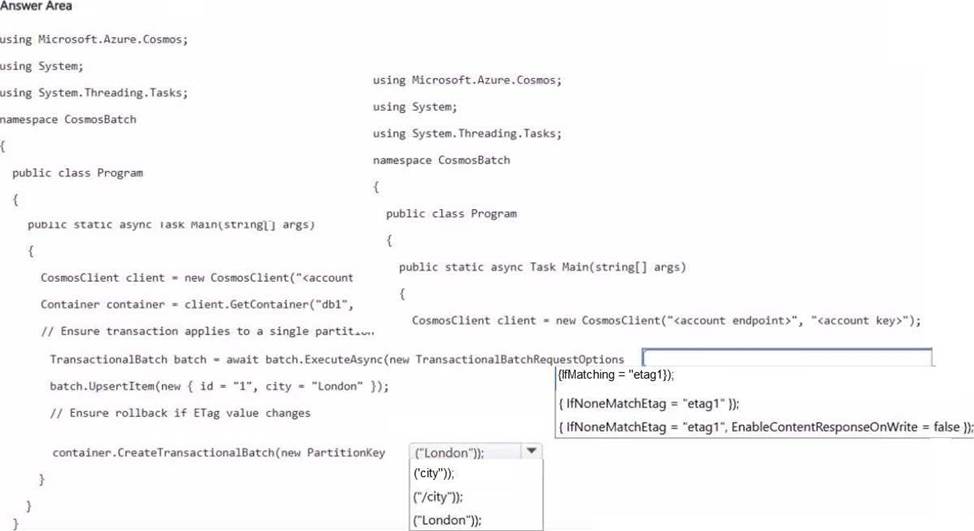
You have an Azure Cosmos DB for NoSQL database named DB1 that hosts a container named Contained. The partition key for Container! is /city.
You are developing a cloud-native app named App1 that will store customer information in DB1.
App1 will perform transactional batch operations to update the items in Contained.
You need to configure App1 to meet the following requirements:
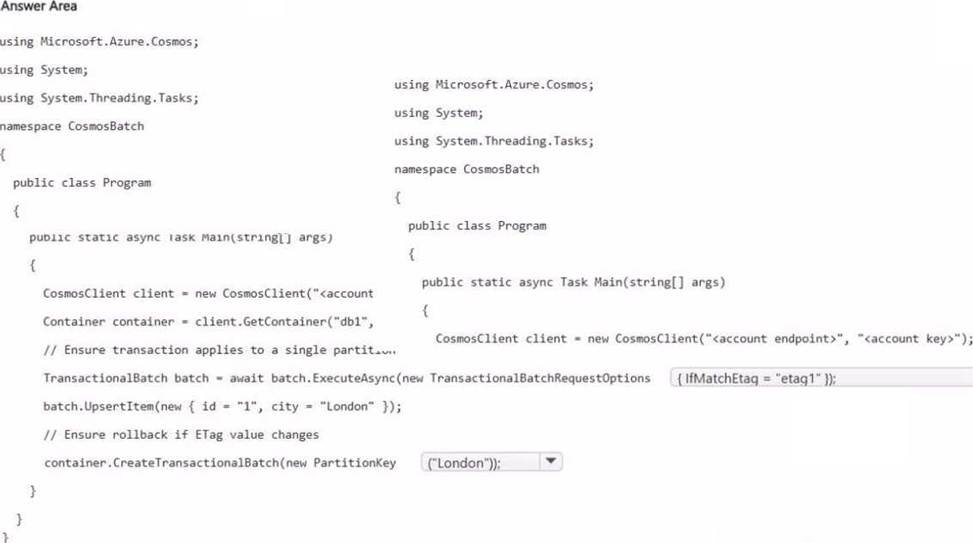
• Ensure that batch operations are rolled back if an item’s ETag value has changed since the value was last read.
• Ensure that all operations in the batch apply to a single partition key value.
How should you complete the C# code? To answer, select the appropriate options in the answer area. NOTE: Each correct selection is worth one point.
You have a database named db1 in an Azure Cosmos DB f You have a third-party application that is exposed thro You need to migrate data from the application to a.
What should you use?
- A . Database Migration Assistant
- B . Azure Data Factory
- C . Azure Migrate
You plan to implement an Azure Cosmos DB container that will store telemetry data from 1,000 loT devices. The data will be updated once every minute. An app will read the data once daily and generate aggregated reports that summarize the state of each device.
You need to configure a partition key for the container.
The solution must meet the following requirements:
• Minimize the possibility of reaching the partition limits.
• Spread read and write operations evenly across the partitions.
• Minimize how long it takes to locate a specific set of telemetry values.
To what should you set the partition key?
- A . the date and a random value
- B . the device ID and date
- C . the device ID
- D . the date
HOTSPOT
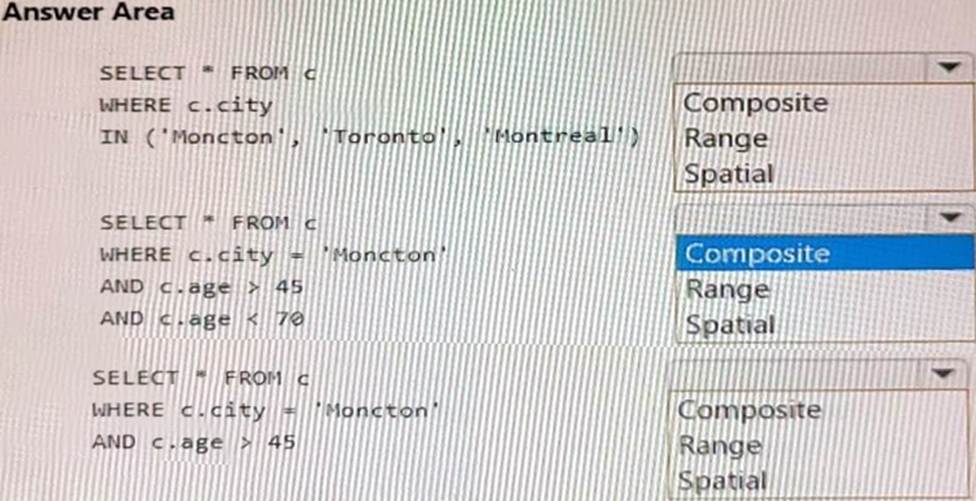
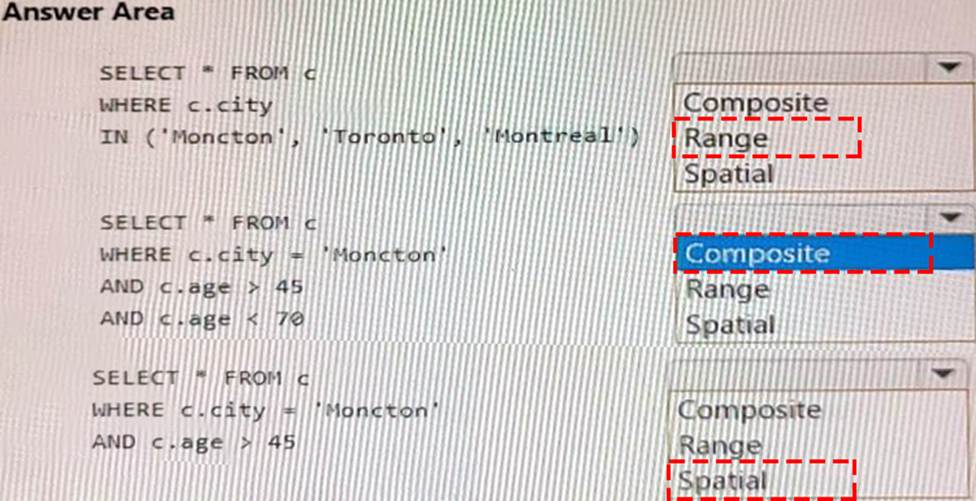
You have an Azure Cosmos DB for NoSQL account that frequently receives the same three queries.
You need to configure indexing to minimize RUs consumed by the queries.
Which type of index should you use for each query? To answer, select the appropriate options in the answer area. NOTE: Each correct selection is worth one point.
You have a container in an Azure Cosmos DB Core (SQL) API account. The container stores telemetry data from IoT devices. The container uses telemetryId as the partition key and has a throughput of 1,000 request units per second (RU/s). Approximately 5,000 IoT devices submit data every five minutes by using the same telemetryId value.
You have an application that performs analytics on the data and frequently reads telemetry data for a single IoT device to perform trend analysis.
The following is a sample of a document in the container.
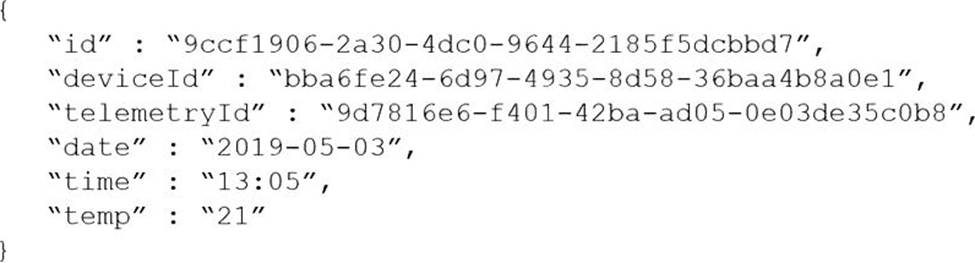
You need to reduce the amount of request units (RUs) consumed by the analytics application.
What should you do?
- A . Decrease the offer Throughput value for the container.
- B . Increase the offer Throughput value for the container.
- C . Move the data to a new container that has a partition key of deviceId.
- D . Move the data to a new container that uses a partition key of date.
You have an Azure Cosmos DB Core (SQL) API account.
You run the following query against a container in the account.
SELECT
IS_NUMBER("1234") AS A,
IS_NUMBER(1234) AS B,
IS_NUMBER({prop: 1234}) AS C
What is the output of the query?
- A . [{"A": false, "B": true, "C": false}]
- B . [{"A": true, "B": false, "C": true}]
- C . [{"A": true, "B": true, "C": false}]
- D . [{"A": true, "B": true, "C": true}]
You are building an application that will store data in an Azure Cosmos DB for NoSQL account. The account uses the session default consistency level. The account is used by five other applications. The account has a single read-write region and 10 additional read regions. Approximately 20 percent of the items stored in the account are updated hourly.
Several users will access the new application from multiple devices.
You need to ensure that the users see the same item values consistently when they browse from the different devices. The solution must not affect the other applications.
Which two actions should you perform? Each correct answer presents part of the solution. NOTE: Each correct selection is worth one point.
- A . Use implicit session management when performing read requests.
- B . Provide a stored session token when performing read requests.
- C . Associate a session token to the user account.
- D . Set the default consistency level to eventual.
- E . Associate a session token to the device.
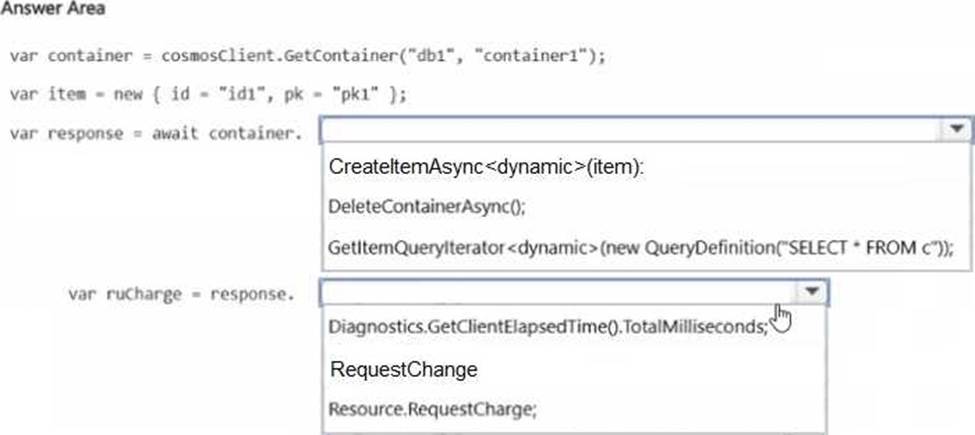
HOTSPOT
You have an Azure Cosmos DB for NoSQL database named DB1 that hosts a container named Container1. The partition key for Container 1 is /pki.
You have a .NET app that connects to DBi.
You need to retrieve the request unit (RU) cost of a point operation and store the value as a variable.
How should you complete the C# code? To answer, select the appropriate options in the answer area. NOTE: Each correct selection is worth one point.

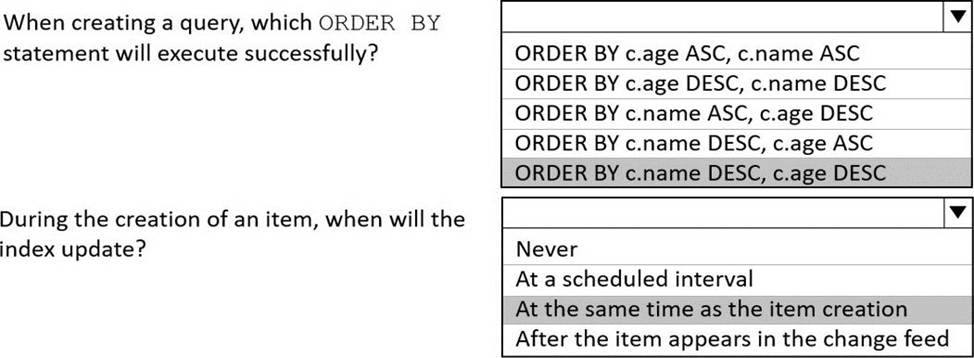
HOTSPOT
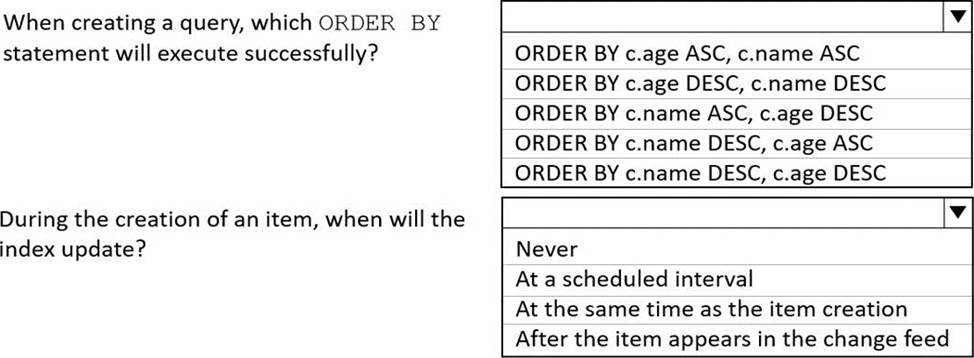
You have the indexing policy shown in the following exhibit.
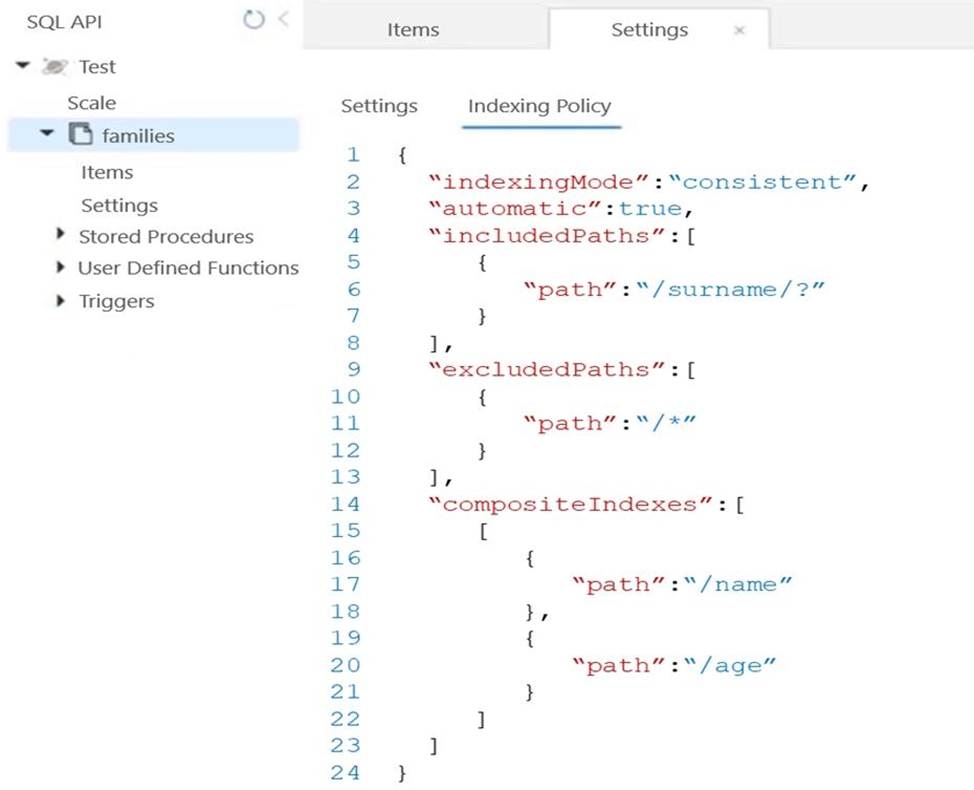
Use the drop-down menus to select the answer choice that answers each question based on the information presented in the graphic. NOTE: Each correct selection is worth one point.
You have an Azure Cosmos DB for NoSQL account named account1 that has a single read-write region and one additional read region. Account1 uses the strong default consistency level.
You have an application that uses the eventual consistency level when submitting requests to account1.
How will writes from the application be handled?
- A . Writes will use the strong consistency level.
- B . Azure Cosmos DB will reject writes from the application.
- C . The write order is not guaranteed during replication.
- D . Writes will use the eventual consistency level.