
Practice Free D-PVM-DS-01 Exam Online Questions
At a disaster planning meeting, an architect is presented with the following facts by a client:
A Unix host is replicating storage from a Production PowerMax to a VMAX 250FX.
RDF pairs have been split with Production and DR hosts accessing their respective storage.
Invalid tracks have started to build against PowerMax and VMAX 250FX.
The client now wants to bring production back to PowerMax, discarding the VMAX 250FX updates while keeping the updates on the PowerMax.
What is the correct action to take?
- A . Establish
- B . Failover
- C . Resume
- D . Failback
An architect is helping a customer set up asynchronous replication for a new PowerMax array. The customer is looking to change the maximum SRDF/A cache usage and CPU allocation for different copy tasks.
Which Settings view in the Unisphere for PowerMax user interface should be used to make these changes?
- A . Performance > System Registrations
- B . Data Protection > SRDF Groups
- C . Management > Symmetrix Attributes
- D . Preferences > General
An architect is in a meeting with a customer to discuss storage provisioning on PowerMax arrays.
What is a consideration for Autoprovisioning Groups on PowerMax arrays?
- A . A port may only belong to one Port Group
- B . A Storage Group may contain other Storage Groups and devices
- C . An initiator may only belong to one Initiator Group
- D . A device cannot belong to more than one Storage Group
An architect is in a meeting with a customer to discuss storage provisioning on PowerMax arrays.
What is a consideration for Autoprovisioning Groups on PowerMax arrays?
- A . A port may only belong to one Port Group
- B . A Storage Group may contain other Storage Groups and devices
- C . An initiator may only belong to one Initiator Group
- D . A device cannot belong to more than one Storage Group
What action is required on a PowerMax thin device before it can be deleted?
- A . Unmap from front-end ports
- B . Remove from Storage Group
- C . Set to Write Disable
- D . Set to Not Ready
What action is required on a PowerMax thin device before it can be deleted?
- A . Unmap from front-end ports
- B . Remove from Storage Group
- C . Set to Write Disable
- D . Set to Not Ready
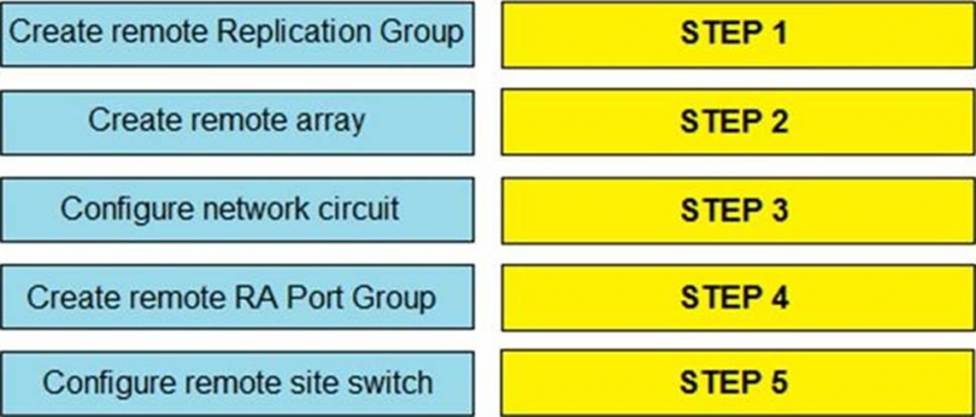
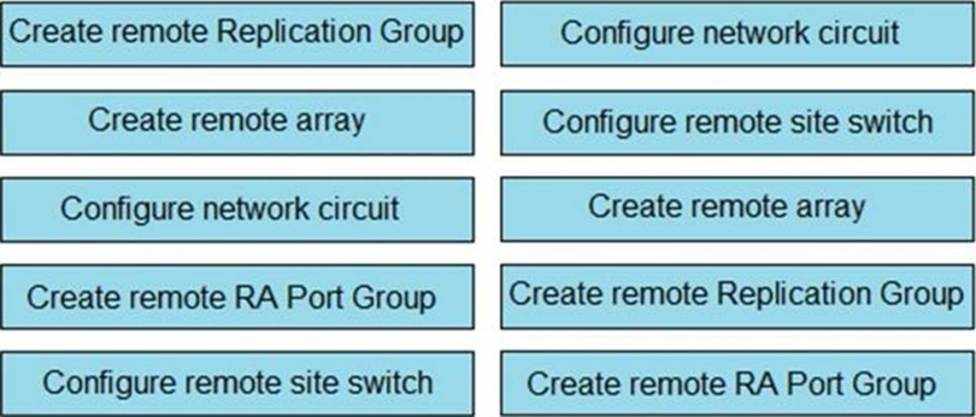
An architect is configuring BCSD to design SRDF/S between two new PowerMax arrays. The architect has completed the tasks for the local side of the solution, including RA Port Group, Replication Group, and site switch.
What is the correct order of steps the architect needs to take to complete the SRDF setup?
After an SRDF failover operation, production work has been moved to the remote site. A large number of invalid tracks has accumulated. The tracks need to be synchronized back to the R1 volumes.
Which SRDF operation can reduce the re-synchronization time while continuing production work on the remote site?
- A . Restore
- B . Update
- C . Establish
- D . Failback
A storage administrator adds data to the VM on a remote ESXi server to resume the production work from an R2 device.
What action needs to be taken before performing an SRDF failback and resuming production work from the R1 device?
- A . Restart the VM on the remote ESXi server
- B . Set the R1 device to Write Enabled on the failback
- C . Shut down the VM on the remote ESXi server
- D . Set the R2 device to Write Disabled on the failback
Which PowerMax initially ordered configuration provides the fewest available slots for front-end I/O modules per engine?
- A . PowerMax 2000 dual-engine
- B . PowerMax 8000 multi-engine
- C . PowerMax 2000 single-engine
- D . PowerMax 8000 single-engine