
Practice Free D-CI-DS-23 Exam Online Questions
Why would an organization want to incorporate SOA in their DIY PaaS?
- A . Containers are used in place of role based access control for developers.
- B . Applications using modular functions have a flexible and scalable architecture.
- C . Standard interfaces are used between applications and their supporting platforms.
- D . Open Source APIs help users select and switch vendors based on value provided.
Which cloud service model provides a fully managed environment for deploying and scaling applications without needing to manage the underlying infrastructure?
- A . Infrastructure as a Service (IaaS)
- B . Platform as a Service (PaaS)
- C . Software as a Service (SaaS)
- D . Function as a Service (FaaS)
What are examples of hybrid cloud requirements?
- A . Connectivity, service mobility, hardware compatibility, and monitoring
- B . Security, connectivity, service mobility, and hardware compatibility
- C . Service mobility, hardware compatibility, monitoring, and security
- D . Monitoring, security, connectivity, and service mobility
Refer to the exhibit.
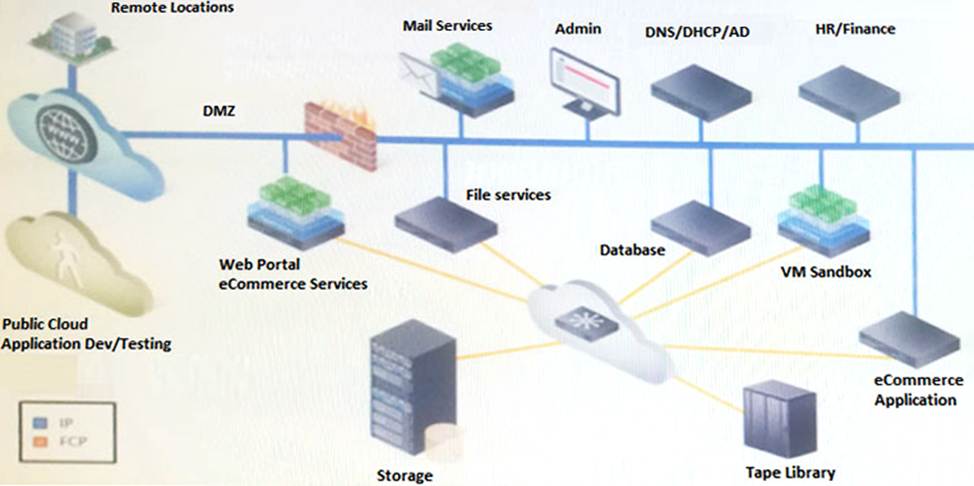
Your company recently negotiated several contracts with new customers to use its proprietary eCommerce system. As a result, the customer base has grown rapidly, which has introduced several challenges and requirements.
Business requirements:
– Applications need to scale quickly.
– Metrics and reporting to anticipate business trends and efficient use of resources.
– External customers are looking to license the eCommerce application.
Other considerations:
– Applications need to be recorded for the public cloud.
– Address security vulnerabilities for customer data in the cloud.
Refer to Case 1.
You are sizing the compute capacity of blade servers in a converged infrastructure solution with the following specifications:
– Number of cores: 16
– Processor speed: 3.5 GHz
– Utilization percentage: 75%
What is the total GHz processing capability of one blade server?
- A . 18,6
- B . 20,2
- C . 42,0
- D . 56,7
Refer to the exhibit.
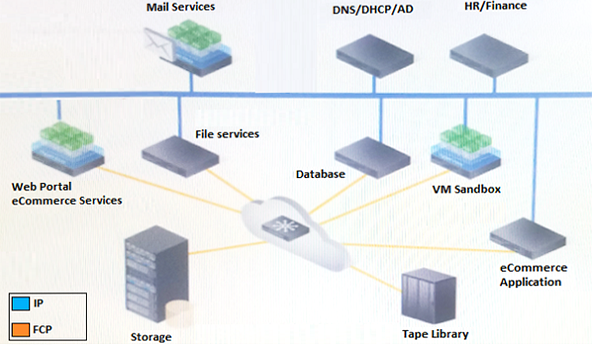
Your company is currently using a traditional SAN storage network. The server infrastructure is partially virtualized. There is a public cloud in place that is used to test development and application migration to cloud.
Business requirements:
– Consolidate the network, storage, and compute resources
– Simplify network management and storage provisioning
– Maintain application performance
– Need to share resources to reduce cost and improve efficiency
Other considerations:
– Monitoring of protection SLAs
– All transactions must be logged for auditing review
– Users are validated using internal credentials
Refer to Case 4.
You are designing a transformation from Platform 2.0 to cloud. You review the existing infrastructure and business requirements. You must detect events that can exploit vulnerabilities in the cloud.
Which technology should you select?
- A . ISO
- B . PCI DSS
- C . Firewall
- D . IDPS
A cloud architect is designing a private cloud for an organization. The organization has no existing backup infrastructure. They want to offer consumers the ability to back up VM instances using image-based backups.
What is a consideration when selecting a backup application for this environment?
- A . Backup application enables consumers to restore the VMs to any point in time
- B . Hypervisor servers’ hardware is on the backup application vendor’s compatibility list
- C . Cloud gateway is used by the backup application to access the cloud based VMs
- D . Backup application can be integrated with the selected CMP components
Which type of storage is typically designed to span multiple sets of hardware and has a flat repository?
- A . Object
- B . File
- C . Ephemeral
- D . Block
An organization wants to deploy SaaS applications in their cloud. The SaaS applications will be using application HA to maintain up-time levels of 99.9%. If an instance of the application fails, a new instance will be deployed to replace it.
What should the cloud architect include in the design to support this up-time requirement?
- A . Additional hot stand-by hosts
- B . Sufficient host capacity and orchestration
- C . HA and replication licenses for hypervisors
- D . Quorum disks
Which design consideration applies to object storage?
- A . Multi-tenancy is supported through file and directory permissions
- B . It is best suited for high performance and low latency applications
- C . A RAID controller on the host computer handles redundancy
- D . A common authentication mechanism is accessible by all tenants
What is the primary purpose of data collection and analysis in cloud design?
- A . To increase operational costs
- B . To reduce performance monitoring
- C . To make informed decisions
- D . To eliminate data storage