
Practice Free D-CI-DS-23 Exam Online Questions
What should be used when sizing memory for nodes of a HCI deployment?
- A . Host memory consumption
- B . VM memory consumption
- C . vCPU consumption
- D . Total core count
A company has the following requirements:
– Modular building blocks
– Scalability
– In-house management solution
– No physical SAN
What type of infrastructure would meet these requirements?
- A . Cloud-in-a-Box
- B . Converged
- C . Traditional
- D . Hyper-Converged
A company has the following requirements:
– Modular building blocks
– Scalability
– In-house management solution
– No physical SAN
What type of infrastructure would meet these requirements?
- A . Cloud-in-a-Box
- B . Converged
- C . Traditional
- D . Hyper-Converged
You are a cloud architect responsible for designing a multiple availability zone configuration for the organization’s geographically dispersed clouds. You must provide the ability for services to survive a failure at the data center or site level.
The primary requirement is to provide for automated site recovery.
What is a key consideration for automating the setup, failover, and recovery of services at the remote site?
- A . When implementing automated site recovery, you must have automated orchestration of site failback processes
- B . The number of storage volumes in the DR site must be identical in number and size to the primary site
- C . The recovery site must have sufficient available capacity to host workloads after a disaster at the primary site
- D . The DR site must contain the same vendor hardware as the primary site
To which infrastructure resources and cloud services are a consumer-accessible SDN solution likely to need controlled access?
- A . Hypervisors, SDN service API, and CMDB
- B . SDN service API, CMDB, and physical and virtual switches
- C . Physical and virtual switches, hypervisors, and SDN service API
- D . CMDB, physical and virtual switches, and hypervisors
You have the following requirements for a CMP solution:
– Lower acquisition costs of software
– Control over deployment of software release cycles
– Option to have paid support
What type of CMP solution should you recommend?
- A . Proprietary
- B . Software defined
- C . Open-source
- D . Vendor supported open-source
Which properties define a cloud environment?
- A . Power, connectivity, physical security
- B . Self-service, dedicated leased services in-house
- C . Dedicated, but privatized, virtualized data center technologies in-house
- D . Self-service, Internet server computing, shared resources, pay as you use
Which cloud services are typically responsible for automatically scaling applications?
- A . Orchestration and monitoring
- B . Metering and service catalog
- C . Monitoring and metering
- D . Service catalog and orchestration
Refer to the exhibit.
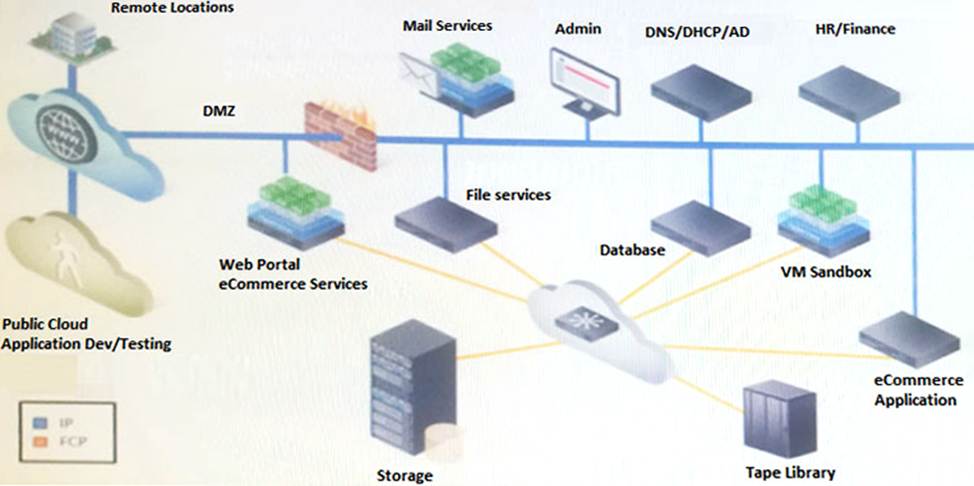
Your company recently negotiated several contracts with new customers to use its proprietary eCommerce system. As a result, the customer base has grown rapidly, which has introduced several challenges and requirements.
Business requirements:
– Applications need to scale quickly
– Metrics and reporting to anticipate business trends and efficient use of resources
– External customers are looking to license the eCommerce application
Other considerations:
– Applications need to be recorded for the public cloud
– Address security vulnerabilities for customer data in the cloud
Refer to Case 1.
You are designing a transformation from Platform 2.0 to cloud. You review the existing infrastructure and business requirements. You must define the method to connect the onpremises network directly to the public cloud provider.
Which technology should you select?
- A . KMS
- B . IDPS
- C . MPLS
- D . IPSec VPN
Why is it important for a cloud architect to use minimal up-front sizing when planning capacity for nodes in a HCI deployment?
- A . Accommodate the workload of a node that has failed or is under maintenance
- B . Minimal up-front sizing is correlated to lower licensing costs of the HCI deployment
- C . Reduce CAPEX costs of the HCI deployment by sizing for only the capacity required
- D . Optimize storage resources by designing only for what is required to run mission critical workloads