
Practice Free CTFL_SYLL_4.0 Exam Online Questions
Question #61
The following decision table is used to assist a doctor in determining the drug therapy to prescribe for a patient (aged 6 to 65 years) diagnosed with acute sinusitis.
The table consists of three Boolean conditions and six actions:
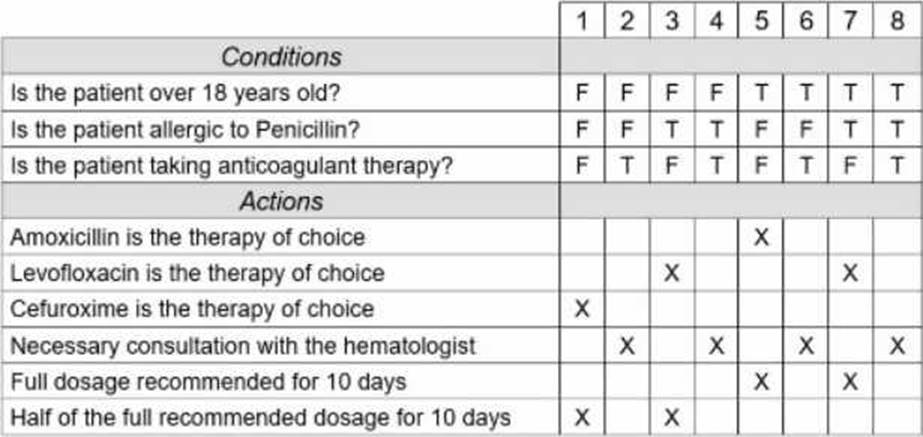
Based only on the given information, which of the following statements is true?
- A . Column 7 represents an impossible situation and thus can be deleted
- B . Columns 1 and 3 can be merged into a single column
- C . Columns 2, 4. 6 and 8 can be merged into a single column
- D . Columns 5 and 7 can be merged into a single column
Correct Answer: A
A
Explanation:
In the given decision table, Column 7 represents the following conditions and actions:
The patient is over 18 years old: True
The patient is allergic to Penicillin: True
The patient is taking anticoagulant therapy: True
When analyzing this column:
If the patient is over 18 years old, allergic to Penicillin, and taking anticoagulant therapy, the decision table suggests consultation with a hematologist and prescribing half of the full recommended dosage for 10 days.
This column does not represent an impossible situation based on the conditions provided. However, upon deeper inspection and understanding of medical practices, it can be argued that such a specific combination of conditions could be highly unlikely, making it appear unnecessary or an edge case that might be considered for deletion.
Given the constraints of the conditions and the requirements of the decision table, the provided answer needs to be verified against real-world medical guidelines to confirm if this scenario is indeed impossible or just
A
Explanation:
In the given decision table, Column 7 represents the following conditions and actions:
The patient is over 18 years old: True
The patient is allergic to Penicillin: True
The patient is taking anticoagulant therapy: True
When analyzing this column:
If the patient is over 18 years old, allergic to Penicillin, and taking anticoagulant therapy, the decision table suggests consultation with a hematologist and prescribing half of the full recommended dosage for 10 days.
This column does not represent an impossible situation based on the conditions provided. However, upon deeper inspection and understanding of medical practices, it can be argued that such a specific combination of conditions could be highly unlikely, making it appear unnecessary or an edge case that might be considered for deletion.
Given the constraints of the conditions and the requirements of the decision table, the provided answer needs to be verified against real-world medical guidelines to confirm if this scenario is indeed impossible or just
Question #62
Who of the following has the best knowledge to decide what tests in a test project should be automated?
- A . The developer
- B . The customer
- C . The development manager
- D . The test leader
Correct Answer: D
D
Explanation:
The test leader is the person who is responsible for planning, monitoring, and controlling the test activities and resources in a test project. The test leader should have the best knowledge of the test objectives, scope, risks, resources, schedule, and quality criteria. The test leader should also be aware of the test automation criteria, such as the execution frequency, the test support, the team education, the roles and responsibilities, and the devs and testers collaboration1. Based on these factors, the test leader can decide which tests are suitable for automation and which are not, and prioritize them accordingly. The test leader can also coordinate with the test automation engineers, the developers, and the stakeholders to ensure the alignment of the test automation strategy with the test project goals and expectations. Reference = ISTQB Certified Tester Foundation Level (CTFL) v4.0 Syllabus, Chapter 2, Section 2.3.1, Page 152; ISTQB Glossary of Testing Terms v4.0, Page 403; ISTQB Certified Tester Foundation Level (CTFL) v4.0 Syllabus, Chapter 6, Section 6.1.1, Page 514; Top 8 Test Automation Criteria You Need To Fulfill – QAMIND1
D
Explanation:
The test leader is the person who is responsible for planning, monitoring, and controlling the test activities and resources in a test project. The test leader should have the best knowledge of the test objectives, scope, risks, resources, schedule, and quality criteria. The test leader should also be aware of the test automation criteria, such as the execution frequency, the test support, the team education, the roles and responsibilities, and the devs and testers collaboration1. Based on these factors, the test leader can decide which tests are suitable for automation and which are not, and prioritize them accordingly. The test leader can also coordinate with the test automation engineers, the developers, and the stakeholders to ensure the alignment of the test automation strategy with the test project goals and expectations. Reference = ISTQB Certified Tester Foundation Level (CTFL) v4.0 Syllabus, Chapter 2, Section 2.3.1, Page 152; ISTQB Glossary of Testing Terms v4.0, Page 403; ISTQB Certified Tester Foundation Level (CTFL) v4.0 Syllabus, Chapter 6, Section 6.1.1, Page 514; Top 8 Test Automation Criteria You Need To Fulfill – QAMIND1
Question #62
Who of the following has the best knowledge to decide what tests in a test project should be automated?
- A . The developer
- B . The customer
- C . The development manager
- D . The test leader
Correct Answer: D
D
Explanation:
The test leader is the person who is responsible for planning, monitoring, and controlling the test activities and resources in a test project. The test leader should have the best knowledge of the test objectives, scope, risks, resources, schedule, and quality criteria. The test leader should also be aware of the test automation criteria, such as the execution frequency, the test support, the team education, the roles and responsibilities, and the devs and testers collaboration1. Based on these factors, the test leader can decide which tests are suitable for automation and which are not, and prioritize them accordingly. The test leader can also coordinate with the test automation engineers, the developers, and the stakeholders to ensure the alignment of the test automation strategy with the test project goals and expectations. Reference = ISTQB Certified Tester Foundation Level (CTFL) v4.0 Syllabus, Chapter 2, Section 2.3.1, Page 152; ISTQB Glossary of Testing Terms v4.0, Page 403; ISTQB Certified Tester Foundation Level (CTFL) v4.0 Syllabus, Chapter 6, Section 6.1.1, Page 514; Top 8 Test Automation Criteria You Need To Fulfill – QAMIND1
D
Explanation:
The test leader is the person who is responsible for planning, monitoring, and controlling the test activities and resources in a test project. The test leader should have the best knowledge of the test objectives, scope, risks, resources, schedule, and quality criteria. The test leader should also be aware of the test automation criteria, such as the execution frequency, the test support, the team education, the roles and responsibilities, and the devs and testers collaboration1. Based on these factors, the test leader can decide which tests are suitable for automation and which are not, and prioritize them accordingly. The test leader can also coordinate with the test automation engineers, the developers, and the stakeholders to ensure the alignment of the test automation strategy with the test project goals and expectations. Reference = ISTQB Certified Tester Foundation Level (CTFL) v4.0 Syllabus, Chapter 2, Section 2.3.1, Page 152; ISTQB Glossary of Testing Terms v4.0, Page 403; ISTQB Certified Tester Foundation Level (CTFL) v4.0 Syllabus, Chapter 6, Section 6.1.1, Page 514; Top 8 Test Automation Criteria You Need To Fulfill – QAMIND1
Question #64
The following 4 equivalence classes are given:
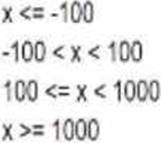
Which of the following alternatives includes correct test values for x. based on equivalence partitioning?
- A . -100; 100:1000; 1001
- B . -500; 0; 100; 1000
- C . -99; 99:101; 1001
- D . -1000; -100; 100; 1000
Correct Answer: D
D
Explanation:
The question is about selecting the correct test values for x based on equivalence partitioning. Equivalence partitioning is a software test design technique that divides the input data of a software unit into partitions of equivalent data from which test cases can be derived.
In this case, the given equivalence classes are:
(x leq -100)
(-100 < x < 100)
(100 leq x < 1000)
(x geq 1000)
Option D provides a value from each of these partitions:
For (x leq -100), it gives -1000.
For (-100 < x < 100), it gives -100 and 100.
For (100 leq x < 1000), it gives 500.
For (x geq 1000), it gives 1500.
So, option D covers all four given equivalence classes with appropriate values.
Reference: ISTQB Certified Tester Foundation Level (CTFL) v4.0 documents available at ISTQB and ASTQB.
1: ISTQB Foundation Level Syllabus 2018, Version 4.0, p. 38
2: ISTQB Foundation Level Syllabus 2018, Version 4.0, p. 39
: ISTQB Foundation Level Syllabus 2018, Version 4.0, p. 40
D
Explanation:
The question is about selecting the correct test values for x based on equivalence partitioning. Equivalence partitioning is a software test design technique that divides the input data of a software unit into partitions of equivalent data from which test cases can be derived.
In this case, the given equivalence classes are:
(x leq -100)
(-100 < x < 100)
(100 leq x < 1000)
(x geq 1000)
Option D provides a value from each of these partitions:
For (x leq -100), it gives -1000.
For (-100 < x < 100), it gives -100 and 100.
For (100 leq x < 1000), it gives 500.
For (x geq 1000), it gives 1500.
So, option D covers all four given equivalence classes with appropriate values.
Reference: ISTQB Certified Tester Foundation Level (CTFL) v4.0 documents available at ISTQB and ASTQB.
1: ISTQB Foundation Level Syllabus 2018, Version 4.0, p. 38
2: ISTQB Foundation Level Syllabus 2018, Version 4.0, p. 39
: ISTQB Foundation Level Syllabus 2018, Version 4.0, p. 40