
Practice Free CCA-F Exam Online Questions
In a financial application, identity verification must be completed before processing transactions.
What is the most architecturally sound method to enforce this prerequisite workflow?
- A . Provide negative few-shot examples in the system prompt demonstrating the agent refusing to process unverified transactions.
- B . Implement programmatic prerequisites that block downstream tool calls (e.g., process_transaction) until the identity verification step has successfully completed.
- C . Write a capitalized warning in the prompt: ‘NEVER process a transaction before verifying identity’.
- D . Set tool_choice:"any" so the agent can evaluate the financial risk dynamically before acting.
In an extended exploration session, which built-in Claude Code command is explicitly used to reduce context usage when the window fills with verbose discovery output?
- A . /clear
- B . /compact
- C . – – resume
- D . /init
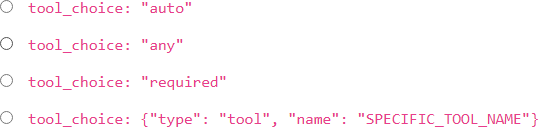
You are building a pipeline that must execute a specific data extraction tool on every document processed.
Which configuration ensures the model will invoke this specific tool rather than returning conversational text?
- A . Option A
- B . Option B
- C . Option C
- D . Option D
During the final synthesis phase, the system receives conflicting statistical data from two different subagents: one derived from a verified financial database, and another extracted from an outdated PDF.
How should the synthesis agent handle this conflict?
- A . Arbitrarily select the value from the financial database since structured databases are inherently more accurate.
- B . Average the two conflicting values together to provide a balanced estimate in the final report.
- C . Track information provenance by preserving both values, their sources, confidence levels, and timestamps, allowing informed resolution.
- D . Halt the synthesis process and prompt the user to manually select the correct statistical value.
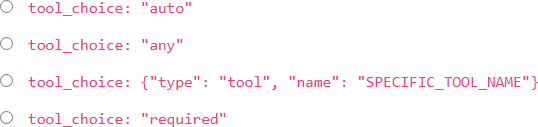
To ensure an agent strictly outputs a specific JSON structure without generating conversational text, and guarantees that a specific tool is invoked, which tool_choice configuration is required?
- A . Option A
- B . Option B
- C . Option C
- D . Option D
When implementing the control flow for an agentic loop, which of the following approaches represent tested anti-patterns that must be avoided? Choose 2 correct answers.
- A . Parsing the assistant’s natural language text output to determine loop termination.
- B . Setting arbitrary iteration caps as the primary stopping mechanism.
- C . Adding tool results to the conversation context between iterations so the model can incorporate new information.
- D . Inspecting the stop _ reason field of the API response to govern execution continuity.
When designing JSON schemas and interfaces for an agent’s tools, which of the following practices represent recommended tool design principles? Choose 2 correct answers.
- A . Keeping tool descriptions under 10 words to minimize context window token consumption.
- B . Expanding tool descriptions to explicitly document what happens with empty inputs or invalid boundary data.
- C . Splitting a generic document analysis tool into distinct, purpose-built extract_data and verify _ claim tools.
- D . Combining all related backend API endpoints into a single monolithic tool to simplify the allowedTools array.
An automated pipeline is using a PreToolUse hook to block unauthorized file reads by evaluating the requested file path.
How does the hook command properly communicate to Claude *why* the action was blocked so the agent can adjust its behavior?
- A . By returning an exit code of 2 and writing the explanation to standard error, which is fed back to Claude as feedback.
- B . By silently terminating the session and initiating a new one with an updated system prompt.
- C . By overriding the context window entirely with a generic access denied template.
- D . By returning an empty JSON array [] on standard output.
In a multi-agent system, a subagent times out querying a database.
How should this error be propagated back to the coordinator agent?
- A . Catch the timeout and return an empty result set marked as successful to keep the workflow moving.
- B . Return structured error context including the failure type, what was attempted, and partial results.
- C . Propagate the exception directly to a top-level handler to terminate the entire workflow.
- D . Return a generic string {"error": "Operation failed"}.
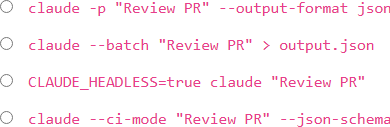
You are integrating Claude Code into a GitHub Actions CI/CD pipeline to automate pull request reviews.
Which flag combination must be used to ensure the process runs without hanging and produces machine-parseable output?
- A . Option A
- B . Option B
- C . Option C
- D . Option D