
Practice Free CBAP Exam Online Questions
A national branch of a global company is struggling to improve business processes of its Public and Government Affairs (PGA) department. To work with external stakeholders effectively, PGA employees need to collect, manage, and exchange a vast amount of information. Complex cases involve collaboration of many employees from different departments. The ability to share information and to coordinate corresponding activities is crucial for the company’s growth plans. Their current tools and practices do not serve the purpose well. The existing system, which was deployed a couple of years ago, has only a few active users. The majority of PGA employees avoid using it because the system is hard to use and lacks needed functionality. Consequently, available information is mostly unstructured and stored either locally or on a shared network drive. Some of the information exists only in a paper form.
The branch’s PGA head, who sponsors the project, wants to implement a configurable solution that two other branches successfully deployed several months ago. Both deployments were done by three solution consultants, who will be available to assist in the project. They will be responsible for tailoring the solution to PGA needs, as well as for training the PGA staff. With their help, the sponsor plans to complete the project in approximately three months.
The solution consultants reside in another country 7 hours ahead of the rest of the project team. They will be available part-time, but are planning two one-week long trips to the PGA central office to conduct initial training and to participate in the final deployment of the system into production. The consultants, in turn, expect a business analyst (BA) to assist in collecting necessary data and defining customization requirements.
The solution consultants have composed a set of as-is solution documents. A spreadsheet contains a catalog of brief definitions of all requirements with priorities assigned to them. A separate document explains data models and user interfaces. For the new and changed requirements, the BA wants to capture additional attributes such as the source, reason, complexity, and priority of change. Some of these requirements can be reused in other work.
How should information for these requirements be managed?
- A . Rewrite requirements independent of the solution design
- B . Enter the information in the company’s change management system
- C . Add the attributes to the original requirements catalog and change requirements
- D . Create a new workbook of requirements with necessary attributes
A business analyst (BA) at a regional bank has recently been assigned to assist on a project to expand into new markets. The chief executive officer (CEO) envisions the bank as a national brand and has asked the chief financial officer (CFO) to monitor project progress closely. The project manager (PM) has asked the BAs on the team to recommend an appropriate business analysis approach.
Based on the nature of the project and the industry, which approach should they recommend?
- A . An unstructured approach utilizing informal team interaction, model-driven documentation standards, and iterative requirements development
- B . An agile approach with frequent team interaction, adaptive documentation standards, and iterative requirements development
- C . A moderate approach utilizing the bank’s existing waterfall project lifecycle and documentation deliverables not requiring formal approval
- D . A formal approach with planned team interaction, agreed upon documentation deliverables requiring formal approval, and front-loaded requirements development
D
Explanation:
Reference: IIBA BABOK v3 (p. 378)
As a program manager, you decided to overlap two phases of your program.
Which of the following terms best describe your act?
- A . Lead time
- B . Rolling
- C . Fast tracking
- D . Crashing
The solutes presented by a business analyst (BA) to the stakeholders eliminated the need to maintain different variations of ship-to-country and location-to-rout* for various freight carriers. Instead, the routing would use a standard carrier code, giving the business me flexibility to just ship to new countries without raising a change request to IT. which was the current road-block to business .
What opportunity did the BA present to the stakeholders?
- A . Increase efficiencies
- B . Decrease stakeholder involvement
- C . increase access to information
- D . Decrease project timeline
Your organization needs to adapt to the change economy, new technologies, and an increase in competition in order to survive. They’ve asked you to complete a business analysis approach that will help them change their organizational policies in order to achieve their goals and objectives.
What business analysis technique has this organization asked you to complete?
- A . Focus groups
- B . Business rules analysis
- C . Brainstorming
- D . Root cause analysis
A business unit of a transnational manufacturer wants to implement a robust process for addressing integrity- critical equipment deterioration incidents. Timely and complete resolution of such incidents is vital for the business unit’s continuous safe and profitable operation. Treating each incident involves many employees from different departments extensively collaborating and exchanging information. That information is spread across multiple systems having their access limited to particular user groups. With the current manual process, some incidents get forgotten and remain unresolved for years.
The project’s Sponsor is an Equipment Integrity and Reliability Advisor, who moved into this position from another business unit. That business unit implemented a proprietary application to integrate the information and to assist in tracking and managing the incidents. Having a positive experience with the application, the Sponsor is suggesting to customize it and reuse in the new business unit.
The business unit’s Enterprise Architect (EA), who is responsible for assessing solution options and presenting them to executive decision makers, has a few concerns with adopting the existing application. The application uses point-to-point interfaces with other data sources whereas the business unit’s target architecture relies on a data warehouse-based integration. Moreover, the two business units use different legacy systems, as well as different front-end implementation technologies. Additionally, the existing application is monolingual, while the business unit needs user interfaces and some data to be presented in two languages. With all of this, it may be easier to build a new application from scratch than to customize the existing one. To understand which option is better, the EA asks a business analyst (BA) to define business requirements.
The EA wants to understand whether the integration capabilities of the existing solution match the business unit’s IT landscape. The requirement definition that the EA needs should read as, "Each record of an incident shall."
- A . be associated with the unit of equipment to which it belongs."
- B . include the associated equipment’s information from the asset management system."
- C . contain the ID of the equipment to which it belongs."
- D . be related to a unit of equipment using the Equipment ID stored in the asset management system."
Which of the following is the comparison of planned project results with actual project results?
- A . Variance analysis
- B . Cost-benefit analysis
- C . Statistical Sampling
- D . Trend analysis
You and Tom are writing the solution scope for a new project in your organization. You need to create a method to define what solution will and will not provide for the organization.
What technique can you and Tom use to establish appropriate boundaries for the solution?
- A . Interviews with the key stakeholders
- B . User stories
- C . Functional decomposition
- D . Scope modeling
The table illustrate the statement of cash flower for a courier company for the last fiscal year:
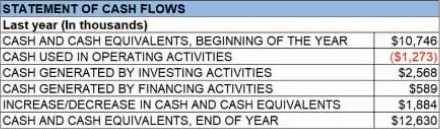
Due to aggressive market competition the management of the company performed a strategy review and based on their0-findings and the current market conditions, they came up with strategic and tactical changes in order to keep a competitive market position.
In order to strength customer retention strategies through a new competitive advantage, the company is considering implementing a live parcel tracking system. The added value will be that the customers may determine the exact location on of the parcel whether it is in a warehouse, crossing the ocean through an overseas the exact location of th parcel whether it is in a warehouse, crossing the ocean through an overseas the ship, or travelling in a delivery truck at any time. The system tracks the location of the parcel by tracking the vehicle in which it is contained. However, for a group of old delivery trucks, it was noticed that the engine sound and vibration disturbed the tracking signal and caused of management would like to sell these vehicles and replace them with newer ones, the Chief Financial Officer (CFO) was strongly against that approach. The CFO argoad that instead of hanging tracking devices on the trucks body they can have the truck drivers manually send the truck send the truck location from a hand held mobile device every 20 minutes.
The CFO’s resistance to replacing the older vehicles represents which type of cost?
- A . Maintenance
- B . Operating
- C . Opportunity
- D . Sunk
You are the business analyst for your organization and are trying to determine the best solution for an identified problem. You have determined that you could create a software solution using inhouse resources for $65,000 and with an ongoing support of $5,600 per month. A vendor offers you a quote that they can create the software for $49,000 with an ongoing support of $6,100 per month.
Which solution should you choose?
- A . Create the software if you’ll keep the solution less than 32 months.
- B . Create the software if you’ll use the solution longer than 32 months.
- C . There is not enough information to determine which solution is financially better.
- D . Buy from the vendor if you’ll keep the solution longer than 32 months.