
Practice Free CBAP Exam Online Questions
Which of the following processes is must at the end of each project phase to determine the completeness of the project work and to gain the customer’s acceptance to move the project forward?
- A . Scope verification
- B . Inspection of key results
- C . Quality control
- D . Phase gate review
Which of the following is described in the statement below?
"It shows the history and pattern of variation. It is a line graph that shows data points plotted in the order in which they occur. They show trends in a process over time, variation over time, or declines or improvements in a process over time. Trend analysis is performed using them."
- A . Cause and effect diagram
- B . Histogram
- C . Run chart
- D . Pareto chart
A company has a process improvement initiative that is projected to increase revenue by $150,000 USD non- compounded per year. The budgeted cost of the initiative is $200.000 and supporting the initiative will cost $30.000 for years two and three.
What is the projected return on investment over the first 3 years?
- A . 44%
- B . 73%
- C . 40%
- D . 51%
Which of the following is a process of adding labor to a project to reduce the project duration?
- A . Forming
- B . Storming
- C . Rolling wave planning
- D . Crashing
A business analyst (BA) was tasked with eliciting requirements for a new product scheduling system. The BA interviewed and discussed the requirements with the manager and Supervisor. The requirements were written and approved by both the supervise and manager .
Which stakeholders were missed in the requirements?
- A . End users
- B . Project manager
- C . Upper management
- D . IT support
You have completed the requirements documentation and the stakeholders have signed off on the requirements. Now the requirements are advancing into a project as your organization has chartered a project based on the identified requirements.
What stakeholder is now responsible for assessing the solution scope to determine the
project scope?
- A . Project sponsor
- B . Project manager
- C . Business analyst
- D . Key stakeholders
Company A is a nation-wide leader in commercial demolition. Having just celebrated its 100th year of operations, the company decided to begin doing work internationally. The current system used for reporting company finances is unable to keep pace with the potential demands of doing work in geographically dispersed locations. Therefore, the company decided to replace its client-based Profit & Loss (P&L) reporting system with a more robust, web-based system. This will ensure transparency across the organization and enable better decision making.
The business analyst (BA) at Company A has recently completed several rounds of elicitation to determine the requirements for the new, web-based system. Over 1250 requirements were elicited.
An initial Requirements Traceability Matrix (RTM) has been drafted, and a subset of the RTM can be seen below:
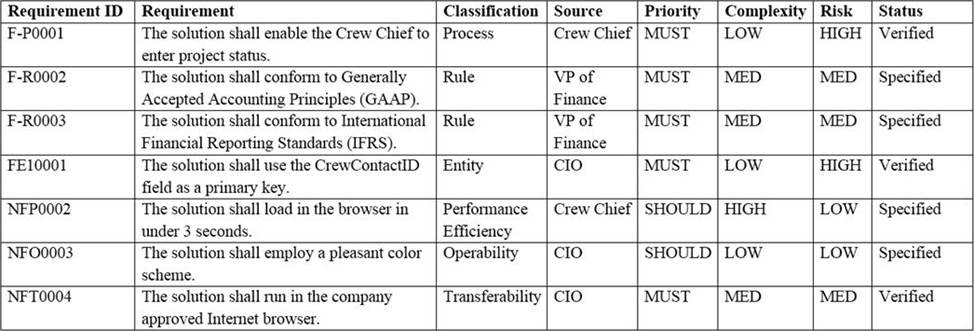
The risk associated with Requirement ID F-P0001 is HIGH. The BA has gone back to the Crew Chief to determine why this requirement’s risk is HIGH. The Crew Chief stated that it was based on an assumption.
Which of the following assumptions would make this requirement’s risk high?
- A . The users will require specialized training.
- B . The web-based interface will be complex.
- C . The system will be inaccessible in remote locations.
- D . The cost of the solution outweighs its benefit.
Several risks were identified for an upcoming change initiative. One risk is related to a slippage concern because of loose gravel at the local site of the change initiative. The business analyst (BA) has recommended that all on-site stakeholders must wear durable, slip-resistant boots while the change initiative is being executed.
This is an example of which type of risk treatment?
- A . Transfer
- B . Mitigate
- C . Accept
- D . Avoid
Which of the following is a visual decomposition of the program scope and the resources needed in order to create the things defined within the program scope?
- A . Resource breakdown structure (RBS)
- B . product breakdown structure (PBS)
- C . Budgeted Cost of Work Scheduled (BCWS)
- D . Work Breakdown Structure (WBS)
A business analyst (BA) has just completed a number of elicitation activities and is preparing to review the stated requirements. As part of this, the BA is checking the compliance of the stated requirements with organizational standards for business analysis.
What state is the BA attempting to move the requirements into?
- A . Validated
- B . Verified
- C . Accepted
- D . Specified