Practice Free AZ-305 Exam Online Questions
What two parameters would you recommend set up to ensure that the new IPS Customers database will scale to meet the workload demands?
- A . Define the maximum of CPU cores
- B . Define the maximum resource limit per group of databases
- C . Define the maximum of Database Transaction Units
- D . Define the maximum of the allocated storage
- E . Define the maximum size for a database
Note: This section contains one or more sets of questions with the same scenario and problem. Each question presents a unique solution to the problem. You must determine whether the solution meets the stated goals. More than one solution in the set might solve the problem. It is also possible that none of the solutions in the set solve the problem.
After you answer a question in this section, you will NOT be able to return. As a result, these questions do not appear on the Review Screen.
Your company, named Contoso, Ltd., has a Microsoft Entra tenant named contoso.com that uses Privileged Identity Management (PIM) and is linked to an Azure subscription named Sub 1.
You use Azure Backup to back up all the resources in Sub1 to a Recovery Services vault named Vault 1.
An external company named Fabrikam, Inc. provides security management services to Contoso.
Fabrikam has a Microsoft Entra tenant named fabrikam.com and an Azure subscription.
You need to prevent a compromised administrator account in contoso.com from modifying backup policies in and deleting backups from Sub 1.
Solution: In Vault 1, you generate a security PIN for critical operations.
Does this meet the goal?
- A . Yes
- B . No
Note: This question is part of a series of questions that present the same scenario. Each question in the series contains a unique solution that might meet the stated goals. Some question sets might have more than one correct solution, while others might not have a correct solution.
After you answer a question in this section, you will NOT be able to return to it. As a result, these questions will not appear in the review screen.
Your company has deployed several virtual machines (VMs) on-premises and to Azure. Azure ExpressRoute has been deployed and configured for on-premises to Azure connectivity.
Several VMs are exhibiting network connectivity issues.
You need to analyze the network traffic to determine whether packets are being allowed or denied to the VMs.
Solution: Use the Azure Traffic Analytics solution in Azure Log Analytics to analyze the network traffic.
Does the solution meet the goal?
- A . Yes
- B . No
B
Explanation:
Instead use Azure Network Watcher to run IP flow verify to analyze the network traffic.
Reference:
https://docs.microsoft.com/en-us/azure/network-watcher/network-watcher-monitoring-overview
https://docs.microsoft.com/en-us/azure/network-watcher/network-watcher-ip-flow-verify-overview
HOTSPOT
You have an Azure subscription.
You create a storage account that will store documents.
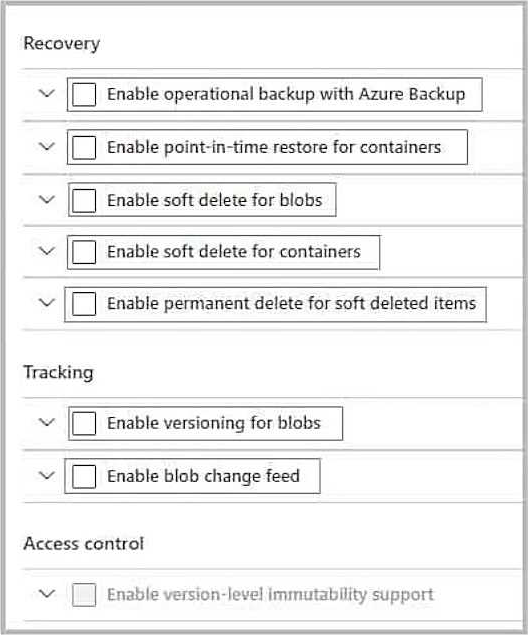
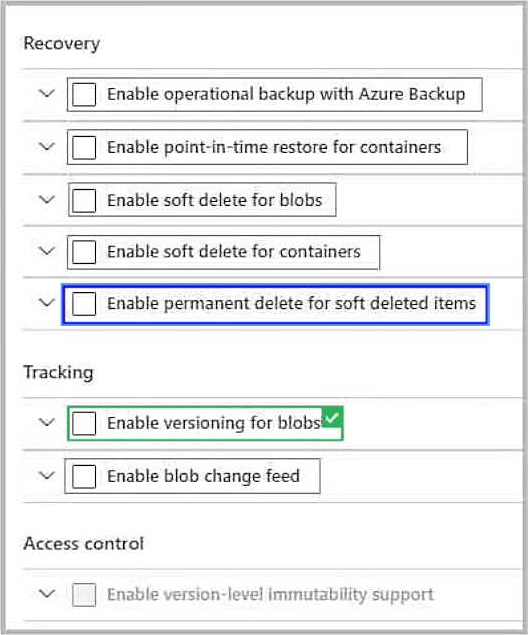
You need to configure the storage account to meet the following requirements:
• Ensure that retention policies are standardized across the subscription.
• Ensure that data can be purged if the data is copied to an unauthorized location.
Which two settings should you enable? To answer, select the appropriate settings in the answer area. NOTE: Each correct selection is worth one point.
HOTSPOT
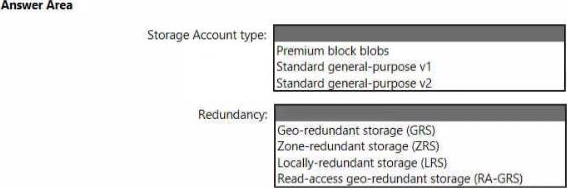
You have an on-premises file server that stores 2 TB of data files.
You plan to move the data files to Azure Blob Storage In the West Europe Azure region,
You need to recommend a storage account type to store the data files and a replication solution for the storage account.
The solution must meet the following requirements:
• Be available if a single Azure datacenter fails.
• Support storage tiers.
• Minimize cost.
What should you recommend? To answer, select the appropriate options in the answer area. NOTE: Each correct selection is worth one point.
Explanation:
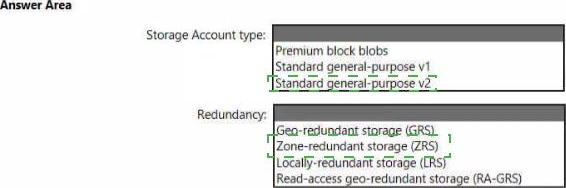
Account Type: StorageV2
Replication solution: Zone-redundant storage (ZRS)
https://docs.microsoft.com/en-us/azure/storage/common/storage-redundancy
https://docs.microsoft.com/en-us/azure/storage/common/storage-redundancy#supported-azure-storage-services
https://docs.microsoft.com/en-us/azure/storage/common/storage-account-overview#types-of-storage-accounts
Data must be available if a single Azure datacenter fails. It means the storage account must support ZRS replication. Also, solution should support storage tiers. Only General-purpose V2 supports ZRS and storage tiers.
https://docs.microsoft.com/en-us/azure/storage/blobs/storage-blob-storage-tiers
You plan provision a High Performance Computing (HPC) cluster in Azure that will use a third-party scheduler.
You need to recommend a solution to provision and manage the HPC cluster node.
What should you include in the recommendation?
- A . Azure Lighthouse
- B . Azure CycleCloud
- C . Azure Purview
- D . Azure Automation
B
Explanation:
You can dynamically provision Azure HPC clusters with Azure CycleCloud.
Azure CycleCloud is the simplest way to manage HPC workloads.
Note: Azure CycleCloud is an enterprise-friendly tool for orchestrating and managing High Performance Computing (HPC) environments on Azure. With CycleCloud, users can provision infrastructure for HPC systems, deploy familiar HPC schedulers, and automatically scale the infrastructure to run jobs efficiently at any scale. Through CycleCloud, users can create different types of file systems and mount them to the compute cluster nodes to support HPC workloads.
Reference: https://docs.microsoft.com/en-us/azure/cyclecloud/overview
You have an Azure subscription.
You need to recommend a solution to provide developers with the ability to provision Azure virtual machines.
The solution must meet the following requirements:
• Only allow the creation of the virtual machines in specific regions.
• Only allow the creation of specific sizes of virtual machines.
What should you include in the recommendation?
- A . Conditional Access policies
- B . role-based access control (RBAC)
- C . Azure Resource Manager (ARM) templates
- D . Azure Policy
D
Explanation:
https://docs.microsoft.com/en-us/azure/governance/policy/tutorials/create-and-manage
https://docs.microsoft.com/en-us/azure/cloud-adoption-framework/manage/azure-server-management/common-policies#restrict-vm-size
HOTSPOT
You have an Azure subscription that contains the resources shown in the following table.
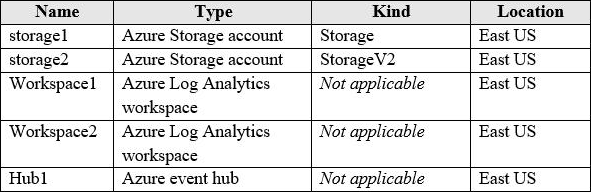
You create an Azure SQL database named DB1 that is hosted in the East US region.
To DB1, you add a diagnostic setting named Settings1. Settings1 archives SQLInsights to storage1 and sends SQLInsights to Workspace1.
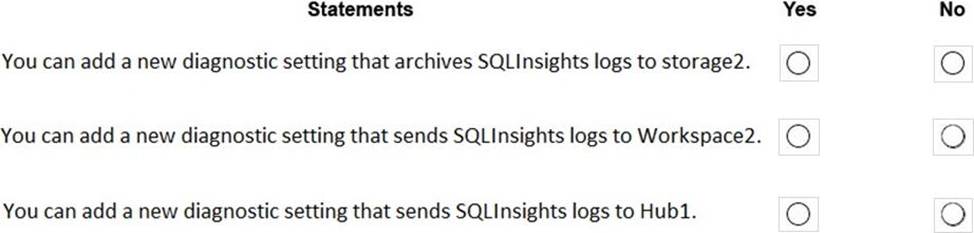
For each of the following statements, select Yes if the statement is true. Otherwise, select No. NOTE: Each correct selections is worth one point.
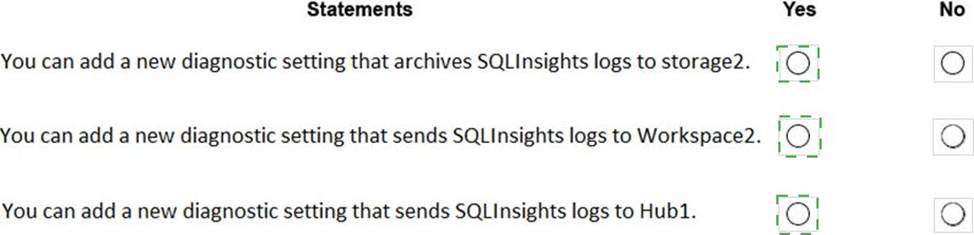
Explanation:
Box 1: Yes
Box 2: Yes
Box 3: Yes
For more information on Azure SQL diagnostics , you can visit the below link https://docs.microsoft.com/en-us/azure/azure-sql/database/metrics-diagnostic-telemetry-logging-streaming-export-configure
Your company has 300 virtual machines hosted in a VMware environment. The virtual machines vary in size and have various utilization levels.
You plan to move all the virtual machines to Azure.
You need to recommend how many and what size Azure virtual machines will be required to move the current workloads to Azure. The solution must minimize administrative effort.
What should you use to make the recommendation?
- A . Azure Cost Management
- B . Azure Pricing calculator
- C . Azure Migrate
- D . Azure Advisor
C
Explanation:
https://docs.microsoft.com/en-us/azure/migrate/migrate-appliance#collected-data—vmware
"Metadata discovered by the Azure Migrate appliance helps you to figure out whether servers are ready for migration to Azure, right-size servers, plans costs, and analyze application dependencies".
https://docs.microsoft.com/en-us/learn/modules/design-your-migration-to-azure/2-plan-your-azure-migration
DRAG DROP
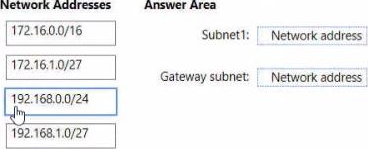
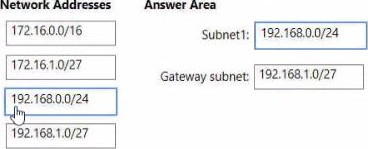
You have an on-premises network that uses an IP address space of 172.16.0.0/16. You plan to deploy
25 virtual machines to a new Azure subscription.
You identify the following technical requirements:
• All Azure virtual machines must be placed on the same subnet named Subnet1.
• All the Azure virtual machines must be able to communicate with all on-premises servers.
• The servers must be able to communicate between the on-premises network and Azure by using a site-to-site VPN.
You need to recommend a subnet design that meets the technical requirements.
What should you include in the recommendation? To answer, drag the appropriate network addresses to the correct subnets. Each network address may be used once, more than once, or not at all. You may need to drag the split bar between panes or scroll to view content. NOTE: Each correct selection is worth one point.