
Practice Free AZ-305 Exam Online Questions
HOTSPOT
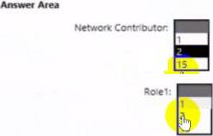
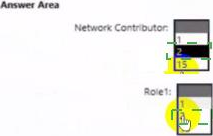
You need to implement the Azure RBAC role assignment. The solution must meet the authentication and authorization requirements.
How many assignment should you configure for the Network Contributor role for Role1? To answer, select appropriate in the answer area.
Explanation:
2 2
You have to design a Data Engineering solution for your company. The company currently has an Azure subscription. They also have application data hosted in a database on a Microsoft SQL Server hosted in their on-premises data center server. They want to implement the following requirements Transfer transactional data from the on-premises SQL server onto a data warehouse in Azure. Data needs to be transferred every day in the night as a scheduled job
A managed Spark cluster needs to be in place for data engineers to perform analysis on the data stored in the SQL data warehouse. Here the data engineers should have the ability to develop notebooks in Scale, R and Python.
They also need to have a data lake store in place for the ingestion of data from multiple data sources Which of the following would the use for hosting the data warehouse in Azure?
- A . Azure Data Factory
- B . Azure Databricks
- C . Azure Data Lake Gen2 Storage accounts
- D . Azure Synapse Analytics
HOTSPOT
Your company has the divisions shown in the following table.

You plan to deploy a custom application to each subscription.
The application will contain the following:
✑ A resource group
✑ An Azure web app
✑ Custom role assignments
✑ An Azure Cosmos DB account
You need to use Azure Blueprints to deploy the application to each subscription.
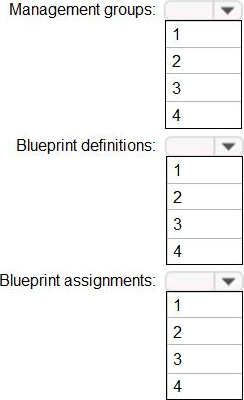
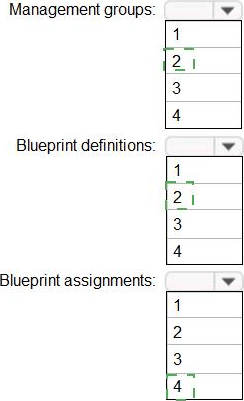
What is the minimum number of objects required to deploy the application? To answer, select the appropriate options in the answer area. NOTE: Each correct selection is worth one point.
Explanation:
Box 1: 2
One management group for East, and one for West.
When creating a blueprint definition, you’ll define where the blueprint is saved. Blueprints can be saved to a management group or subscription that you have Contributor access to. If the location is a management group, the blueprint is available to assign to any child subscription of that management group.
Box 2: 2
Box 3: 4
One assignment for each subscription.
"Assigning a blueprint definition to a management group means the assignment object exists at the management group. The deployment of artifacts still targets a subscription. To perform a management group assignment, the Create Or Update REST API must be used and the request body must include a value for properties.scope to define the target subscription." https://docs.microsoft.com/en-us/azure/governance/blueprints/overview#blueprint-assignment
You have an Azure subscription.
You need to deploy an Azure Kubernetes Service (AKS) solution that will use Linux nodes.
The solution must meet the following requirements:
✑ Minimize the time it takes to provision compute resources during scale-out operations.
✑ Support autoscaling of Linux containers.
✑ Minimize administrative effort.
Which scaling option should you recommend?
- A . Virtual Kubelet
- B . cluster autoscaler
- C . horizontal pod autoscaler
- D . AKS virtual nodes
D
Explanation:
https://docs.microsoft.com/en-us/azure/aks/virtual-nodes
You plan to deploy an Azure SQL database that will store Personally Identifiable Information (Pll). You need to ensure that only privileged users can view the Pll.
What should you include in the solution?
- A . Transparent Data Encryption (TDE)
- B . Data Discovery & Classification
- C . dynamic data masking
- D . role-based access control (RBAC)
HOTSPOT
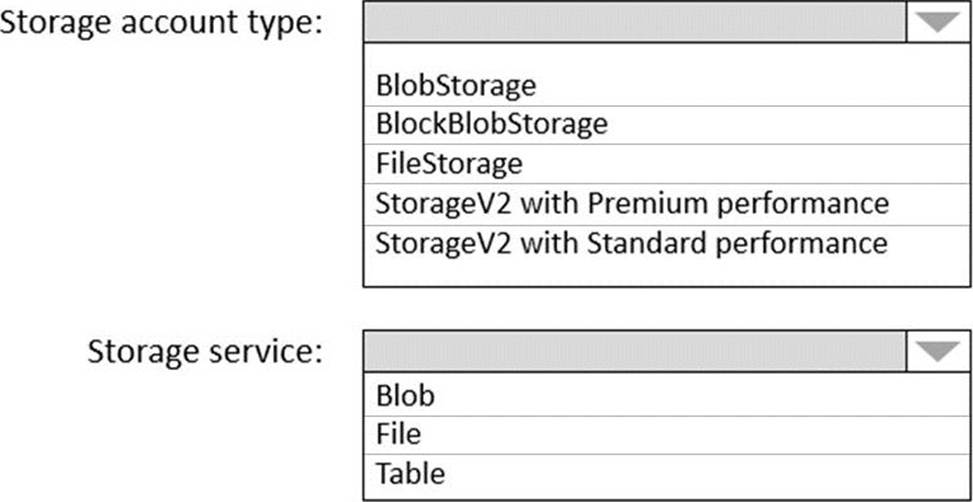
You need to design a storage solution for an app that will store large amounts of frequently used data.
The solution must meet the following requirements:
✑ Maximize data throughput.
✑ Prevent the modification of data for one year.
✑ Minimize latency for read and write operations.
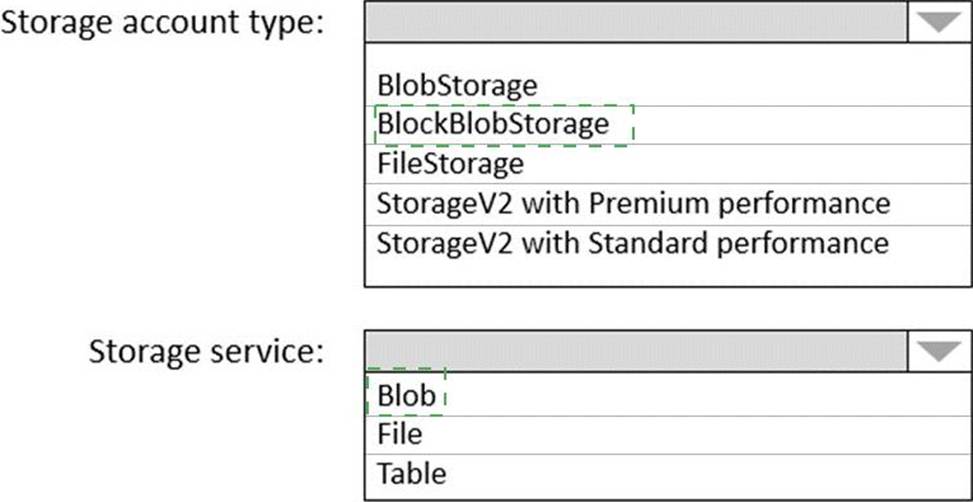
Which Azure Storage account type and storage service should you recommend? To answer, select the appropriate options in the answer area. NOTE: Each correct selection is worth one point.
Explanation:
Box 1: BlockBlobStorage
Block Blob is a premium storage account type for block blobs and append blobs. Recommended for scenarios with high transactions rates, or scenarios that use smaller objects or require consistently low storage latency.
Box 2: Blob
The Archive tier is an offline tier for storing blob data that is rarely accessed. The Archive tier offers the lowest storage costs, but higher data retrieval costs and latency compared to the online tiers (Hot and Cool). Data must remain in the Archive tier for at least 180 days or be subject to an early deletion charge.
Reference: https://docs.microsoft.com/en-us/azure/storage/blobs/archive-blob
You need to recommend a solution that meets the data requirements for App1.
What should you recommend deploying to each availability zone that contains an instance of App1?
- A . an Azure Cosmos DB that uses multi-region writes
- B . an Azure Storage account that uses geo-zone-redundant storage (GZRS)
- C . an Azure Data Lake store that uses geo-zone-redundant storage (GZRS)
- D . an Azure SQL database that uses active geo-replication
You have an Azure subscription that contains a Basic Azure virtual WAN named Virtual/WAN1 and the virtual hubs shown in the following table.
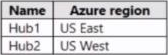
You have an ExpressRoute circuit in the US East region.
You need to create an ExpressRoute association to VirtualWAN1.
What should you do first?
- A . Upgrade VirtualWAN1 to Standard.
- B . Create a gateway on Hub1.
- C . Create a hub virtual network in US East.
- D . Enable the ExpressRoute premium add-on.
A
Explanation:
US East and US West are in the same geopolitical region so there is no need for enabling ExpressRoute premium add-on https://docs.microsoft.com/en-us/azure/virtual-wan/virtual-wan-about#basicstandard
The current config of virtual WAN is only Basic as given, so it can connect to only site to site VPN, to connect to express route it needs to be upgraded from basic to standard.
https://docs.microsoft.com/en-us/azure/virtual-wan/virtual-wan-about
https://docs.microsoft.com/en-us/azure/virtual-wan/virtual-wan-about
Your company has an Azure Web App that runs via the Premium App Service Plan. A development team will be using the Azure Web App. You have to configure the Azure Web app so that it can fulfil the below requirements.
Provide the ability to switch the web app from the current version to a newer version
Provide developers with the ability to test newer versions of the application before the switch to the newer version occurs
Ensure that the application version can be rolled back
Minimize downtime
Which of the following can be used for this requirement?
- A . Create a new App Service Plan
- B . Make use of deployment slots
- C . Map a custom domain
- D . Backup the Azure Web App
Your company has offices in the United States, Europe, Asia, and Australia.
You have an on-premises app named App1 that uses Azure Table storage. Each office hosts a local instance of App1.
You need to upgrade the storage for App1.
The solution must meet the following requirements:
✑ Enable simultaneous write operations in multiple Azure regions.
✑ Ensure that write latency is less than 10 ms.
✑ Support indexing on all columns.
✑ Minimize development effort.
Which data platform should you use?
- A . Azure SQL Database
- B . Azure SQL Managed Instance
- C . Azure Cosmos DB
- D . Table storage that uses geo-zone-redundant storage (GZRS) replication
C
Explanation:
Azure Cosmos DB Table API has
✑ Single-digit millisecond latency for reads and writes, backed with <10-ms latency reads and <15-ms latency writes at the 99th percentile, at any scale, anywhere in the world.
✑ Automatic and complete indexing on all properties, no index management.
✑ Turnkey global distribution from one to 30+ regions. Support for automatic and manual failovers at any time, anywhere in the world.
Reference: https://docs.microsoft.com/en-us/azure/cosmos-db/table-support