
Practice Free AZ-305 Exam Online Questions
You have 100 Microsoft SQL Server integration Services (SSIS) packages that are configured to use 10 on-premises SQL Server databases as their destinations.
You plan to migrate the 10 on-premises databases to Azure SQL Database
You need to recommend a solution to host the SSlS packages in Azure. The solution must ensure that the packages can target the SQL Database instances as their destinations.
What should you include in the recommendation?
- A . SQL Server Migration Assistant (SSMA)
- B . Azure Data Catalog
- C . Data Migration Assistant
- D . Azure Data Factory
D
Explanation:
https://docs.microsoft.com/bs-cyrl-ba/azure/sql-database/sql-database-managed-instance-migrate
Quote from that page "Azure SQL Database and SQL Server databases in an Azure Virtual Machine.
DMS is the recommended method of migration for your enterprise workloads.
If you use SQL Server Integration Services (SSIS) on your SQL Server on premises, DMS does not yet support migrating SSIS catalog (SSISDB) that stores SSIS packages, but you can provision Azure-SSIS Integration Runtime (IR) in Azure Data Factory (ADF) that will create a new SSISDB in a managed instance and then you can redeploy your packages to it, see Create Azure-SSIS IR in ADF.
To learn more about this scenario and configuration steps for DMS, see Migrate your on-premises database to managed instance using DMS."
https://docs.microsoft.com/en-us/azure/data-factory/how-to-migrate-ssis-job-ssms
You have an on-premises network to which you deploy a virtual appliance.
You plan to deploy several Azure virtual machines and connect the on-premises network to Azure by using a Site-to-Site connection.
All network traffic that will be directed from the Azure virtual machines to a specific subnet must flow through the virtual appliance.
You need to recommend solutions to manage network traffic.
Which two options should you recommend? Each correct answer presents a complete solution.
- A . Configure Azure Traffic Manager.
- B . Implement an Azure virtual network.
- C . Implement Azure ExpressRoute.
- D . Configure a routing table.
BD
Explanation:
Connectivity can be from an any-to-any (IP VPN) network, a point-to-point Ethernet network, or a virtual cross-connection through a connectivity provider at a co-location facility. ExpressRoute connections do not go over the public Internet. This allows ExpressRoute connections to offer more reliability, faster speeds, lower latencies, and higher security than typical connections over the Internet.
Reference:
https://docs.microsoft.com/en-us/azure/vpn-gateway/vpn-gateway-forced-tunneling-rm
https://docs.microsoft.com/en-us/azure/expressroute/expressroute-introduction
You plan to migrate on-premises MySQL databases to Azure Database for MySQL Flexible Server.
You need to recommend a solution for the Azure Database for MySQL Flexible Server configuration.
The solution must meet the following requirements:
• The databases must be accessible if a datacenter fails.
• Costs must be minimized.
Which compute tier should you recommend?
- A . Burstable
- B . General Purpose
- C . Memory Optimized
HOTSPOT
You have an Azure subscription that contains the SQL servers shown in the following table.

The subscription contains the storage accounts shown in the following table.

You create the Azure SQL databases shown in the following table.

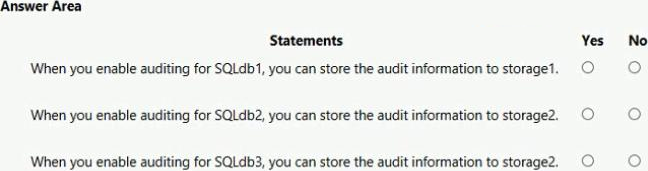
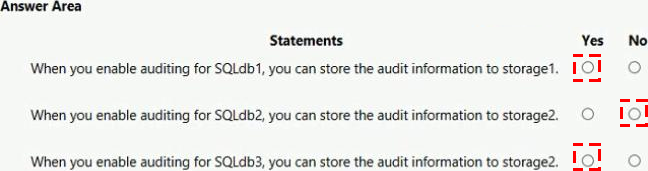
Explanation:
Box 1: Yes
Be sure that the destination is in the same region as your database and server.
Box 2: No
Box 3: Yes
https://docs.microsoft.com/en-us/azure/sql-database/sql-database-auditing
Reference:
https://docs.microsoft.com/en-us/azure/sql-database/sql-database-auditing
https://docs.microsoft.com/en-us/previous-versions/azure/dn741340(v=azure.100)?redirectedfrom=MSDN
You have an Azure subscription that contains an Azure Blob storage account named store1.
You have an on-premises file server named Setver1 that runs Windows Sewer 2016. Server1 stores 500 GB of company files.
You need to store a copy of the company files from Server 1 in store1.
Which two possible Azure services achieve this goal? Each correct answer presents a complete solution. NOTE: Each correct selection is worth one point
- A . an Azure Batch account
- B . an integration account
- C . an On-premises data gateway
- D . an Azure Import/Export job
- E . Azure Data factory
D, E
Explanation:
https://docs.microsoft.com/en-us/azure/storage/common/storage-import-export-data-from-blobs
https://docs.microsoft.com/en-us/answers/questions/31113/fastest-method-to-copy-500gb-table-from-on-premise.html
You have multiple on-premises networks
You have multiple Azure subscriptions. Each subscription contains a virtual network that is assigned an IP address space of 172.16.0.0/16. Each virtual network is connected to the on premises networks by using ExpressRoute.
You plan to deploy a container orchestration solution that will use multiple Azure Kubernetes Service (AKS) clusters. The clusters will be deployed to the existing virtual networks.
You need to recommend a network configuration for the AKS dusters.
The solution must meet the following requirements:
• Minimize the number of IP addresses required on each virtual network.
• Support outbound connectivity to on-premises datacenters.
• Support Windows node pools
Which AKS network model should you recommend?
- A . Azure CNI Overlay
- B . kubenet
- C . Azure CNI
- D . Azure CNI Powered by Cilium
HOTSPOT
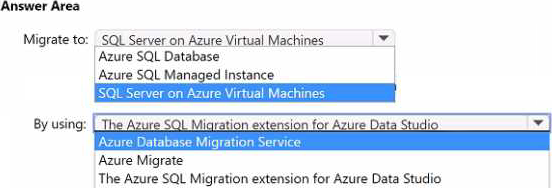
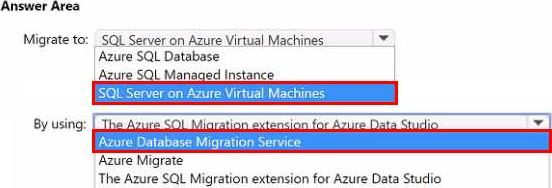
Your on-premises datacenter contains a server named Server1 that runs Microsoft SQL Server 2022. Server1 contains a 30-TB database named DB1 that stores customer data. Server1 runs a custom application named App1 that verifies the compliance of records in DB1.
App1 must run on the same server as DB1.
You have an Azure subscription.
You need to migrate DB1 to Azure. The solution must minimize administrative effort.
To which service should you migrate DB1, and what should you use to perform the migration? To answer, select the appropriate options in the answer area.
You need to recommend an App Service architecture that meets the requirements for Appl. The solution must minimize costs.
What should few recommend?
- A . one App Service Environment (ASE) per availability zone
- B . one App Service plan per availability zone
- C . one App Service plan per region
- D . one App Service Environment (ASE) per region
DRAG DROP
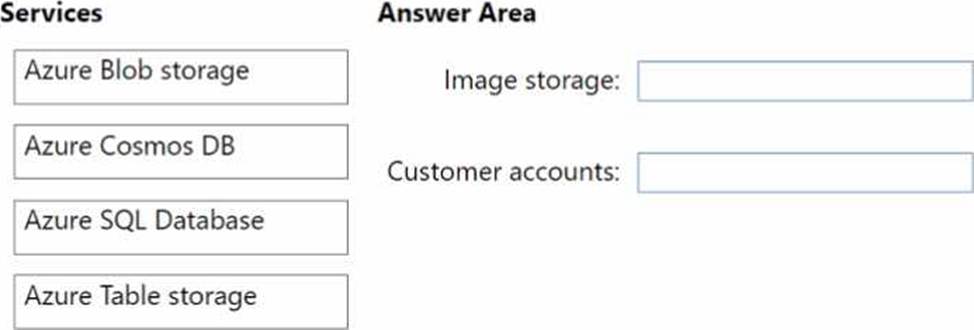
You have an on-premises app named App1.
Customers use App1 to manage digital images.
You plan to migrate App1 to Azure.
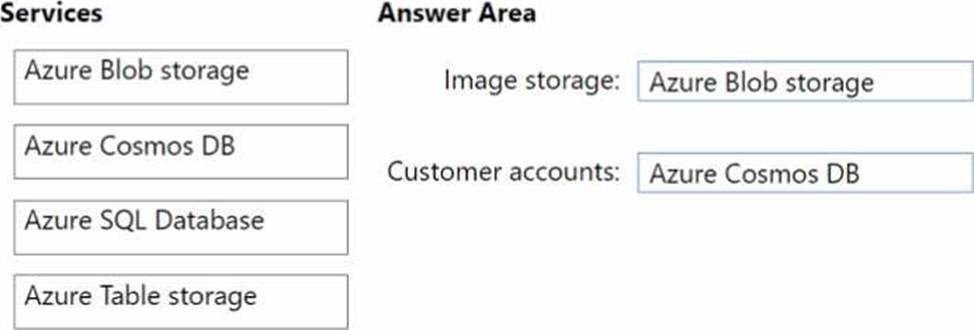
You need to recommend a data storage solution for Appl.
The solution must meet the following image storage requirements:
• Encrypt images at rest.
• Allow files up to 50 MB.
• Manage access to the images by using Azure Web Application Firewall (WAF) on Azure Front Door.
The solution must meet the following customer account requirements:
• Support automatic scale out of the storage.
• Maintain the availability of App1 if a datacenter fails.
• Support reading and writing data from multiple Azure regions.
Which service should you include in the recommendation for each type of data? To answer, drag the appropriate services to the correct type of data. Each service may be used once, more than once, or not at all. You may need to drag the split bar between panes or scroll to view content. NOTE: Each correct selection is worth one point.
You have 100 devices that write performance data to Azure Blob Storage.
You plan to store and analyze the performance data in an Azure SQL database.
You need to recommend a solution to continually copy the performance data to the Azure SQL database.
What should you include in the recommendation?
- A . Azure Database Migration Service
- B . Azure Data Box
- C . Data Migration Assistant (DMA)
- D . Azure Data Factory