
Practice Free AZ-305 Exam Online Questions
You plan to automate the deployment of resources to Azure subscriptions.
What is a difference between using Azure Blueprints and Azure Resource Manager (ARM) templates?
- A . ARM templates remain connected to the deployed resources.
- B . Only ARM templates can contain policy definitions.
- C . Blueprints remain connected to the deployed resources.
- D . Only Blueprints can contain policy definitions.
C
Explanation:
With Azure Blueprints, the relationship between the blueprint definition (what should be deployed) and the blueprint assignment (what was deployed) is preserved. This connection supports improved tracking and auditing of deployments. Azure Blueprints can also upgrade several subscriptions at once that are governed by the same blueprint.
Reference: https://docs.microsoft.com/en-us/answers/questions/26851/how-is-azure-blue-prints-different-
from-resource-m.html
You plan to move a web application named App! from an on-premises data center to Azure.
App1 depends on a custom COM component that is installed on the host server.
You need to recommend a solution to host App1 in Azure.
The solution must meet the following requirements:
✑ App1 must be available to users if an Azure data center becomes unavailable.
✑ Costs must be minimized.
What should you include in the recommendation?
- A . In two Azure regions, deploy a load balancer and a virtual machine scale set.
- B . In two Azure regions, deploy a Traffic Manager profile and a web app.
- C . In two Azure regions, deploy a load balancer and a web app.
- D . Deploy a load balancer and a virtual machine scale set across two availability zones.
D
Explanation:
(https://docs.microsoft.com/en-us/dotnet/azure/migration/app-service#com-and-com-components)
Azure App Service does not allow the registration of COM components on the platform. If your app makes use of any COM components, these need to be rewritten in managed code and deployed with the site or application. https://docs.microsoft.com/en-us/dotnet/azure/migration/app-service
"Azure App Service with Windows Containers If your app cannot be migrated directly to App Service, consider App Service using Windows Containers, which enables usage of the GAC, COM components, MSIs, full access to .NET FX APIs, DirectX, and more."
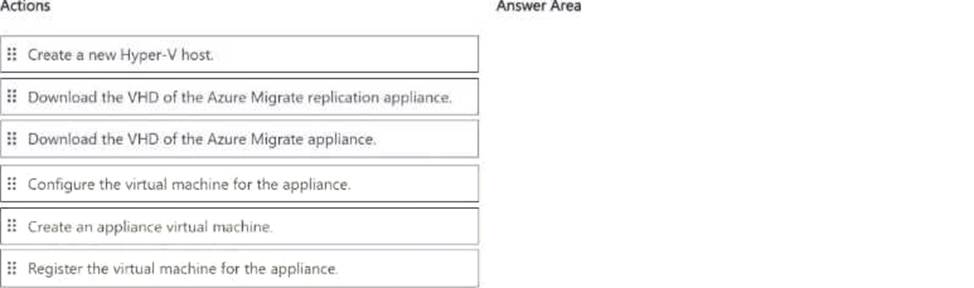
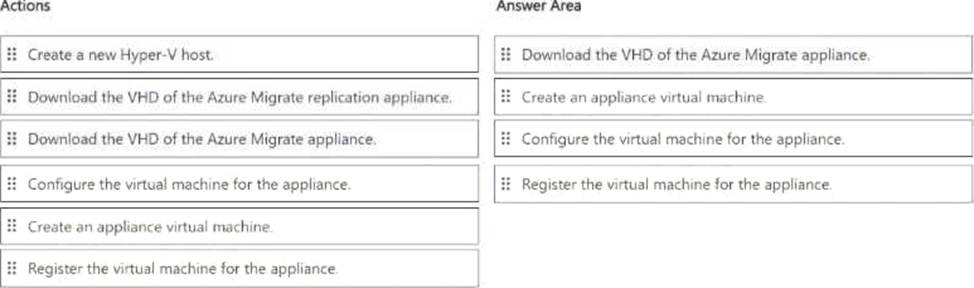
DRAG DROP
You have 15 on-premises Hyper-V virtual machines.
You have an Azure subscription that contains an Azure Migrate project named Project 1.
You need to assess the virtual machines for migration to Azure by using Project 1.
Which four actions should you perform in sequence? To answer, move the appropriate actions from the list of actions to the answer area and arrange them in the correct order.
Explanation:
You have an Azure web app that uses an Azure key vault named KeyVault1 in the West US Azure region.
You are designing a disaster recovery plan for KeyVault1.
You plan to back up the keys in KeyVault1.
You need to identify to where you can restore the backup.
What should you identify?
- A . KeyVault1 only
- B . the same region only
- C . the same geography only
- D . any region worldwide
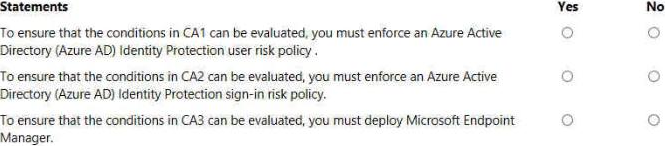
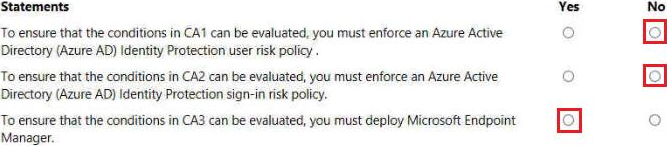
HOTSPOT
You have an Azure subscription that is linked to an Azure Active Directory Premium Plan 2 tenant The tenant has multi-factor authentication (MFA) enabled for all users.
You have the named locations shown in the following table.

You have the users shown in the following table.

You plan to deploy the Conditional Access policies shown in the following table.

For each of the following statements, select Yes if the statement is true. Otherwise, select No. NOTE: Each correct selection is worth one point.
You need to implement the Azure RBAC role assignments for the Network Contributor role. The solution must meet the authentication and authorization requirements.
What is the minimum number of assignments that you must use?
- A . 1
- B . 2
- C . 5
- D . 10
- E . 15
B
Explanation:
Scenario: The Network Contributor built-in RBAC role must be used to grant permissions to the network administrators for all the virtual networks in all the Azure subscriptions.
RBAC roles must be applied at the highest level possible.
The accounting department at your company migrates to a new financial accounting software. The accounting department must keep file-based database backups for seven years for compliance purposes. It is unlikely that the backups will be used to recover data.
You need to move the backups to Azure. The solution must minimize costs.
Where should you store the backups?
- A . Azure Blob storage that uses the Archive tier
- B . Azure SQL Database
- C . Azure Blob storage that uses the Cool tier
- D . a Recovery Services vault
A
Explanation:
Azure Front Door enables you to define, manage, and monitor the global routing for your web traffic by optimizing for best performance and instant global failover for high availability. With Front Door, you can transform your global (multi-region) consumer and enterprise applications into robust, high-performance personalized modern applications, APIs, and content that reaches a global audience with Azure.
Front Door works at Layer 7 or HTTP/HTTPS layer and uses anycast protocol with split TCP and Microsoft’s global network for improving global connectivity.
Reference: https://docs.microsoft.com/en-us/azure/frontdoor/front-door-overview
You have an Azure subscription.
You need to deploy an Azure Kubernetes Service (AKS) solution that will use Windows Server 2019 nodes.
The solution must meet the following requirements:
• Minimize the time it takes to provision compute resources during scale-out operations.
• Support autoscaling of Windows Server containers.
Which scaling option should you recommend?
- A . horizontal pod autoscaler
- B . Kubernetes version 1.20.2 or newer
- C . cluster autoscaler
- D . Virtual nodes
- E . with Virtual Kubelet ACI
C
Explanation:
https://docs.microsoft.com/en-us/azure/aks/cluster-autoscaler#about-the-cluster-autoscaler
You have 100 servers that run Windows Server 2012 R2 and host Microsoft SQL Server 2012 R2 instances.
The instances host databases that have the following characteristics:
✑ The largest database is currently 3 TB. None of the databases will ever exceed 4 TB.
✑ Stored procedures are implemented by using CLR.
You plan to move all the data from SQL Server to Azure.
You need to recommend an Azure service to host the databases.
The solution must meet the following requirements:
✑ Whenever possible, minimize management overhead for the migrated databases.
✑ Minimize the number of database changes required to facilitate the migration.
✑ Ensure that users can authenticate by using their Active Directory credentials.
What should you include in the recommendation?
- A . Azure SQL Database single databases
- B . Azure SQL Database Managed Instance
- C . Azure SQL Database elastic pools
- D . SQL Server 2016 on Azure virtual machines
B
Explanation:
Reference: https://docs.microsoft.com/en-us/azure/sql-database/sql-database-managed-instance
SQL Managed Instance allows existing SQL Server customers to lift and shift their on-premises applications to the cloud with minimal application and database changes. At the same time, SQL Managed Instance preserves all PaaS capabilities (automatic patching and version updates, automated backups, high availability) that drastically reduce management overhead and TCO.
https://docs.microsoft.com/en-us/azure/azure-sql/managed-instance/transact-sql-tsql-differences-sql-server#clr
https://docs.microsoft.com/en-gb/azure/azure-sql/database/transact-sql-tsql-differences-sql-server#transact-sql-syntax-not-supported-in-azure-sql-database
HOTSPOT
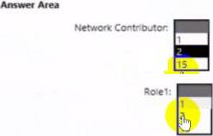
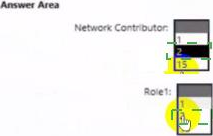
You need to implement the Azure RBAC role assignment. The solution must meet the authentication and authorization requirements.
How many assignment should you configure for the Network Contributor role for Role1? To answer, select appropriate in the answer area.
Explanation:
2 2