
Practice Free AZ-204 Exam Online Questions
HOTSPOT
You are developing an ASP.NET Core web application. You plan to deploy the application to Azure Web App for Containers.
The application needs to store runtime diagnostic data that must be persisted across application restarts.
You have the following code:

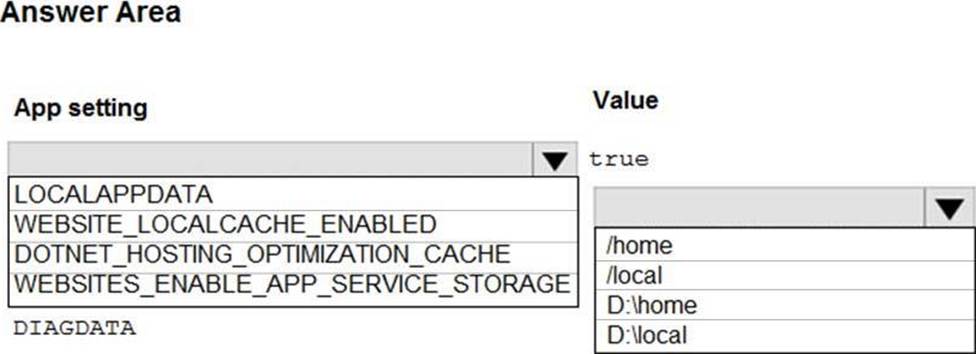
You need to configure the application settings so that diagnostic data is stored as required.
How should you configure the web app’s settings? To answer, select the appropriate options in the answer area. NOTE: Each correct selection is worth one point.
Explanation:
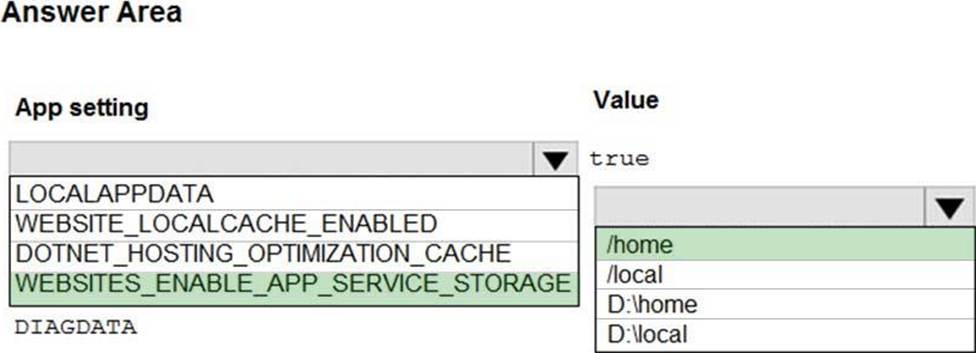
Box 1: If WEBSITES_ENABLE_APP_SERVICE_STORAGE
If WEBSITES_ENABLE_APP_SERVICE_STORAGE setting is unspecified or set to true, the /home/ directory will be shared across scale instances, and files written will persist across restarts
Box 2: /home
Reference: https://docs.microsoft.com/en-us/azure/app-service/containers/app-service-linux-faq
HOTSPOT
You implement an Azure solution to include Azure Cosmos DB. the latest Azure Cosmos DB SDK, and the Azure Cosmos DB for NoSQL API. You also implement a change feed processor on a new container instance by using the Azure Functions trigger for Azure Cosmos DB.
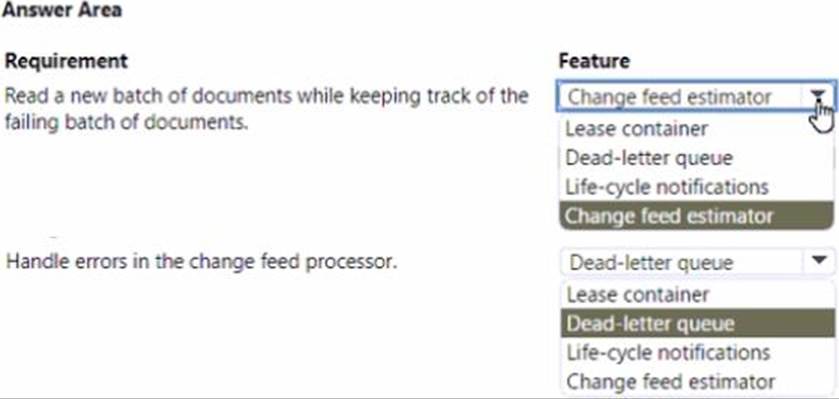
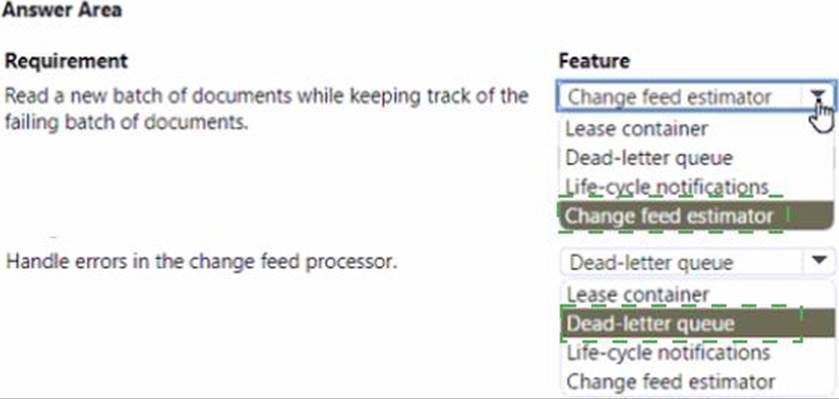
A large batch of documents continues to fail when reading one of the documents in the batch. The same batch of documents is continuously retried by the triggered function and a new batch of documents must be read.
You need to implement the change feed processor to read the documents.
Which feature should you implement? To answer, select the appropriate features in the answer area. NOTE: Each correct selection is worth one point.
You have a Standard tier instance of Azure Cache for Radis named redis1 configured with the default settings.
You need to configure a Maxmemory policy to increase the amount of cache available for read operations.
How should you configure the Maxmemory policy?
- A . Decrease the value of maxmemory-reserved.
- B . Increase the value of maxmemory-reserved.
- C . Set the Maxmemory policy to noeviction.
- D . Set the Maxmemory policy to volatile-lru.
You have a Standard tier instance of Azure Cache for Radis named redis1 configured with the default settings.
You need to configure a Maxmemory policy to increase the amount of cache available for read operations.
How should you configure the Maxmemory policy?
- A . Decrease the value of maxmemory-reserved.
- B . Increase the value of maxmemory-reserved.
- C . Set the Maxmemory policy to noeviction.
- D . Set the Maxmemory policy to volatile-lru.
You have a Standard tier instance of Azure Cache for Radis named redis1 configured with the default settings.
You need to configure a Maxmemory policy to increase the amount of cache available for read operations.
How should you configure the Maxmemory policy?
- A . Decrease the value of maxmemory-reserved.
- B . Increase the value of maxmemory-reserved.
- C . Set the Maxmemory policy to noeviction.
- D . Set the Maxmemory policy to volatile-lru.
DRAG DROP
You are developing an application. You have an Azure user account that has access to two subscriptions.
You need to retrieve a storage account key secret from Azure Key Vault.
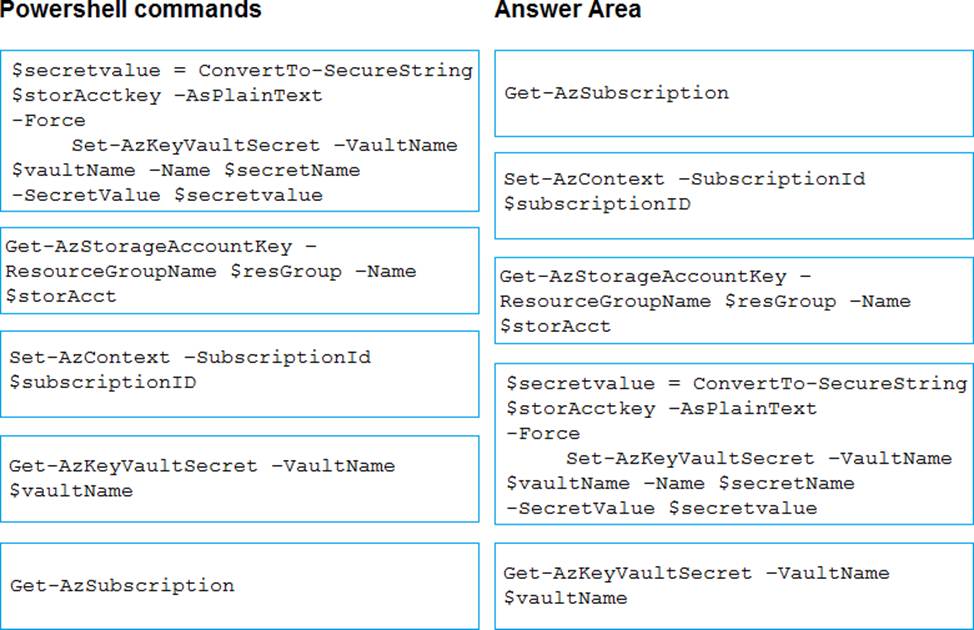
In which order should you arrange the PowerShell commands to develop the solution? To answer, move all commands from the list of commands to the answer area and arrange them in the correct order.
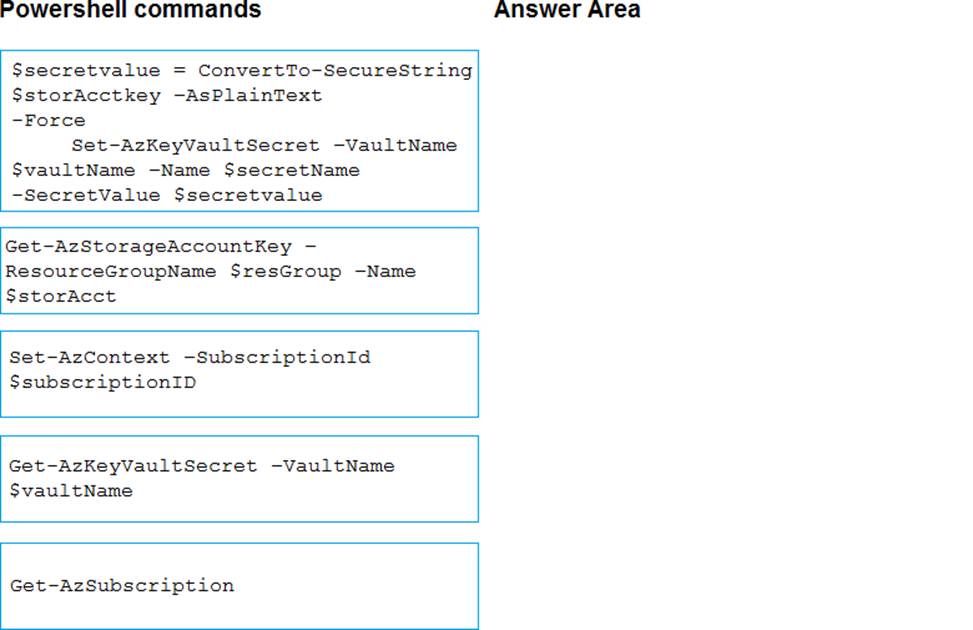
Explanation:
Step 1: Get-AzSubscription
If you have multiple subscriptions, you might have to specify the one that was used to create your key vault. Enter the following to see the subscriptions for your account:
Get-AzSubscription
Step 2: Set-AzContext -SubscriptionId
To specify the subscription that’s associated with the key vault you’ll be logging, enter:
Set-AzContext -SubscriptionId <subscriptionID>
Step 3: Get-AzStorageAccountKey
You must get that storage account key.
Step 4: $secretvalue = ConvertTo-SecureString <storageAccountKey> -AsPlainText -Force Set-AzKeyVaultSecret -VaultName <vaultName> -Name <secretName> -SecretValue $secretvalue
After retrieving your secret (in this case, your storage account key), you must convert that key to a secure string, and then create a secret with that value in your key vault.
Step 5: Get-AzKeyVaultSecret
Next, get the URI for the secret you created. You’ll need this URI in a later step to call the key vault and retrieve your secret. Run the following PowerShell command and make note of the ID value, which is the secret’s URI:
Get-AzKeyVaultSecret CVaultName <vaultName>
Reference: https://docs.microsoft.com/bs-latn-ba/Azure/key-vault/key-vault-key-rotation-log-monitoring
A development team is creating a new REST API. The API will store data in Azure Blob storage. You plan to deploy the API to Azure App Service.
Developers must access the Azure Blob storage account to develop the API for the next two months. The Azure Blob storage account must not be accessible by the developers after the two-month time period.
You need to grant developers access to the Azure Blob storage account.
What should you do?
- A . Generate a shared access signature (SAS) for the Azure Blob storage account and provide the SAS to all developers.
- B . Create and apply a new lifecycle management policy to include a last accessed date value. Apply the policy to the Azure Blob storage account.
- C . Provide all developers with the access key for the Azure Blob storage account. Update the API to include the Coordinated Universal Time (UTC) timestamp for the request header.
- D . Grant all developers access to the Azure Blob storage account by assigning role-based access control (RBAC) roles.
A
Explanation:
Reference: https://docs.microsoft.com/en-us/azure/storage/common/storage-sas-overview
HOTSPOT
You are developing an app that manages users for a video game. You plan to store the region, email address, and phone number for the player. Some players may not have a phone number. The player’s region will be used to load-balance data.
Data for the app must be stored in Azure Table Storage.
You need to develop code to retrieve data for an individual player.
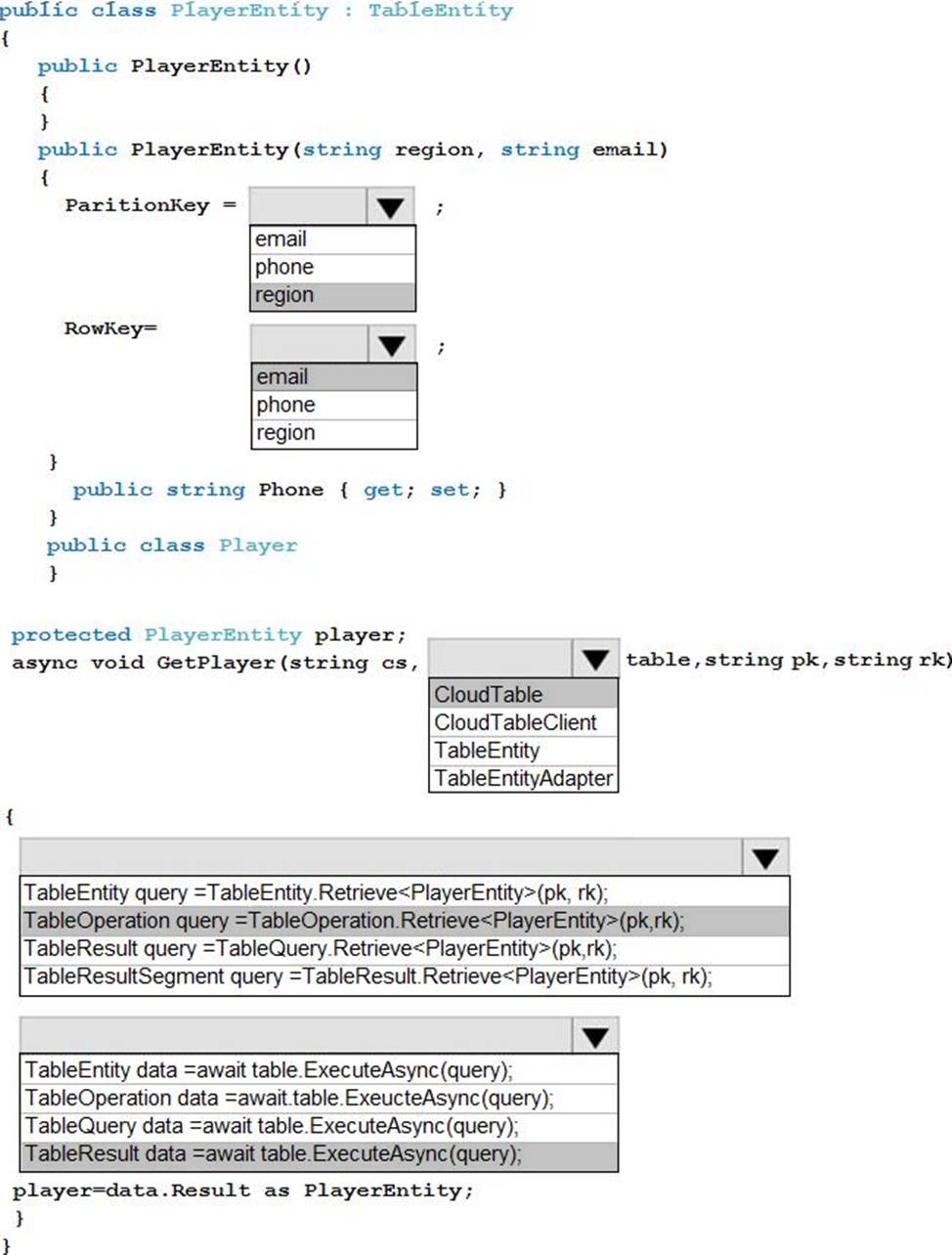
How should you complete the code? To answer, select the appropriate options in the answer area. NOTE: Each correct selection is worth one point.
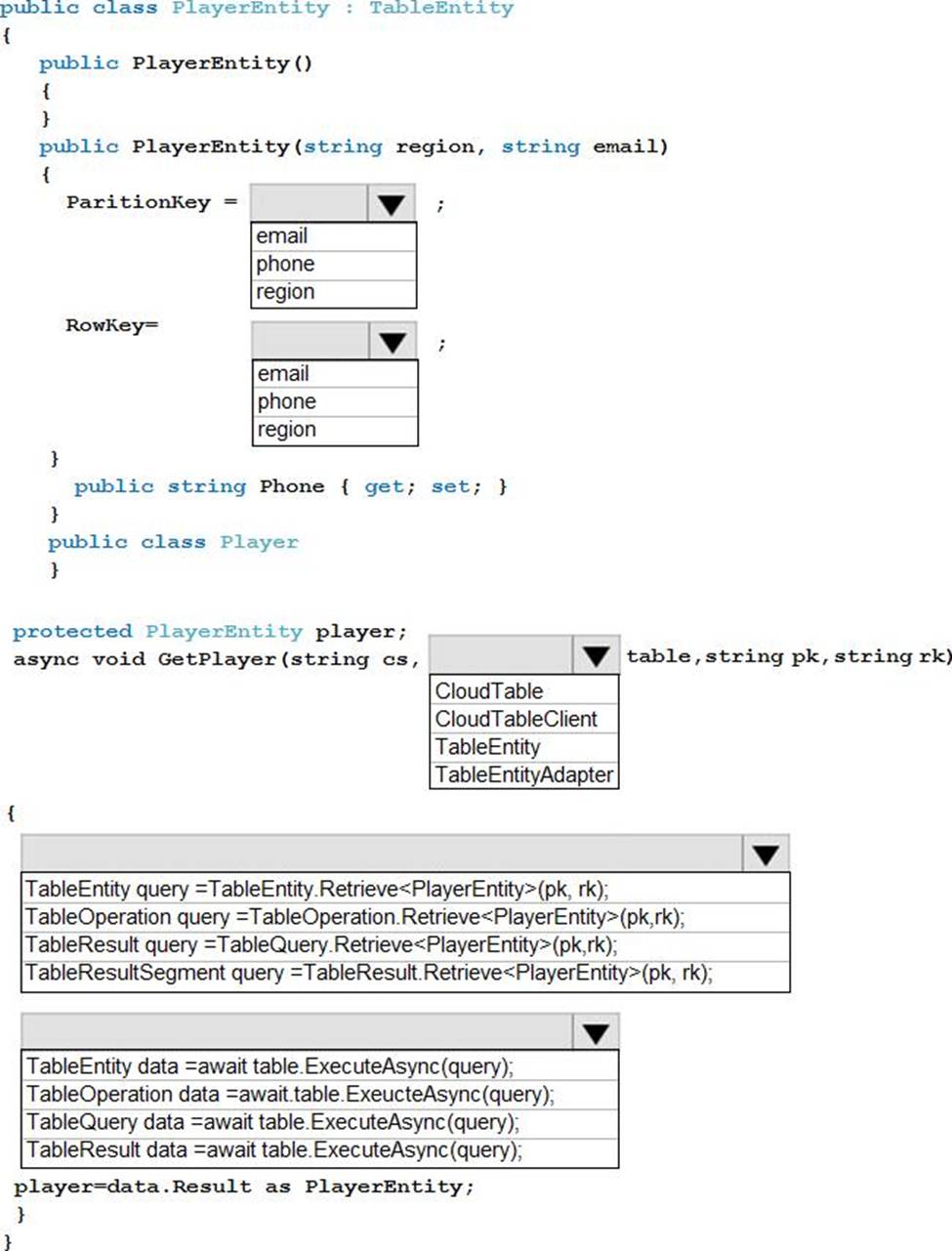
Explanation:
Box 1: region
The player’s region will be used to load-balance data.
Choosing the PartitionKey.
The core of any table’s design is based on its scalability, the queries used to access it, and storage operation requirements. The PartitionKey values you choose will dictate how a table will be partitioned and the type of queries that can be used. Storage operations, in particular inserts, can also affect your choice of PartitionKey values.
Box 2: email
Not phone number some players may not have a phone number.
Box 3: CloudTable
Box 4: TableOperation query =..
Box 5: TableResult
Reference: https://docs.microsoft.com/en-us/rest/api/storageservices/designing-a-scalable-partitioning-strategy-for-azure-table-storage
HOTSPOT
You are developing an app that manages users for a video game. You plan to store the region, email address, and phone number for the player. Some players may not have a phone number. The player’s region will be used to load-balance data.
Data for the app must be stored in Azure Table Storage.
You need to develop code to retrieve data for an individual player.
How should you complete the code? To answer, select the appropriate options in the answer area. NOTE: Each correct selection is worth one point.
Explanation:
Box 1: region
The player’s region will be used to load-balance data.
Choosing the PartitionKey.
The core of any table’s design is based on its scalability, the queries used to access it, and storage operation requirements. The PartitionKey values you choose will dictate how a table will be partitioned and the type of queries that can be used. Storage operations, in particular inserts, can also affect your choice of PartitionKey values.
Box 2: email
Not phone number some players may not have a phone number.
Box 3: CloudTable
Box 4: TableOperation query =..
Box 5: TableResult
Reference: https://docs.microsoft.com/en-us/rest/api/storageservices/designing-a-scalable-partitioning-strategy-for-azure-table-storage
HOTSPOT
You are developing an app that manages users for a video game. You plan to store the region, email address, and phone number for the player. Some players may not have a phone number. The player’s region will be used to load-balance data.
Data for the app must be stored in Azure Table Storage.
You need to develop code to retrieve data for an individual player.
How should you complete the code? To answer, select the appropriate options in the answer area. NOTE: Each correct selection is worth one point.
Explanation:
Box 1: region
The player’s region will be used to load-balance data.
Choosing the PartitionKey.
The core of any table’s design is based on its scalability, the queries used to access it, and storage operation requirements. The PartitionKey values you choose will dictate how a table will be partitioned and the type of queries that can be used. Storage operations, in particular inserts, can also affect your choice of PartitionKey values.
Box 2: email
Not phone number some players may not have a phone number.
Box 3: CloudTable
Box 4: TableOperation query =..
Box 5: TableResult
Reference: https://docs.microsoft.com/en-us/rest/api/storageservices/designing-a-scalable-partitioning-strategy-for-azure-table-storage