
Practice Free AZ-204 Exam Online Questions
HOTSPOT
You need to configure App Service to support the corporate website migration.
Which configuration should you use? To answer, select the appropriate options in the answer area NOTE: Each correct selection is worth one point.
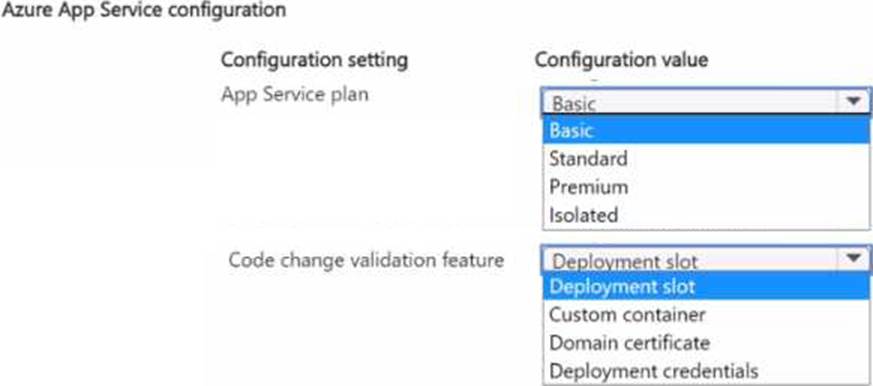
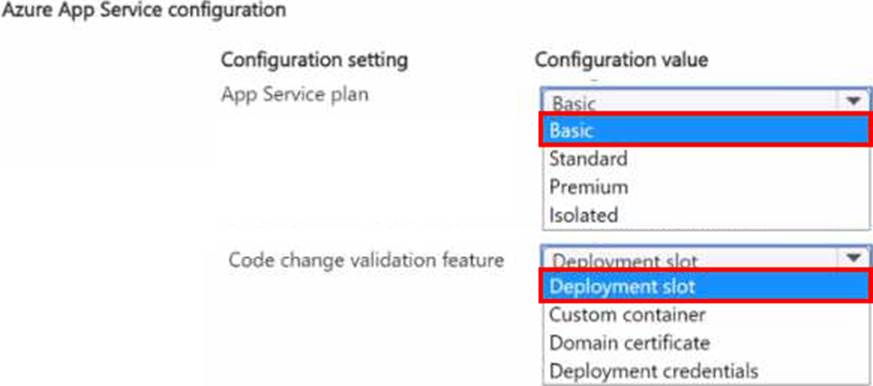
HOTSPOT
You need to configure App Service to support the corporate website migration.
Which configuration should you use? To answer, select the appropriate options in the answer area NOTE: Each correct selection is worth one point.
You develop a gateway solution for a public facing news API. The news API back end is implemented as a RESTful service and uses an OpenAPI specification.
You need to ensure that you can access the news API by using an Azure API Management service instance.
Which Azure PowerShell command should you run?
- A . Import-AzureRmApiManagementApi CContext $ApiMgmtContext CSpecificationFormat"Swagger" -SpecificationPath $SwaggerPath CPath $Path
- B . New-AzureRmApiManagementBackend -Context $ApiMgmtContext -Url $Url -Protocolhttp
- C . New-AzureRmApiManagement CResourceGroupName $ResourceGroup CName $Name CLocation $Location COrganization $Org CAdminEmail $AdminEmail
- D . New-AzureRmApiManagementBackendProxy CUrl $ApiUrl
D
Explanation:
New-AzureRmApiManagementBackendProxy creates a new Backend Proxy Object which can be piped when creating a new Backend entity.
Example: Create a Backend Proxy In-Memory Object
PS C:>$secpassword = ConvertTo-SecureString "PlainTextPassword" -AsPlainText -Force
PS C:>$proxyCreds = New-Object System.Management.Automation.PSCredential ("foo", $secpassword)
PS C:>$credential = New-AzureRmApiManagementBackendProxy -Url "http://12.168.1.1:8080" – ProxyCredential $proxyCreds
PS C:>$apimContext = New-AzureRmApiManagementContext -ResourceGroupName "Api-Default-WestUS" -ServiceName "contoso"
PS C:>$backend = New-AzureRmApiManagementBackend -Context $apimContext -BackendId 123 – Url ‘https://contoso.com/awesomeapi’ -Protocol http -Title "first backend" – SkipCertificateChainValidation $true -Proxy $credential -Description "backend with proxy server"
Creates a Backend Proxy Object and sets up Backend
Incorrect Answers:
A: The Import-AzureRmApiManagementApi cmdlet imports an Azure API Management API from a file or a URL in Web Application Description Language (WADL), Web Services Description Language (WSDL), or Swagger format.
B: New-AzureRmApiManagementBackend creates a new backend entity in Api Management.
C: The New-AzureRmApiManagement cmdlet creates an API Management deployment in Azure API Management.
Reference: https://docs.microsoft.com/en-us/powershell/module/azurerm.apimanagement/new-azurermapimanagementbackendproxy?view=azurermps-6.13.0
HOTSPOT
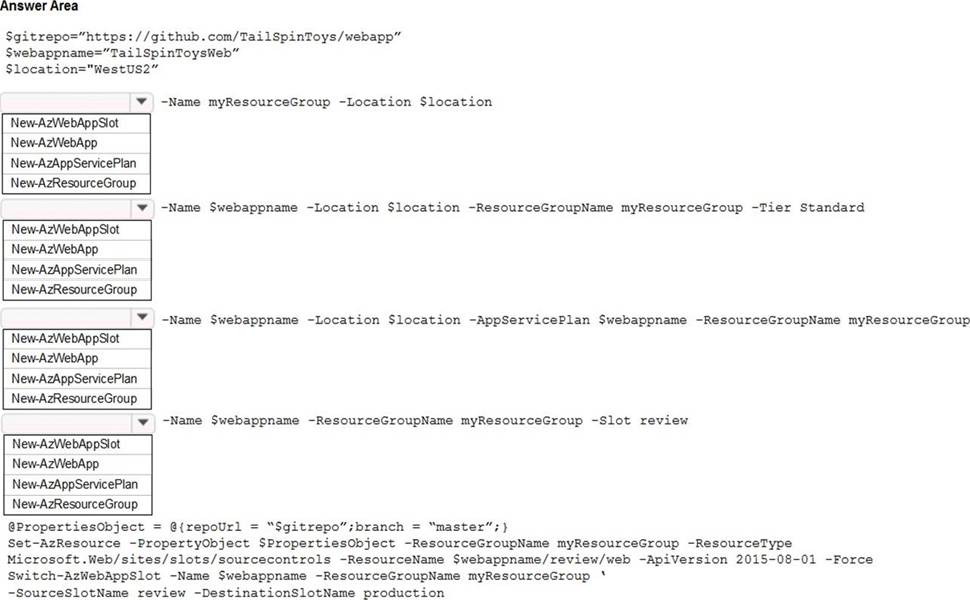
A company is developing a Node.js web app. The web app code is hosted in a GitHub repository located at https://github.com/TailSpinToys/weapp.
The web app must be reviewed before it is moved to production. You must deploy the initial code release to a deployment slot named review.
You need to create the web app and deploy the code.
How should you complete the commands? To answer, select the appropriate options in the answer area. NOTE: Each correct selection is worth one point.
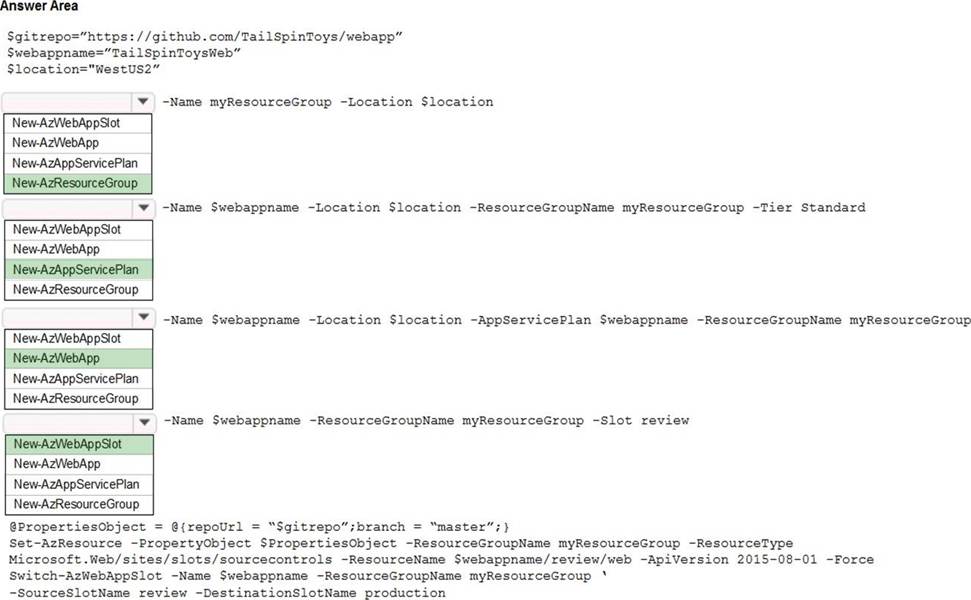
Explanation:
The New-AzResourceGroup cmdlet creates an Azure resource group.
The New-AzAppServicePlan cmdlet creates an Azure App Service plan in a given location
The New-AzWebApp cmdlet creates an Azure Web App in a given a resource group
The New-AzWebAppSlot cmdlet creates an Azure Web App slot.
Reference:
https://docs.microsoft.com/en-us/powershell/module/az.resources/new-azresourcegroup?view=azps-2.3.2
https://docs.microsoft.com/en-us/powershell/module/az.websites/new-azappserviceplan?view=azps-2.3.2
https://docs.microsoft.com/en-us/powershell/module/az.websites/new-azwebapp?view=azps-2.3.2
https://docs.microsoft.com/en-us/powershell/module/az.websites/new-azwebappslot?view=azps-2.3.2
Note: This question is part of a series of questions that present the same scenario. Each question in the series contains a unique solution. Determine whether the solution meets the stated goals.
You are developing and deploying several ASP.Net web applications to Azure App Service. You plan to save session state information and HTML output.
You must use a storage mechanism with the following requirements:
• Share session state across all ASP.NET web applications
• Support controlled, concurrent access to the same session state data for multiple readers and a single writer
• Save full HTTP responses for concurrent requests
You need to store the information.
Proposed Solution: Deploy and configure Azure Cache for Redis. Update the web applications.
Does the solution meet the goal?
- A . Yes
- B . No
A
Explanation:
The session state provider for Azure Cache for Redis enables you to share session information between different instances of an ASP.NET web application.
The same connection can be used by multiple concurrent threads.
Redis supports both read and write operations.
The output cache provider for Azure Cache for Redis enables you to save the HTTP responses generated by an ASP.NET web application.
Note: Using the Azure portal, you can also configure the eviction policy of the cache, and control access to the cache by adding users to the roles provided. These roles, which define the operations that members can perform, include Owner, Contributor, and Reader. For example, members of the Owner role have complete control over the cache (including security) and its contents, members of the Contributor role can read and write information in the cache, and members of the Reader role can only retrieve data from the cache.
Reference: https://docs.microsoft.com/en-us/azure/architecture/best-practices/caching
DRAG DROP
You are designing a solution that will use two Azure Functions apps: App1 and App2. App1 is Windows-based and will be deployed as code. App2 is Linux-based and will be deployed as a container image. Estimates show that the duration of the request processing for both apps will range from 1 to 10 minutes.
You plan to implement Appl and App2 by using the hosting plan to satisfy the following requirements:
• Request processing can complete within the estimated time range.
• The autoscaling behavior is event-driven.
• The upper scaling limit is maximized.


Explanation:
Premium to App1.
Premium to App2
You are a developing a SaaS application that stores data as key value pairs.
You must make multiple editions of the application available. In the lowest cost edition, the performance must be best-effort, and there is no regional failover.
In higher cos! editions customers must be able to select guaranteed performance and support for multiple regions. Azure costs must be minimized.
Which Azure Cosmos OB API should you use for the application?
- A . Core
- B . MongoDB
- C . Cassandra
- D . Table API
You are developing a .Net web application that stores data is Azure Consmos DB. The application must use the Core API and allow millions of reads and writes. The Azure Cosmos DII account has been created with multiple write region enabled. The application has been deployed to the East US2 and Central US region.
You need to update the application to support multi-region writes.
What are two possible ways to achieve this goal? Each correct answer presents parts of the solutions. NOTE: Each correct selection is worth one point.
- A . Update the ConnectionPolicy class for the Cosmos client and populate the PreferredLocations property based on the geo-proximity of the application.
- B . Update Azure Cosmos DB to use the Strong consistency level. Add indexed properties to the container to indicate region.
- C . Update the ConnectionPolicy class for the Cosmos client and set the UseMultipleWriteLocations property to true.
- D . Create and deploy a custom conflict resolution policy.
- E . Update Azure Cosmos DB to use the Session consistency level. Send the SessionToken property value from the FeedResponse object of the write action to the end-user by using a cookie.
HOTSPOT
You need to configure API Management for authentication.
Which policy values should you use? To answer, select the appropriate options in the answer area. NOTE: Each correct selection is worth one point.
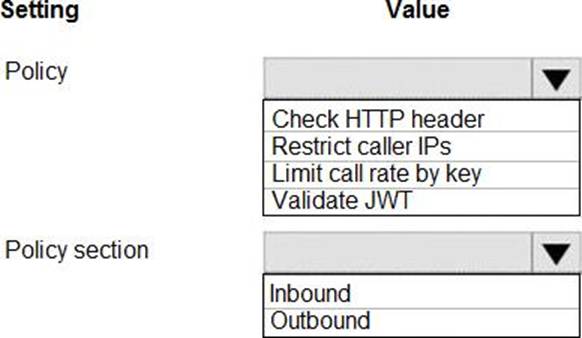
Explanation:
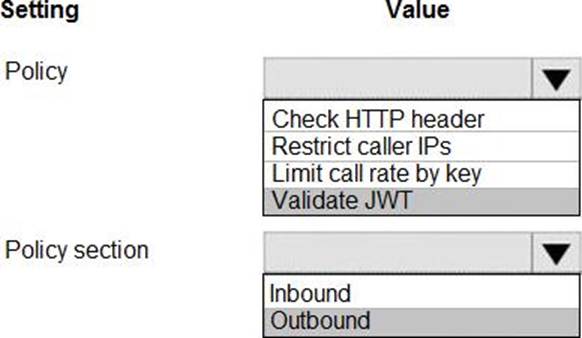
Box 1: Validate JWT
The validate-jwt policy enforces existence and validity of a JWT extracted from either a specified HTTP Header or a specified query parameter.
Scenario: User authentication (see step 5 below)
The following steps detail the user authentication process:
The user selects Sign in in the website.
The browser redirects the user to the Azure Active Directory (Azure AD) sign in page.
The user signs in.
Azure AD redirects the user’s session back to the web application. The URL includes an access token.
The web application calls an API and includes the access token in the authentication header. The application ID is sent as the audience (‘aud’) claim in the access token.
The back-end API validates the access token.
Box 2: Outbound
Reference: https://docs.microsoft.com/en-us/azure/api-management/api-management-access-restriction-policies
HOTSPOT
You need to configure API Management for authentication.
Which policy values should you use? To answer, select the appropriate options in the answer area. NOTE: Each correct selection is worth one point.
Explanation:
Box 1: Validate JWT
The validate-jwt policy enforces existence and validity of a JWT extracted from either a specified HTTP Header or a specified query parameter.
Scenario: User authentication (see step 5 below)
The following steps detail the user authentication process:
The user selects Sign in in the website.
The browser redirects the user to the Azure Active Directory (Azure AD) sign in page.
The user signs in.
Azure AD redirects the user’s session back to the web application. The URL includes an access token.
The web application calls an API and includes the access token in the authentication header. The application ID is sent as the audience (‘aud’) claim in the access token.
The back-end API validates the access token.
Box 2: Outbound
Reference: https://docs.microsoft.com/en-us/azure/api-management/api-management-access-restriction-policies