
Practice Free AZ-204 Exam Online Questions
Topic 7, VanArsdel. Ltd
Case study
Overview
This is a case study. Case studies are not timed separately. You can use as much exam time as you would like to complete each case. However, there may be additional case studies and sections on this exam. You must manage your time to ensure that you are able to complete all questions included on this exam in the time provided.
To answer the questions included in a case study, you will need to reference information that is provided in the case study. Case studies might contain exhibits and other resources that provide more information about the scenario that is described in the case study. Each question is independent of the other questions in this case study.
At the end of this case study, a review screen will appear. This screen allows you to review your answers and to make changes before you move to the next section of the exam. After you begin a new section, you cannot return to this section.
To start the case study
To display the first question in this case study, click the Next button. Use the buttons in the left pane to explore the content of the case study before you answer the questions. Clicking these buttons displays information such as business requirements, existing environment, and problem statements. If the case study has an All Information tab, note that the information displayed is identical to the information displayed on the subsequent tabs. When you are ready to answer a question, click the Question button to return to the question.
Background
VanArsdel. Ltd. is a global office supply company. The company fs based in Canada and has retail store locations across the world. The company is developing several cloud-based solutions to support their stores, distributors, suppliers, and delivery services.
Current environment
Requirements
The application components must meet the following requirements:
Corporate website
• Secure the website by using SSL
• Minimize costs tor data storage and hosting.
• Implement native GitHub workflows for continuous integration and continuous deployment (Cl/CO).
• Distribute the website content globally for local use.
• Implement monitoring by using Application Insights and availability web tests including SSL certificate validity and custom header value verification.
• The website must have 99.95 percent uptime.
Corporate website
The company provides a public website located at htlp://www. vanaisdelttd.com. The website consists of a React JavaScript user interface, HTML,CSS, image assets, and several APIs hosted in Azure functions.
Retail store locations
• Azure Functions must process data immediately when data is uploaded to Blob storage. Azure Functions must update Azure Cosmos D3 by using native SQL language queries.
• Audit store sale transaction information nightly to validate data, process sates financials, and reconcile inventory.
Delivery services
• Store service telemetry data in Azure Cosmos DB by using an Azure Function. Data must include an item id. the delivery vehicle license plate, vehicle package capacity, and current vehicle location coordinates.
• Store delivery driver profile information in Azure Active Directory Azure AD) by using an Azure Function called from the corporate website.
Inventory services
The company has contracted a third-party to develop an API for inventory processing that requires access to a specific blob within the retail store storage account for three months to include read-only access to the data.
Security
• All Azure Functions must centralize management and distribution of configuration data for different environments and geographies, encrypted by using a company-provided RSA-HSM key.
• Authentication and authorization must use Azure AD and services must use managed identities where possible.
Retail Store Locations
• You must perform a point-in-time restoration of the retail store location data due to an unexpected and accidental deletion of data.
• Azure Cosmos DB queries from the Azure Function exhibit high Request Unit (RU) usage and contain multiple, complex queries that exhibit high point read latency for large items as the function app is scaling.
HOTSPOT
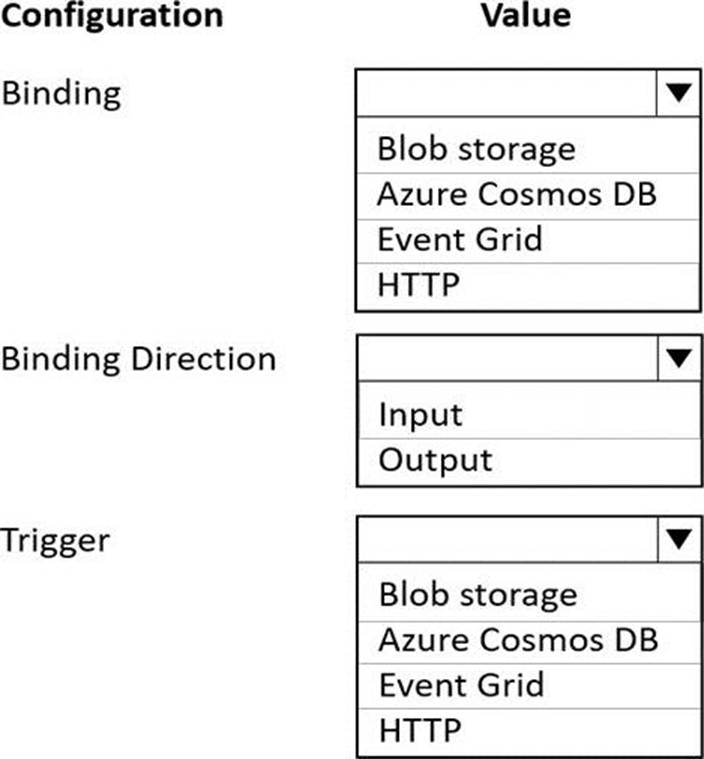
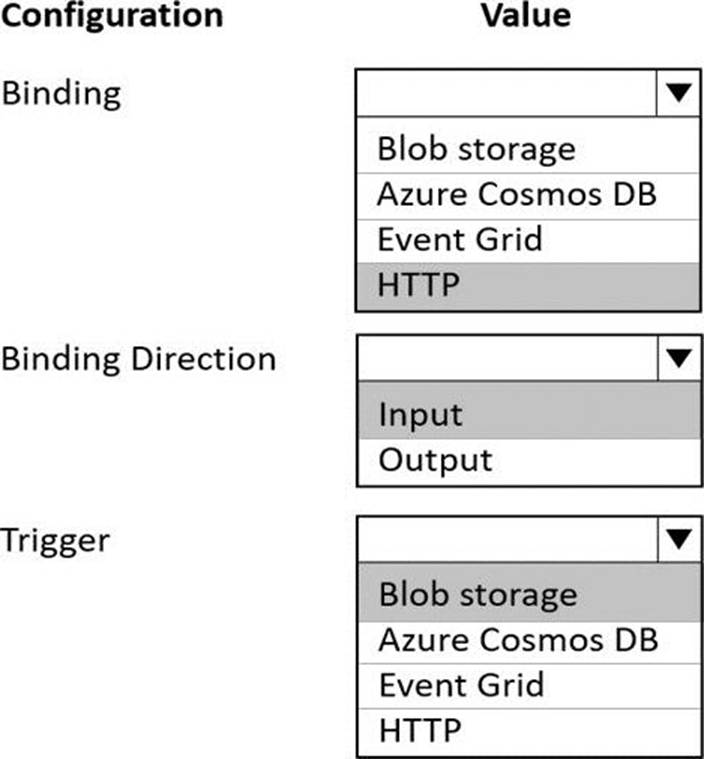
You need to Implement the retail store location Azure Function.
How should you configure the solution? To answer, select the appropriate options in the answer area. NOTE: Each correct selection is worth one point.
Explanation:
Scenario: Retail store locations: Azure Functions must process data immediately when data is uploaded to Blob storage.
Box 1: HTTP
Binding configuration example: https://<storage_account_name>.blob.core.windows.net
Box 2: Input
Read blob storage data in a function: Input binding
Box 3: Blob storage
The Blob storage trigger starts a function when a new or updated blob is detected.
Azure Functions integrates with Azure Storage via triggers and bindings. Integrating with Blob storage allows you to build functions that react to changes in blob data as well as read and write values.
Reference: https://docs.microsoft.com/en-us/azure/azure-functions/functions-bindings-storage-blob-trigger
You need to deploy the CheckUserContent Azure function. The solution must meet the security and cost requirements.
Which hosting model should you use?
- A . Consumption plan
- B . Premium plan
- C . App Service plan
DRAG DROP
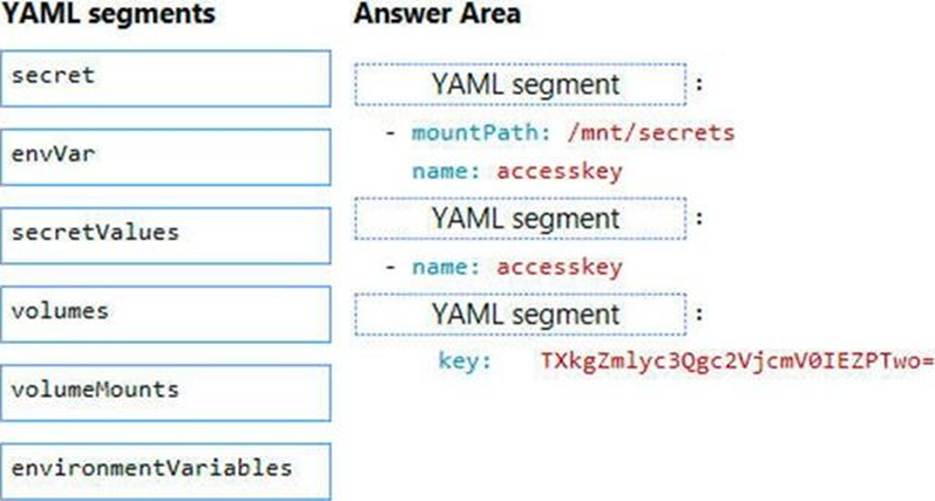
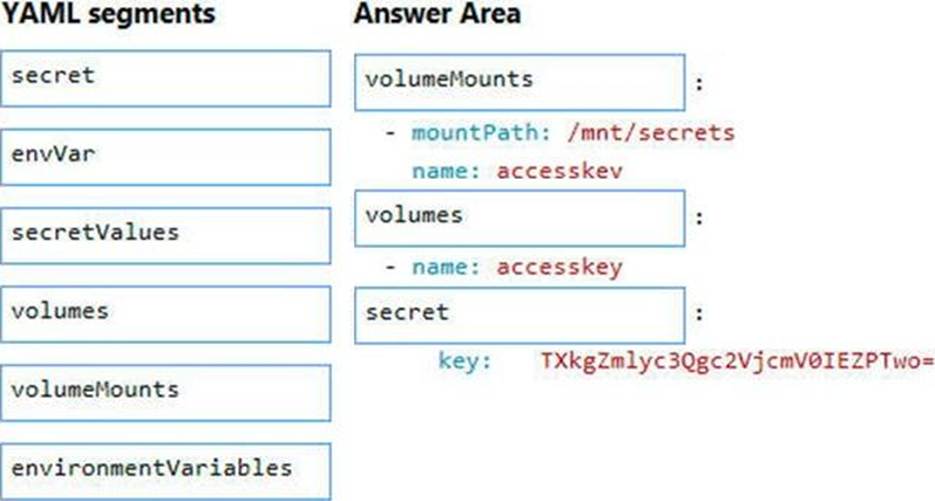
You need to add YAML markup at line CS17 to ensure that the ContentUploadService can access Azure Storage access keys.
How should you complete the YAML markup? To answer, drag the appropriate YAML segments to the correct locations. Each YAML segment may be used once, more than once, or not at all. You may need to drag the split bar between panes or scroll to view content. NOTE: Each correct selection is worth one point.
Explanation:
Box 1: volumeMounts
Example:
volumeMounts:
– mountPath: /mnt/secrets name: secretvolume1 volumes:
– name: secretvolume1 secret:
mysecret1: TXkgZmlyc3Qgc2VjcmV0IEZPTwo=
Box 2: volumes
Box 3: secret
Reference: https://docs.microsoft.com/en-us/azure/container-instances/container-instances-volume-secret
You develop Azure Durable Functions to manage vehicle loans.
The loan process includes multiple actions that must be run in a specified order. One of the actions includes a customer credit check process, which may require multiple days to process.
You need to implement Azure Durable Functions for the loan process.
Which Azure Durable Functions type should you use?
- A . orchestrator
- B . client
- C . activity
- D . entity
A company uses Azure SQL Database to store data for an app. The data includes sensitive information.
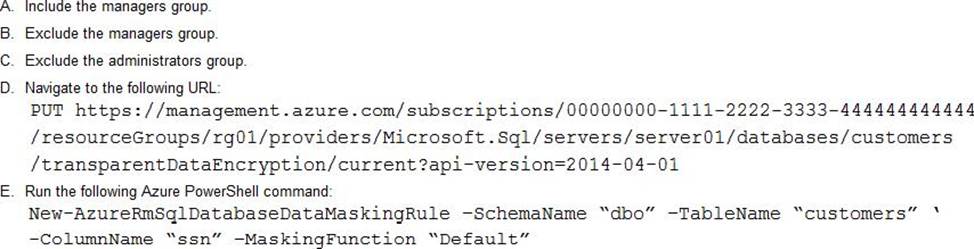
You need to implement measures that allow only members of the managers group to see sensitive information.
Which two actions should you perform? Each correct answer presents part of the solution. NOTE: Each correct selection is worth one point.
- A . Option A
- B . Option B
- C . Option C
- D . Option D
- E . Option E
B,E
Explanation:
Dynamic data masking helps prevent unauthorized access to sensitive data by enabling customers to designate how much of the sensitive data to reveal with minimal impact on the application layer.
SQL users excluded from masking – A set of SQL users or AAD identities that get unmasked data in the SQL query results.
Note: The New-AzureRmSqlDatabaseDataMaskingRule cmdlet creates a data masking rule for an Azure SQL database.
Reference: https://docs.microsoft.com/en-us/powershell/module/azurerm.sql/new-azurermsqldatabasedatamaskingrule?view=azurermps-6.13.0
You ate developing an application that allows users to find musicians that ate looking for work. The application must store information about musicians, the instruments that they play, and other related data.
The application must also allow users to determine which musicians have played together, including groups of three or more musicians that have performed together at a specific location.
Which Azure Cosmos D6 API should you use for the application?
- A . Core
- B . MongoDB
- C . Cassandra
- D . Gremlin
Note: This question is part of a series of questions that present the same scenario. Each question in the series contains a unique solution that might meet the stated goals. Some question sets might have more than one correct solution, while others might not have a correct solution.
After you answer a question in this section, you will NOT be able to return to it. As a result, these questions will not appear in the review screen.
You are developing an Azure solution to collect point-of-sale (POS) device data from 2,000 stores located throughout the world. A single device can produce 2 megabytes (MB) of data every 24 hours. Each store location has one to five devices that send data.
You must store the device data in Azure Blob storage. Device data must be correlated based on a device identifier. Additional stores are expected to open in the future.
You need to implement a solution to receive the device data.
Solution: Provision an Azure Event Grid. Configure event filtering to evaluate the device identifier.
Does the solution meet the goal?
- A . Yes
- B . No
B
Explanation:
Instead use an Azure Service Bus, which is used order processing and financial transactions.
Note: An event is a lightweight notification of a condition or a state change. Event hubs is usually used reacting to status changes.
Reference: https://docs.microsoft.com/en-us/azure/event-grid/compare-messaging-services
HOTSPOT
You are working for Contoso, Ltd.
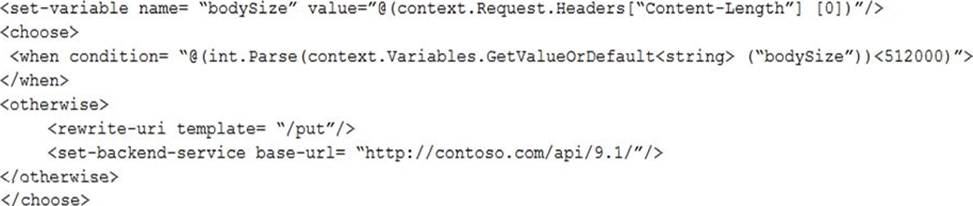
You define an API Policy object by using the following XML markup:
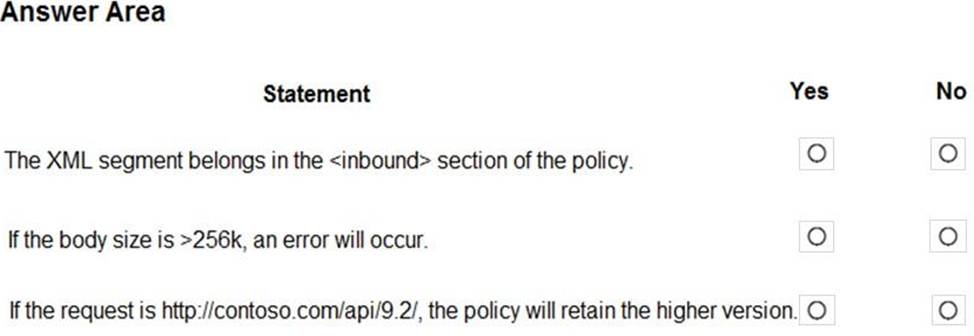
For each of the following statements, select Yes if the statement is true. Otherwise, select No. NOTE: Each correct selection is worth one point.
Explanation:
Box 1: Yes
Use the set-backend-service policy to redirect an incoming request to a different backend than the one specified in the API settings for that operation. Syntax: <set-backend-service base-url="base URL of the backend service" />
Box 2: No
The condition is on 512k, not on 256k.
Box 3: No
The set-backend-service policy changes the backend service base URL of the incoming request to the one specified in the policy.
Reference: https://docs.microsoft.com/en-us/azure/api-management/api-management-transformation-policies
HOTSPOT
You are working for Contoso, Ltd.
You define an API Policy object by using the following XML markup:
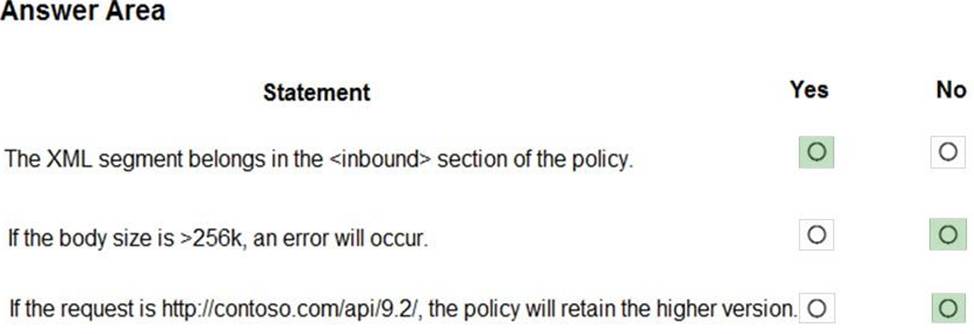
For each of the following statements, select Yes if the statement is true. Otherwise, select No. NOTE: Each correct selection is worth one point.
Explanation:
Box 1: Yes
Use the set-backend-service policy to redirect an incoming request to a different backend than the one specified in the API settings for that operation. Syntax: <set-backend-service base-url="base URL of the backend service" />
Box 2: No
The condition is on 512k, not on 256k.
Box 3: No
The set-backend-service policy changes the backend service base URL of the incoming request to the one specified in the policy.
Reference: https://docs.microsoft.com/en-us/azure/api-management/api-management-transformation-policies
A company is developing a solution that allows smart refrigerators to send temperature information to a central location. You have an existing Service Bus.
The solution must receive and store messages until they can be processed. You create an Azure Service Bus instance by providing a name, pricing tier, subscription, resource group, and location.
You need to complete the configuration.
Which Azure CLI or PowerShell command should you run?
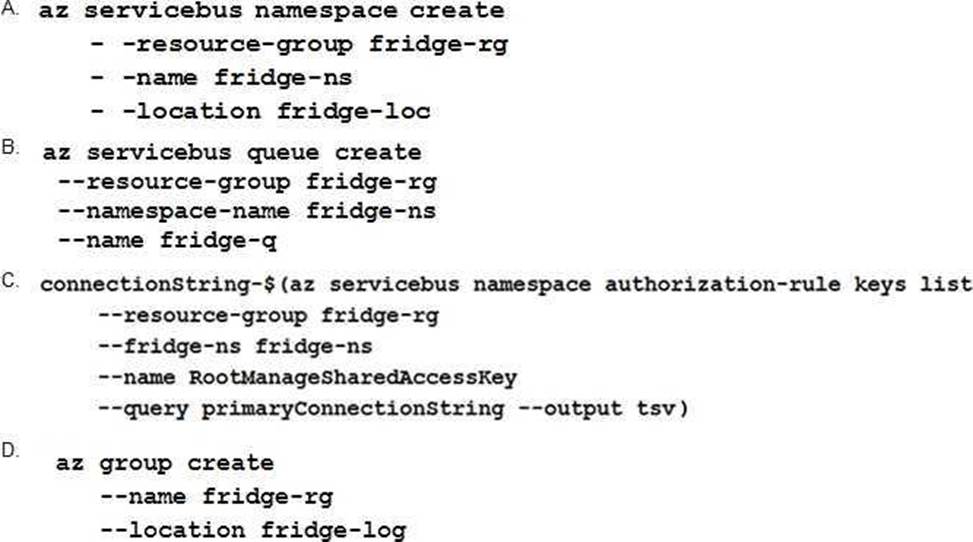
- A . Option A
- B . Option B
- C . Option C
- D . Option D
B
Explanation:
A service bus instance has already been created (Step 2 below). Next is step 3, Create a Service Bus queue.
Note:
Steps:
Step 1: # Create a resource group
resourceGroupName="myResourceGroup"
az group create –name $resourceGroupName –location eastus
Step 2: # Create a Service Bus messaging namespace with a unique name namespaceName=myNameSpace$RANDOM
az servicebus namespace create –resource-group $resourceGroupName –name $namespaceName — location eastus
Step 3: # Create a Service Bus queue
az servicebus queue create –resource-group $resourceGroupName –namespace-name $namespaceName –name BasicQueue
Step 4: # Get the connection string for the namespace
connectionString=$(az servicebus namespace authorization-rule keys list –resource-group
$resourceGroupName –namespace-name $namespaceName –name RootManageSharedAccessKey – -query primaryConnectionString –output tsv)
Reference: https://docs.microsoft.com/en-us/azure/service-bus-messaging/service-bus-quickstart-cli