
Practice Free ACD201 Exam Online Questions
You need to implement a requirement where a third-party system starts a process in Appian. The third-party system can invoke a service only through Web Services Description Language (WSDL).
What should you do to start the process in Appian?
- A . Create a default WSDL URL using process model UUID.
- B . Create a custom plug-in.
- C . Expose process model as a web service.
C
Explanation:
To allow a third-party system to start a process in Appian using WSDL, you should expose the process model as a web service. This generates a WSDL endpoint that the external system can invoke.
You need to implement a field-level audit functionality on the application data, and then display a log of the changes made over time to the users.
What should you do?
- A . Create Audit table(s) and create stored procedures on each transaction table to compare and save the modified data.
- B . Create utility process model(s) to insert new version of the modified data for the same record into the transaction tables on modification.
- C . Create Audit table(s) and create triggers on each transaction table to record modifications into the Audit table.
C
Explanation:
Creating audit tables and using triggers on each transaction table ensures that all field-level changes are automatically recorded at the database level, providing a reliable and consistent audit log for display to users.
You need to test a related action that updates record data.
Appropriate users must be able to access the form. You also need to ensure that the data is successfully updated.
Using Appian, which is the best testing method you should use?
- A . User Accepting Testing
- B . Unit Testing
- C . Performance Testing
A
Explanation:
User Acceptance Testing (UAT) is the best method, as it ensures appropriate users can access the form and verifies that the data update process works as intended in a real-world scenario.
You’re designing a process used to notify multiple users of marketing campaigns. These campaigns occur infrequently, but are sent out to the hundreds of customers that are stored in your app.
How should you best design your process model to send the emails whilst using a common email process model (CMN_SendEmail), to be most performant?
The outputs of this node are not required for the main process.
- A . Set “CMN_SendEmail” as a “Start Process” process node and select “Automatically run multiple instances of this node” for all the users that are on the mailing list.
- B . Set “CMN_SendEmair” as an asynchronous “ Subprocess" node and select "Automatically run multiple instances of this node" for all the users that are on the mailing list.
- C . Set “CMN-SendEmail” as a synchronous "Subprocess" node and select “Automatically run multiple instances of this node” for all the users that are on the mailing list.
A
Explanation:
Using "Start Process" as the node type and enabling "Automatically run multiple instances of this node" for all users on the mailing list launches each email as a separate, lightweight process, maximizing performance and scalability, especially since the main process does not require the outputs.
Your client wants to configure user authentication using single sign-on (SSO) in their cloud environment.
Which two authentication types should you use to support this requirement? (Choose two.)
- A . PIEE user authentication
- B . LDAP authentication
- C . OpenID Connect authentication
- D . Appian authentication
C, D
Explanation:
OpenID Connect authentication supports single sign-on (SSO) by integrating with external identity providers.
Appian authentication can work in conjunction with SSO configurations as part of a hybrid setup or fallback mechanism.
DRAG DROP
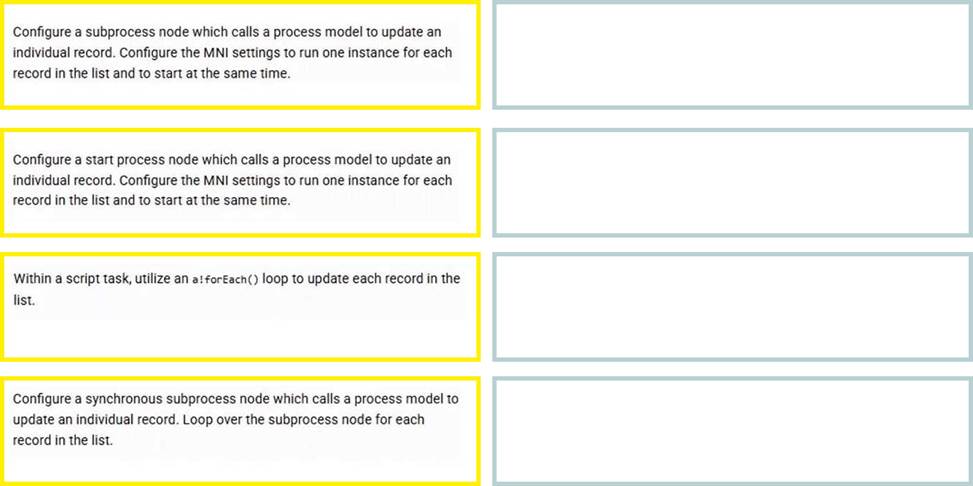
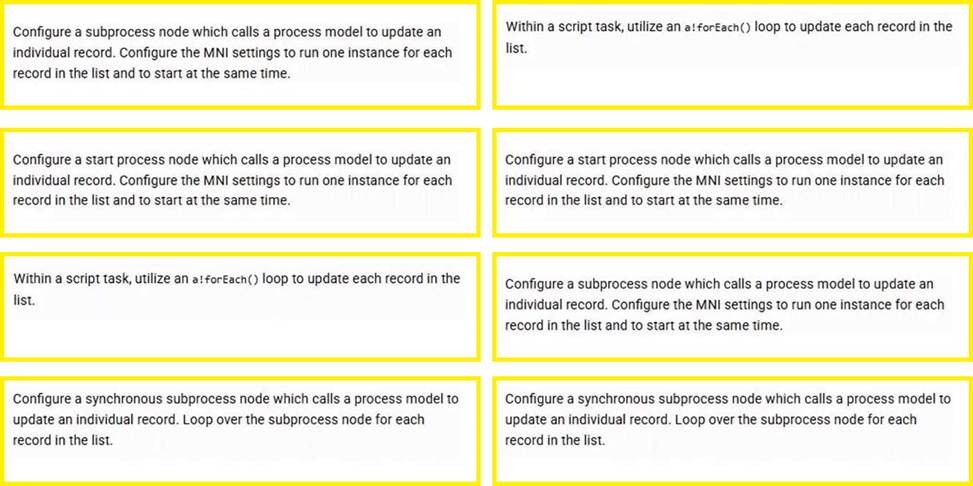
You’re creating a process to update specific fields in a list of records and you save the updated records to the database.
You’re given the following performance considerations:
– Execution time
– Process instance memory usage
– Process execution engine load balancing
Based on these performance metrics, rank the options from best to worst. Note: To answer, move all steps from the Options list to the Answer List area and arrange them in the correct ranking order (best at the top, and worst at the bottom).
After reviewing the latest Expression performance logs, you notice you have several expressions contributing to slow interface or process performance.
Which two conditions will lead to a higher risk associated with slow-performing expressions? (Choose two.)
- A . When the expression is used in a local variable.
- B . When the expression is used frequently or by many concurrent users.
- C . When the expression is evaluated on a mobile device.
- D . When the expression is a custom function plug-in.
B, D
Explanation:
When the expression is used frequently or by many concurrent users.
A slow-running rule that executes a large number of times – or is triggered by many users at once – multiplies its performance impact, raising the overall risk flagged in the expression-performance logs.
When the expression is a custom function plug-in.
Custom Java plug-ins can introduce additional processing overhead (or poorly optimized code). If such functions are slow, they typically appear near the top of performance logs and carry a higher risk score.
You have a requirement to implement an audit trail for any modifications to a record.
You need to select the most efficient design option that has the least impact on your Appian application.
What should you do?
- A . Create a trigger on the database table to capture the audit trail to a table
- B . Create an Appian process to capture the change history and write the audit trail to the database
- C . Create a custom plug in that can write an audit trail to a log file.
Which section of the Interface Performance View explains the contribution towards the overall evaluation time of the current function, rule, or parameter?
- A . Parameters and Direct Children
- B . Precedent Functions and Rules
- C . Descendant Rules
A
Explanation:
The "Parameters and Direct Children" section of the Interface Performance View explains the contribution towards the overall evaluation time of the current function, rule, or parameter.
Your client reported that a form in the application is very slow to load.
You investigate and find a query entity which is nor performing well.
Which action should you perform to improve query performance for the query entity?
- A . Change the data source of the query entity to a view with a WHERE clause.
- B . Apply indices on all the fields referred in the query.
- C . Apply the appropriate filters and indices in both Appian and the database.
C
Explanation:
Applying appropriate filters and indices in both Appian and the database ensures that only relevant data is retrieved and the database query runs efficiently, improving overall query performance.