
Practice Free AB-620 Exam Online Questions
An agent calls a flow that intermittently produces unexpected results during execution.
The agent behaves inconsistently.
You need to investigate agent flow executions to diagnose the issue.
Which two actions should you use? Each correct answer presents a complete solution. NOTE: Each correct selection is worth one point.
- A . Inspect failed run details.
- B . Update the flow trigger definition.
- C . Check the Error column in the Activity tab.
- D . Review flow analytics summary.
- E . Review flow run history.
- F . Increase the connector timeout.
DRAG DROP
A company is building a Copilot Studio solution that must answer policy questions, retrieve operational metrics from structured data, and execute authenticated updates in backend systems. The company decides to use multiple specialized agents rather than a single monolithic agent. Custom agents for each action already exist.
To meet the business needs, the solution must meet the following requirements:
✑ The solution must retrieve up to date metrics from structured data.
✑ The solution must answer policy questions using curated knowledge.
✑ The solution must execute authenticated updates during conversations.
You need to select the appropriate agent design for each requirement.
Which approach should you use for each requirement? To answer, move the appropriate configurations to the correct requirements. You may use each configuration once, more than once, or not at all. You may need to move the split bar between panes or scroll to view content. NOTE: Each correct selection is worth one point.


An agent in Copilot Studio must retrieve real-time data from an external system that exposes a REST API.
The API returns structured JSON data and requires authentication.
The agent must call the API during conversations to fulfill user requests.
The agent must retrieve real-time data from the external system by calling an authenticated REST API during a conversation.
The solution must use a supported mechanism that executes the REST API call and the call must be explicitly configured to run at runtime.
You need to determine which approaches add the REST API to the agent.
Which two solutions meet the goal? Each correct answer is a complete solution. NOTE: Each correct selection is worth one point.
- A . Configure an HTTP action and invoke it from a topic during the conversation.
- B . Create a topic variable and use a Formula to parse the API endpoint string.
- C . Add the REST API as a tool and call it either by using a topic or agent instruction.
- D . Add the REST API as a knowledge source so the agent can query it during conversations.
- E . Enable generative answers and rely on the model to fetch the REST API data automatically.
- F . Create a global variable to store the API URL and call it using a Redirect node.
A company is building an agent in Copilot Studio.
The agent must meet the following requirements:
✑ Responses must be grounded in approved internal content.
✑ The agent must be able to retrieve information from configured data sources in a topic.
You need to configure the agent so that topic responses are grounded from custom data sources.
What should you configure?
- A . Enable analytics to review which topics users trigger most often.
- B . Add a custom prompt that tells the agent to answer only from company data.
- C . Configure knowledge sources in a generative answers node.
- D . Add SharePoint as a knowledge source only at the agent level.
- E . Increase the response length limit to improve answer completeness.
HOTSPOT
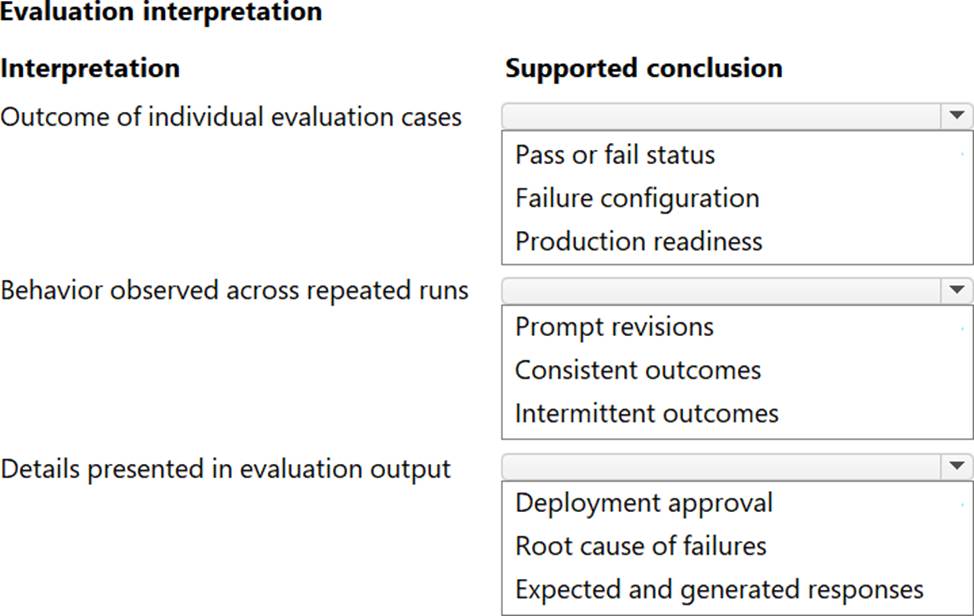
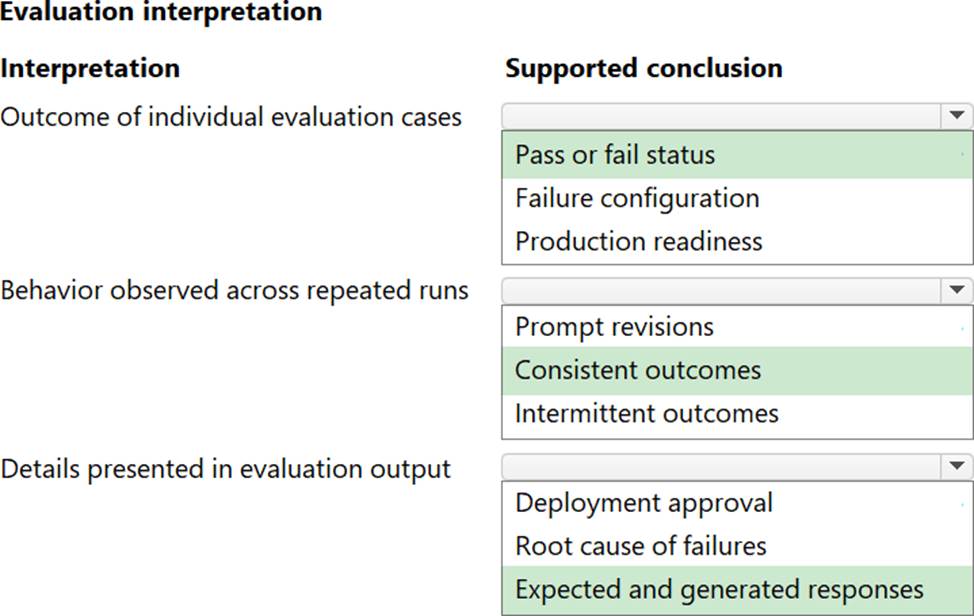
You run multiple evaluation tests for an agent in Copilot Studio before expanding user access.
You observe the following about the evaluation results:
✑ Each evaluation case is reported as meeting or missing the expected response.
✑ Some evaluation cases fail repeatedly across several runs.
✑ Each run displays the expected response and the response generated by the agent.
You need to interpret what the evaluation results reveal.
What should you conclude based on each interpretation? To answer, select the appropriate options in the answer area. NOTE: Each correct selection is worth one point.
HOTSPOT
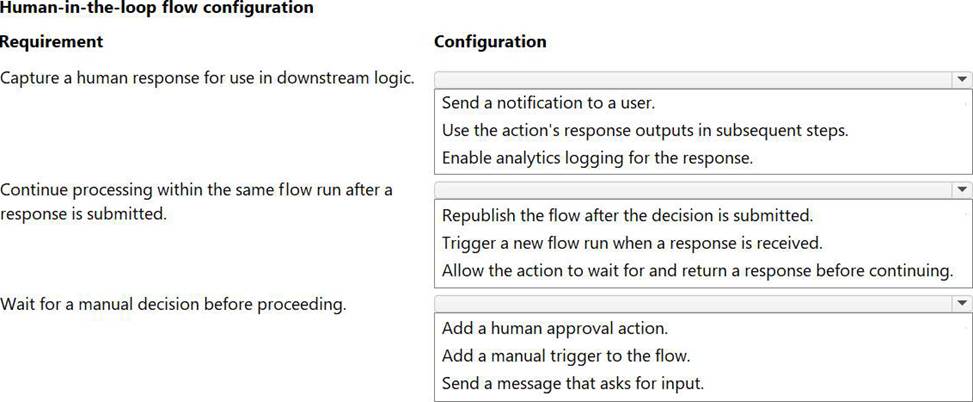
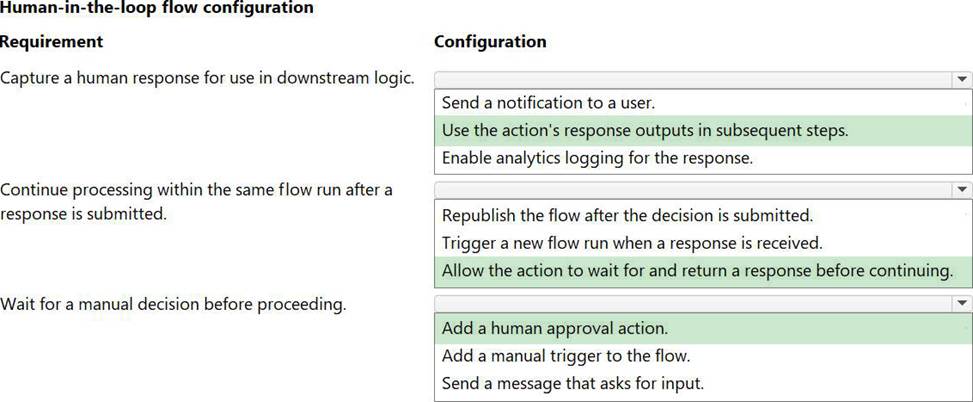
A company uses an agent flow that occasionally requires human input before continuing execution.
Some automated actions must pause until a human provides a decision or additional information .
The flow must be configured to:
✑ Capture a human response for use in later steps.
✑ Continue processing within the same flow run after the response is submitted.
Wait for a manual decision before proceeding.
You need to configure a human-in-the-loop agent flow.
Which setting should you configure for each requirement? To answer, select the appropriate options in the answer area. NOTE: Each correct selection is worth one point.
A company must enable an agent in Copilot Studio to execute operations exposed by an external MCP server.
The MCP server publishes callable tools and requires authentication.
The agent must be able to invoke MCP tools during conversations.
You need to configure MCP tools so the agent can execute MCP tool calls.
What should you do?
- A . Enable generative answers so the model can automatically invoke MCP tools.
- B . Add a Power Platform connector as real-time knowledge to replace MCP tools.
- C . Add the MCP server output as an indexed knowledge source.
- D . Configure authentication for the MCP server connection used by the agent.
DRAG DROP
A company configures an agent flow that interacts with multiple systems to complete user requests.
The company must integrate external services, retrieve data, and notify users as part of the same automated flow run .
To support this scenario, the agent flow must be able to do the following:
✑ Call an external API.
✑ Retrieve stored data from a supported internal data source.
✑ Send a Teams message.
You need to select a connector or action type for each requirement.
What should you use? To answer, move the appropriate connectors or actions to the correct requirements. You may use each connector or action once, more than once, or not at all. You may need to move the split bar between panes or scroll to view content. NOTE: Each correct selection is worth one point.


DRAG DROP
Case Study
This is a case study. Case studies are not timed separately from other exam sections. You can use as much exam time as you would like to complete each case study. However, there might be additional case studies or other exam sections. Manage your time to ensure that you can complete all the exam sections in the time provided. Pay attention to the Exam Progress at the top of the screen so you have sufficient time to complete any exam sections that follow this case study.
To answer the case study questions, you will need to reference information that is provided in the case. Case studies and associated questions might contain exhibits or other resources that provide more information about the scenario described in the case. Information provided in an individual question does not apply to the other questions in the case study.
A Review Screen will appear at the end of this case study. From the Review Screen, you can review and change your answers before you move to the next exam section. After you leave this case study, you will NOT be able to return to it.
To start the case study
To display the first question in this case study, select the "Next" button. To the left of the question, a menu provides links to information such as business requirements, the existing environment, and problem statements. Please read through all this information before answering any questions. When you are ready to answer a question, select the "Question" button to return to the question.
Background
Blue Yonder Airlines is a global carrier headquartered in Los Angeles, California, operating domestic and international flights. The company serves millions of passengers annually through its website, mobile app, and call centers. To improve customer service efficiency and reduce call center volume, Blue Yonder is deploying an AI agent in Microsoft Copilot Studio.
The agent will handle customer inquiries across multiple channels C web chat, mobile app, and Microsoft Teams (for internal support staff). It will answer questions, retrieve data from enterprise systems, and escalate to human agents when needed .
The project is led by a cross-function team:
Product manager: Defines requirements and success metrics.
Lead agent author: Designs topics, intents, and generative behavior.
Flow designers: Build agent flows and integrations.
IT/security and compliance: Oversees identity, data protection, and Responsible AI (RAI) compliance.
Current environment
Channels
Public website: Embedded web chat
Mobile app: In-app chatbot
Microsoft Teams: Internal support agent access
Identity and access
Customers: Anonymous access for general inquiries (e.g., flight status, baggage policy).
Authentication is required for personal data access (e.g., bookings, loyalty points).
Internal staff: Authenticate via Microsoft Entra ID.
Data sources
Reservation and Ticketing System (internal): REST API, no prebuilt connector with custom enterprise database.
Flight Status and Weather APIs (external): REST APIs with API keys.
Customer Support Knowledge Base: SharePoint library with PDFs and policy documents.
Loyalty Program Data: Stored in Dynamics 365 and Dataverse.
Travel Advisory Content: Uses REST API with partner services.
Integration mechanisms
Custom connectors must be used for internal APIs that lack prebuilt connectors.
HTTP request nodes may be used for lightweight external APIs.
Knowledge sources must be used for unstructured content.
Agent flows must be used to encapsulate reusable logic (e.g., rebooking).
Business requirements
Omnichannel support
Deploy the agent across web, mobile, and Teams with a consistent user experience. The Teams deployment must also support internal staff.
Self-service capabilities
The agent must handle common inquiries such as:
Flight status
Booking and rebooking
Loyalty program questions
Travel policies and baggage rules
Human escalation
If the agent cannot resolve an issue or the user requests help, it must:
Escalate to a human agent.
Transfer the conversation transcript and relevant context.
Redact any sensitive personal data before escalation.
Knowledge integration
The agent must use scalable methods for knowledge integration and must not rely on manually authored Q&A topics for each document.
Performance metrics
First-contact resolution: +25%
Tier-1 call deflection: ≥20%
Response time: 90% of queries answered within 30 seconds
Accuracy: ≥95% for known FAQs
CSAT: ≥85% for AI-handled interactions
Technical requirements
Platform constraints
No custom code is permitted; only Copilot Studio’s built-in tools may be used.
All backend logic must be implemented using agent flows.
Markdown must be used for formatting (e.g., bold, bullet points); HTML is not supported.
Authentication
Sign-in is required for personal data access.
Anonymous access is allowed for general inquiries.
User identity must be used for data access; shared or builder credentials must not be used.
Compliance and security
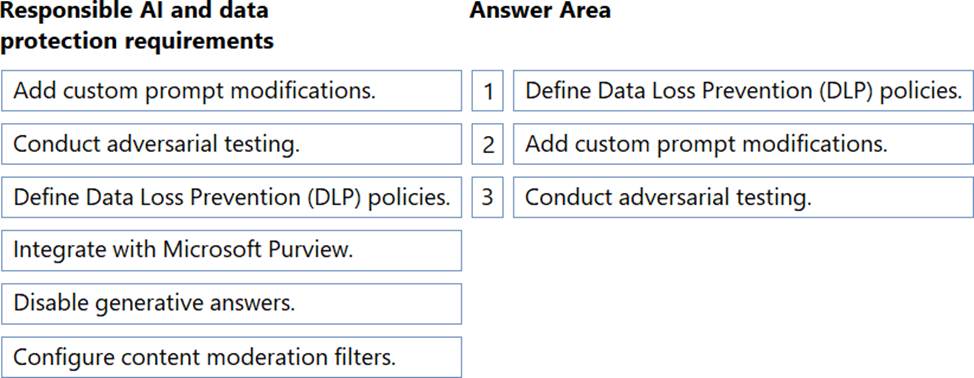
Power Platform DLP policies must be enforced to block unauthorized data flows.
Responsible AI content moderation filters must be enabled.
Prompt modifications must be added to enforce tone, disclaimers, and refusal behavior.
Disclaimers must be applied consistently across all generative responses. Manual edits to individual topics must be avoided.
Monitoring and maintenance
All conversations and actions must be logged for auditing.
Weekly reviews of transcripts and metrics must be conducted.
Issues and constraints
API rate limits: External APIs (e.g., flight status) have usage limits. Agent flows must handle retries and caching to avoid exceeding quotas.
Knowledge base limits: Copilot Studio has limits on the number and size of indexed documents. Large files must be split or summarized.
Generative answer risks: Generative responses must be constrained to avoid policy violations. Prompt modifications and filters must be used to enforce tone, safety, and compliance.
User input variability: Users phrase questions in diverse ways. Topics must include varied trigger phrases and fallback handling.
Authentication UX: The agent must clearly explain when sign-in is required and handle transitions smoothly across channels.
Problem statement
Blue Yonder Airlines must deploy a secure, scalable, and policy-compliant AI agent using Microsoft Copilot Studio. The agent must deliver accurate, helpful, and safe responses across multiple channels, integrate with enterprise systems, and support both anonymous and authenticated users. It must adhere to strict data protection and Responsible AI standards while improving customer service efficiency and satisfaction.
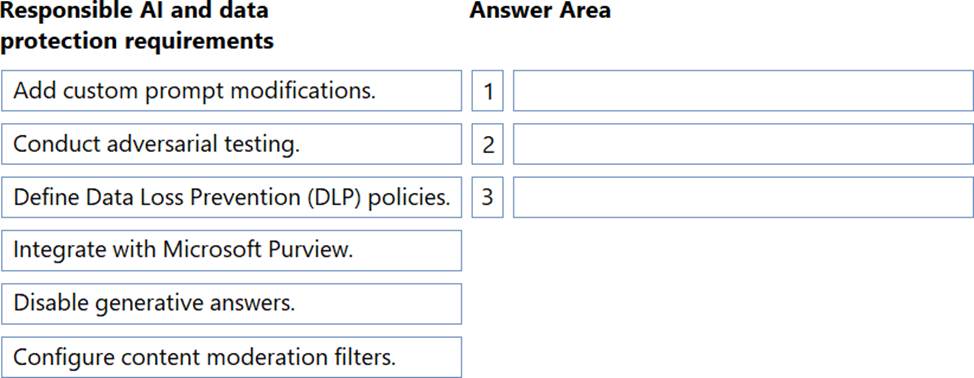
You need to configure the agent in Copilot Studio to meet Blue Vender’s Responsible AI and data protection requirements.
Which three actions should you perform in sequence? To answer, move the appropriate actions from the list of actions to the answer area and arrange them in the correct order.
You create a test set in Copilot Studio to evaluate an agent that answers policy questions and retrieves data from connected knowledge sources.
You run the evaluation and review the following result for one test case:
Expected response: Digital products are non-refundable after download.
Actual response: Digital products cannot be refunded once downloaded.
Result: Pass –
Score: 0.92 –
Reasoning: The actual response semantically matches the expected response.
Knowledge sources used: RefundPolicy_KB
Tools invoked: None –
You need to determine whether additional corrective action is required based on the evaluation results.
Which two actions should you perform? Each correct answer presents a complete solution. NOTE: Each correct selection is worth one point.
- A . Investigate external tool configuration for this test case.
- B . Rerun the evaluation because the score is below 1.00.
- C . Accept the result because semantic matching is sufficient for a passing evaluation.
- D . Confirm that the connected knowledge source is functioning as expected.
- E . Modify the test case because the response is not an exact match.