
Practice Free 350-501 Exam Online Questions
What is the primary purpose of the flexible algorithm in a segment-routing environment?
- A . to distribute designated-path information for certain traffic classes to maintain routing information in accordance with current network-performance indicators
- B . to integrate with legacy routing protocols to ensure backward compatibility and a smooth transition in mixed network environments
- C . to determine and assign labels for specific types of traffic, ensuring that routes maintain a valid backup path as network conditions change
- D . to support adaptive path selection, optimizing network performance based on real-time network metrics
Refer to the exhibit:
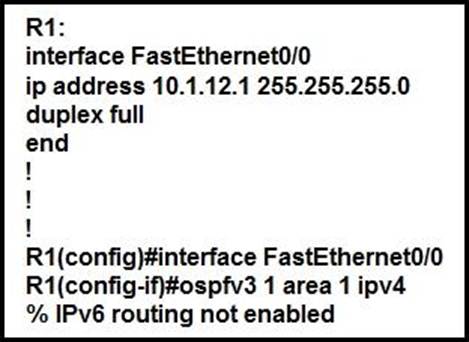
A network engineer is implementing an OSPF configuration Based on the output, which statement is true?
- A . In the ospfv3 1 area 1 ipv4 command, area 0 must be configured instead of area 1.
- B . OSPFv3 does not run for IPv4 on FastEthemet0/0 until IPv6 routing is enabled on the router and IPv6 is enabled on interface Fastfc.thernet0/0
- C . OSPFv3 cannot be configured for IPv4; OSPFv3 works only for IPv6.
- D . IPv6 routing not enabled" is just an informational message and OSPFv3 runs for IPv4 on interface FastEthernet0/0 anyway
D
Explanation:
OSPFv3 is designed to support both IPv4 and IPv6. The message “IPv6 routing not enabled” indicates that IPv6 has not been configured on the router, but this does not prevent OSPFv3 from running for IPv4. The OSPFv3 configuration for IPv4 will still function on the interface FastEthernet0/0 as intended.
Refer to the exhibit.
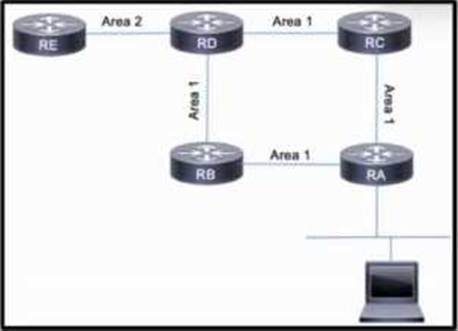
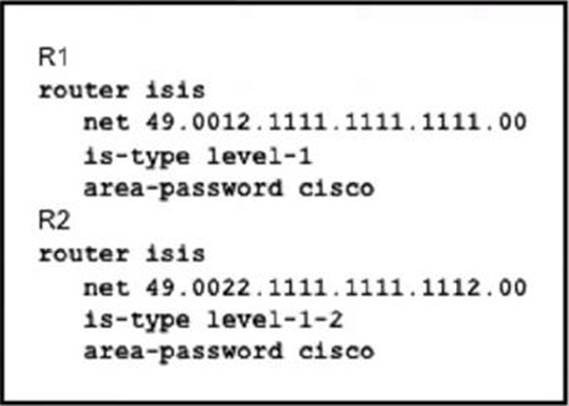
The company is running IS-IS in its core. A network engineer must segment the network into two areas to isolate departments. However, some networks must be shared from area 2 to area 1, so the engineer has decided to implement route filtering between devices.
Which action must the engineer take so that the correct networks are shared between IS-IS areas?
- A . Apply an ACL on RE to deny unnecessary routes from exiting the interface toward RD.
- B . Implement a route map and attach it to a distribute list on RD to filter inbound routes from RE.
- C . Set a unique area ID on each router to fully segment the network.
- D . Implement route-tagging on RB and RD to identify and allow only the routes that should be shared from area 2.
Refer to the exhibit:
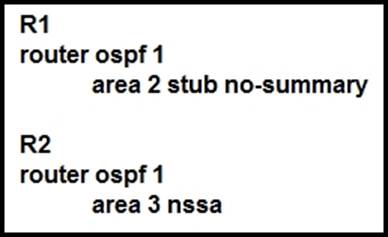
In which way does router R1 operate differently than router R2?
- A . R1 sends LSA type 2 only, while R2 sends type 1 and type 7 LSAs
- B . R1 sends LSA types 1 and 2, while R2 sends type 1. 2. and 7 LSAs
- C . R1 sends LSA type 2 only and R2 sends LSA type 1 only
- D . R1 sends LSA types 5 and 7, while R2 sends type 1, 2, and 7 LSAs
B
Explanation:
Router R1 is configured as a stub area with the “no-summary” option, which means it will not receive summary LSAs (Type 3) from the Area Border Router (ABR). It will only have Type 1 (Router LSAs) and Type 2 (Network LSAs) in its OSPF database for the area it belongs to. Router R2 is configured as an NSSA (Not So Stubby Area), which allows it to import AS external routes as Type-7 LSAs. These Type-7 LSAs can then be converted to Type-5 LSAs by the ABR when propagated into other areas. Therefore, R2 has Types 1, 2, and 7 LSAs in its OSPF database.
Reference: For more detailed information, please refer to the Implementing and Operating Cisco Service Provider Network Core Technologies (SPCOR) course materials, specifically the sections covering OSPF area types and LSA types.
SIMULATION
Simulation 6
Refer to the exhibit.
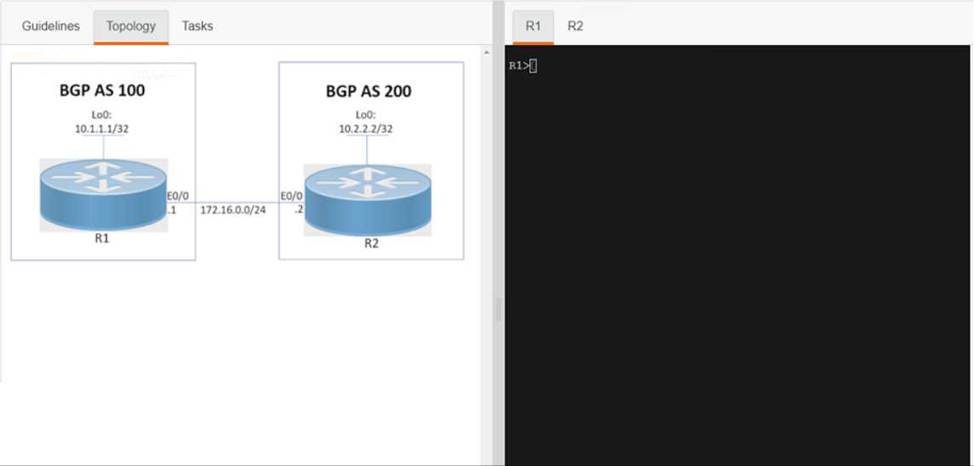
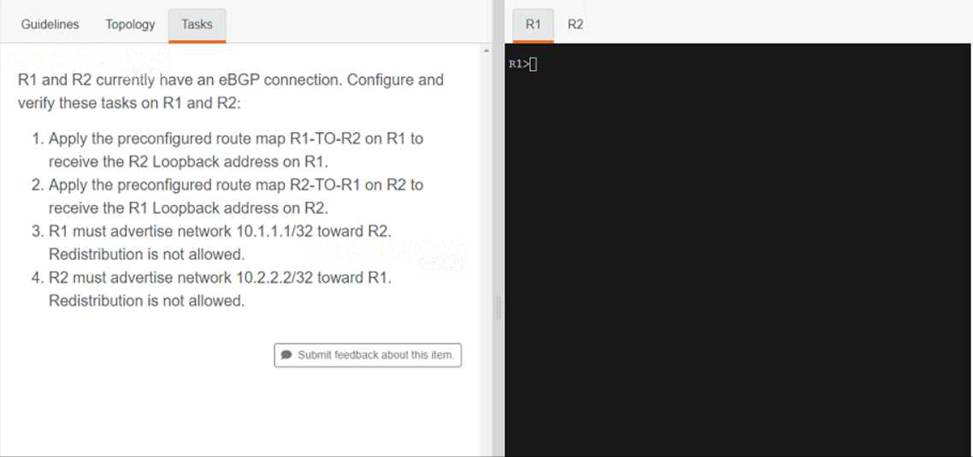
router bgp 100
address-family ipv4
nei 172.16.0.2 route-map R1-TO-R2 in
network 10.1.1.1 mask 255.255.255.255
copy run start
R2
router bgp 200
address-family ipv4
network 10.2.2.2 mask 255.255.255.255
nei 172.16.0.1 route-map R2-TO-R1 in
copy run start
Refer to the exhibit.
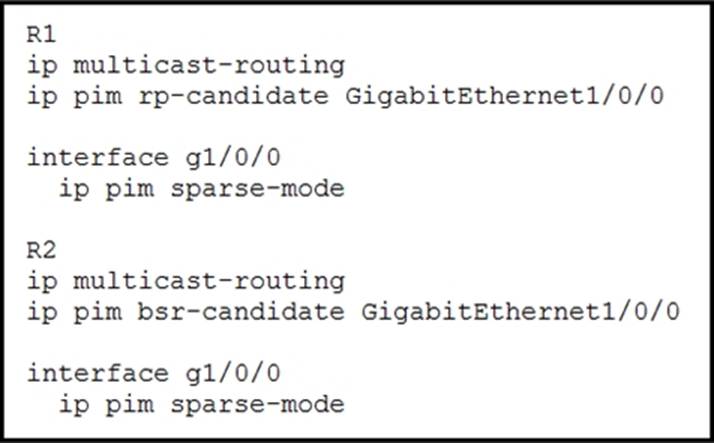
An engineer configured multicast routing on client’s network.
What is the effect of this multicast implementation?
- A . R2 floods information about R1 throughout the multicast domain.
- B . R2 is unable to share information because the ip pirn autorp listener command is missing.
- C . R1 floods information about R2 throughout the multicast domain.
- D . R2 is elected as the RP for this domain.
D
Explanation:
The multicast implementation shown in the exhibit indicates that R2 is elected as the RP (Rendezvous Point) for the domain. This is inferred from the configuration commands which show R2 set up as a Bootstrap Router (BSR) candidate. In PIM-SM (Protocol Independent Multicast Sparse Mode), the BSR is responsible for announcing the RP-set to all routers in the PIM domain, and since R2 is the only BSR candidate, it effectively becomes the RP by default unless there are other configurations not shown in the exhibit.
Reference: The explanation is based on the concepts outlined in the Implementing and Operating Cisco Service Provider Network Core Technologies (SPCOR) course, which covers multicast routing and PIM-SM operations in detail. For more information, you can refer to the official Cisco SPCOR training and certification resources.
What is the primary purpose of containers in a service-provider virtualization environment?
- A . to simplify the integration of various hardware components
- B . to enable secure communication between individual network devices
- C . to provide an isolated environment for applications and services
- D . to improve the redundancy of network components
Refer to the exhibit.
What is the effect of this configuration?
- A . R1 supports a graceful restart operation on the peer, even if graceful restart is disabled on the peer.
- B . R1 supports a peer that is configured for LDP SSO/NSF as the peer recovers from an outage.
- C . R1 failovers only to a peer that is configured for LDP SSO/NSF.
- D . R1 failovers to any peer.
A
Explanation:
The configuration shown indicates that R1 has been configured to support Label Distribution Protocol (LDP) graceful restart. This means that R1 will maintain the forwarding state during an LDP restart, allowing it to continue forwarding packets along known routes while it re-establishes LDP neighbors/peers. This ensures minimal disruption to traffic flow during such events.
Reference: Implementing and Operating Cisco Service Provider Network Core Technologies source documents or study guide
What is a characteristics of the Pipe model for MPLS QoS?
- A . The same QoS policy is applied to all customer traffic on the egress PE.
- B . If the outer EXP is changed, it is copied to the DSCP value.
- C . The MPLS EXP bits are set by the CE.
- D . The DSCP value determines how the packet is forwarded
C
Explanation:
In the Pipe model of MPLS QoS, the MPLS EXP bits are set by the Customer Edge (CE) device. This model allows the CE to mark the packets, and these markings are retained throughout the MPLS network until they reach the egress Provider Edge (PE) router. The PE router does not alter the MPLS EXP value, ensuring that the QoS policy applied by the customer is preserved end-to-end.
Reference: Implementing and Operating Cisco Service Provider Network Core Technologies (SPCOR)
Refer to the exhibit:
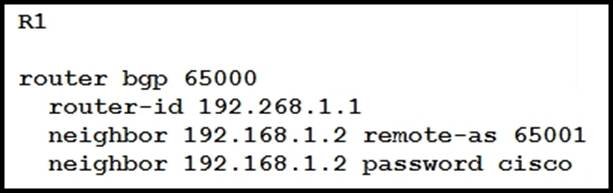
Router R1 and its peer R2 reside on the same subnet in the network, If does it make connections to R27
- A . R1 establishes UDP connections that are authenticated with an MD5 password
- B . R1 establishes TCP connections that are authenticated with a clear-text password
- C . R1 establishes UDP connections that are authenticated with a clear-text password
- D . R1 establishes TCP connections that are authenticated with an MD5 password
D
Explanation:
Router R1 establishes TCP connections that are authenticated with an MD5 password. In the context of BGP (Border Gateway Protocol), TCP is used for establishing connections, and MD5 passwords can be used for authentication to enhance security.