
Practice Free 350-501 Exam Online Questions
Refer to the exhibit.
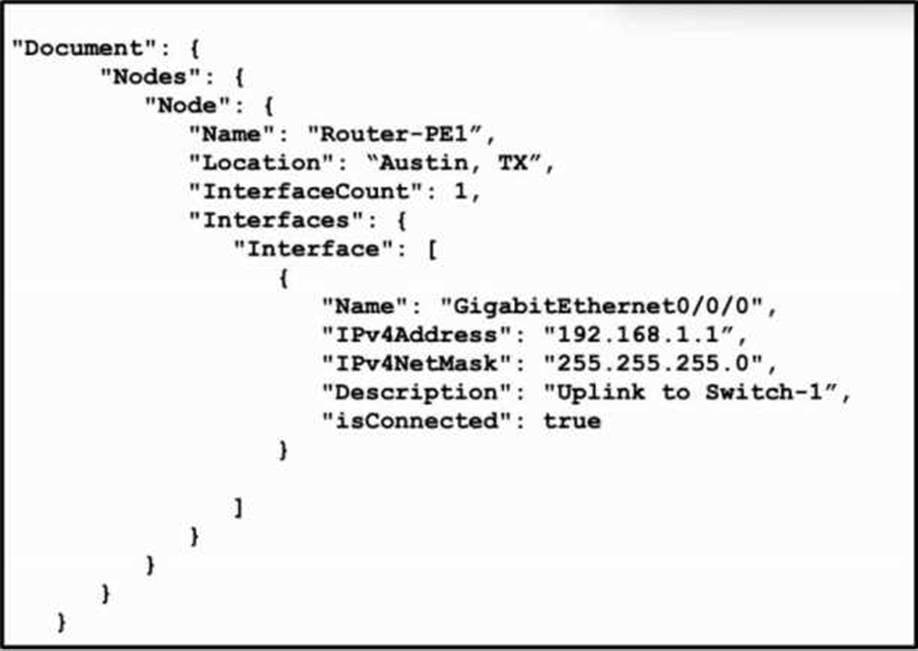
PE1 is a router connected to a major ISP that provides connectivity for multiple enterprises in several different geographic locations. The ISP networking team uses REST APIs to configure the network devices. A senior engineer retrieved the given script from the library and provided it to a junior engineer to deploy.
What effect does the script produce when deployed?
- A . It configures an interface on PE1.
- B . It configures an interface on Switch 1.
- C . It limits PE1 to exactly one configured interface.
- D . It sets the router name, location, and interface on PE1 and Switch-1.
Refer to the exhibit.
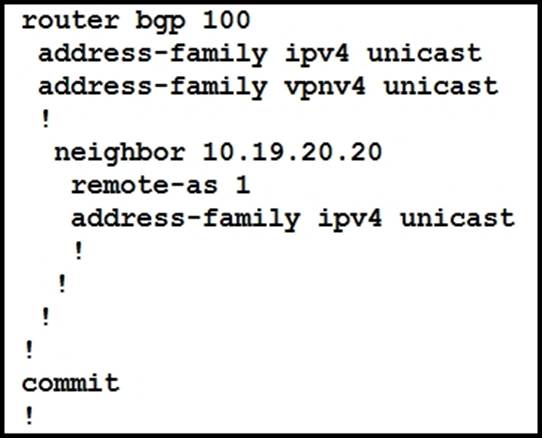
An engineer is trying to implement BGP configuration on a router.
Which configuration error prevents the ASBR from establishing a BGP neighborship to a directly connected BGP speaker?
- A . The routing policy is absent for this Cisco IOS XR eBGP instance.
- B . The IPv4 address family configuration under neighbor configuration-mode must be removed.
- C . The VPNv4 address family interferes with the 8GP IPv4 address family negotiations.
- D . The TCP session parameters are not specified.
B
Explanation:
The IPv4 address family configuration under neighbor configuration-mode must be removed. The exhibit shows the configuration of a BGP neighborship between an ASBR and a directly connected BGP speaker. The ASBR is running Cisco IOS XR. The neighbor is configured with the IPv4 address family, which is not supported on Cisco IOS XR. To establish the BGP neighborship, the IPv4 address family configuration must be removed.
https://www.cisco.com/c/en/us/td/docs/routers/xr12000/software/xr12k_r41/routing/configuration/guide/routing_cg41x r12k_chapter1.html
Refer to the exhibit.
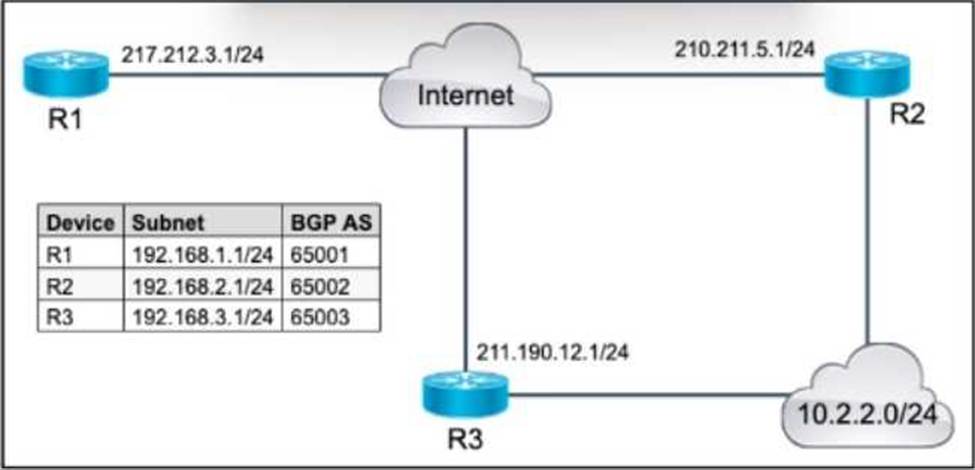
A growing company wants to ensure high availability and redundancy for its critical web servers, which are located in an offsite data center. The network architect decided to implement BGP so that the network can use redundant paths for outbound traffic toward the destination subnet 10.2.2.0/24. A network engineer already configured basic BGP settings on edge router R1, which is a Cisco ASR-1001X router. The engineer also confirmed loopback reachability to routers R2 and R3, and the AS path length toward the destination is the same via R2 and R3.
Which action must the engineer take on R1 to complete the implementation?
- A . Implement as-path multipath under the BGP neighbor configuration.
- B . Implement maximum-paths ibgp 2 under the BGP neighbor configuration.
- C . Implement maximum-paths 2 under the BGP global configuration.
- D . Implement bestpath as-path multipath-relax under the BGP global configuration.
An engineer is implementing MPLS to monitor within the MPLS domain.
Which must the engineer perform to prevent packets from being forwarded beyond the service provider domain when the LSP is down?
- A . Disable IP redirects only on outbound interfaces.
- B . Implement the destination address for the LSP echo request packet in the 127.x.y.z/8 network.
- C . Disable IP redirects on all ingress interfaces.
- D . Configure a private IP address as the destination address of the headend router of Cisco MPLS TE.
D
Explanation:
To prevent packets from being forwarded beyond the service provider domain when the Label Switched Path (LSP) is down, the engineer must configure a private IP address as the destination address of the headend router of Cisco MPLS Traffic Engineering (TE). This ensures that if the LSP fails, the packets will not be routable over the public internet, thus containing them within the service provider’s network.
Reference: = Implementing and Operating Cisco Service Provider Network Core Technologies (SPCOR) documentation provides guidelines on MPLS TE configuration, including the use of private IP addresses for headend routers to maintain traffic within the service provider domain. This practice is aligned with the principles of traffic engineering and network containment for service providers.
Company A must increase throughput between two non-IEEE 802.3ad switches located in the access and distribution layers. A network engineer must create a link group with the same speed and duplex. The STP protocol must not block any of the group ports.
Which action completes the implementation?
- A . Group Ethernet interfaces with mode desirable under the physical interfaces.
- B . Enable Port Aggregation Protocol with mode auto under the logical group interface.
- C . Configure a group logical interface with mode active enabled.
- D . Bundle the physical interfaces with mode lacp configured on each of them.
Refer to the exhibit.
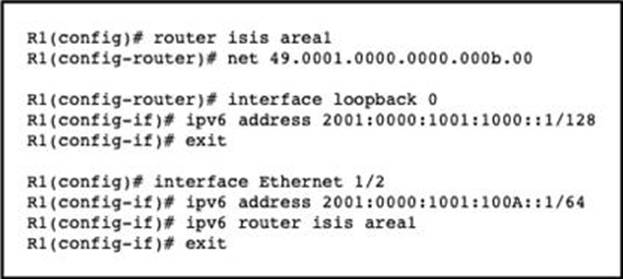
A network engineer with an employee id: 3812:12:993 has started to configure router R1 for IS-IS as shown.
Which additional configuration must be applied to configure the IS-IS instance to advertise only network prefixes associated to passive interfaces?
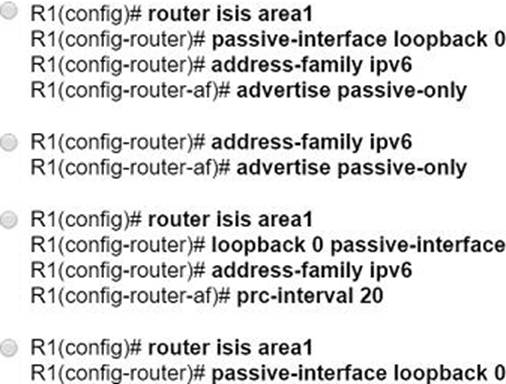
- A . Option A
- B . Option B
- C . Option C
- D . Option D
C
Explanation:
In IS-IS, to advertise only the network prefixes associated with passive interfaces, the command advertise passive-only under the address family configuration mode is used. This ensures that only the prefixes of passive interfaces are advertised to other IS-IS routers in the network. The passive interface command is used to prevent IS-IS from forming adjacencies over that interface, while still allowing the network prefix of the interface to be included in the IS-IS link-state database.
Reference: For a comprehensive understanding, refer to the “Implementing and Operating Cisco Service Provider Network Core Technologies (SPCOR)” source book and study guide
Refer to the exhibit.
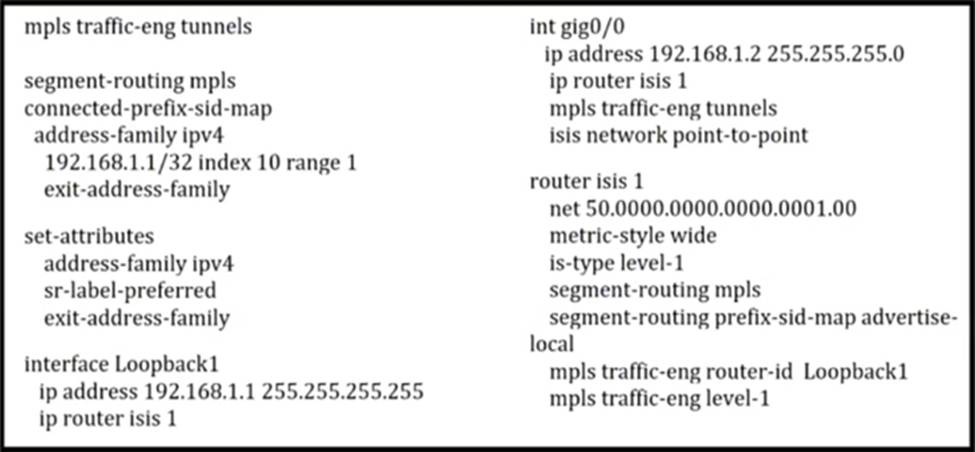
What type of configuration is it?
- A . It is configuration that requires an explicit Cisco MPLS TE path to be configured for the tunnel to run.
- B . It is configuration that requires OSPF to also be running to have optimized Cisco MPLS TE tunnels.
- C . It is configuration for the head-end router of a Cisco MPLS TE tunnel with segment routing.
- D . It is configuration that requires a dynamic Cisco MPLS TE path to be configured for the tunnel to run.
C
Explanation:
The configuration shown is for the head-end router of a Cisco MPLS TE tunnel with segment routing. This setup involves commands related to segment routing and MPLS traffic engineering tunnels, such as “mpls traffic-eng tunnels”, “segment-routing mpls”, and “segment-routing prefix-sid-map advertise-local”. These commands configure the head-end router to effectively create and manage TE tunnels using segment routing.
Reference: Implementing and Operating Cisco Service Provider Network Core Technologies (SPCOR) – Cisco SPCOR Training & Certification.
Refer to the exhibit.
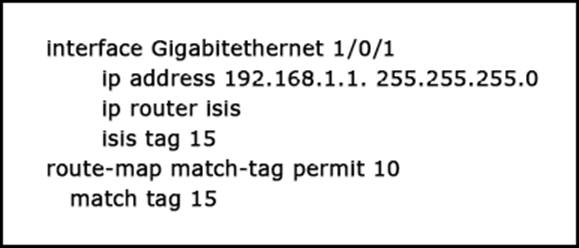
A large organization is merging the network assets of a recently acquired competitor with one of its own satellite offices in the same geographic area. The newly acquired network is running different routing protocol than the company’s primary network. As part of the merger a network engineer implemented this route map.
Which task must the engineer perform to complete the Implementation?
- A . Attach the route map to an IS-IS network statement to advertise the routes learned on this interface to IS-IS
- B . Enable metric style wide to allow the use of extended metrics from the protocols
- C . Attach the route map to the redistribution command to manipulate the routes as they are shared
- D . Configure an additional route map sequence to override the implicit deny at the end of the route map
What is a primary benefit of IPoATM or MPLS over ATM backbone service provider networks?
- A . dedicated circuits
- B . variable-length packets
- C . isochronous system
- D . fixed-length cells
B
Explanation:
IP over ATM (IPoATM) and MPLS offer significant benefits over traditional ATM backbone networks, primarily due to their support for variable-length packets. Unlike ATM, which uses fixed-length cells, IPoATM and MPLS can handle packets of varying sizes, making them more efficient for carrying IP traffic. This efficiency comes from reduced overhead and better bandwidth utilization, as IP packets don’t need to be segmented and reassembled, avoiding the cell-padding issues inherent in ATM’s fixed-size cells1.
Reference: Performance Comparison of MPLS and ATM Based Networks – EUDL1.
Refer to the exhibit.
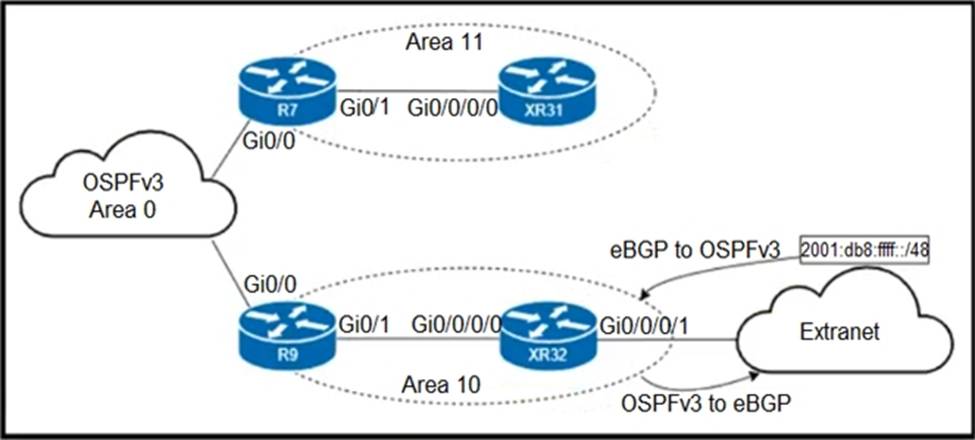
An engineer is updating this network to meet these conditions:
✑ Area 10 will receive inter-area routes and support mutual redistribution of external routes with the extranet.
✑ The ::/0 route is prohibited in Area 10.
✑ Area 11 will receive only the ::/0 route from the ABR.
✑ External route redistribution is not supported in Area 11.
✑ The ABR in Area 11 will advertise no interarea routes.
Which two configurations must be performed to meet the requirements? (Choose two.)
- A . Configure area 11 as nssa no-summary on R7 and as nssa on XR31.
- B . Configure area 10 as stub on R9 and XR32.
- C . Configure area 11 as stub no-summary on R7 and as stub on XR31.
- D . Configure area 11 as nssa default-information-originate on R7 and as nssa on XR31.
- E . Configure area 10 as nssa on R9 and XR32.
A, D
Explanation:
Area 10 should receive inter-area routes and support mutual redistribution with the extranet but not receive the default route (::/0). This requirement does not align with any of the stub or NSSA configurations, as these would restrict the type of routes received.
Area 11 should only receive the default route from the ABR and not support external route redistribution or advertise inter- area routes. Configuring Area 11 as an NSSA (Not So Stubby Area) with the no-summary option on R7 and as NSSA on XR31 would prevent inter-area routes from being advertised into Area 11. Additionally, the default-information-originate command on R7 would generate a default route into Area 11, fulfilling the requirement.
Reference: = The explanation is based on the OSPFv3 configurations and area types as described in the Implementing and Operating Cisco Service Provider Network Core Technologies (SPCOR) course materials.