
Practice Free 350-501 Exam Online Questions
A network engineer must collect traffic statistics for an internal LAN toward the internet The sample must include the source and destination IP addresses, the destination ports, the total number of bytes from each flow using a 64-bit counter, and all transport flag information. Because of CPU limits, the flow collector processes samples that are a maximum of 20 seconds long.
Which two configurations must the network engineer apply to the router? (Choose two.)
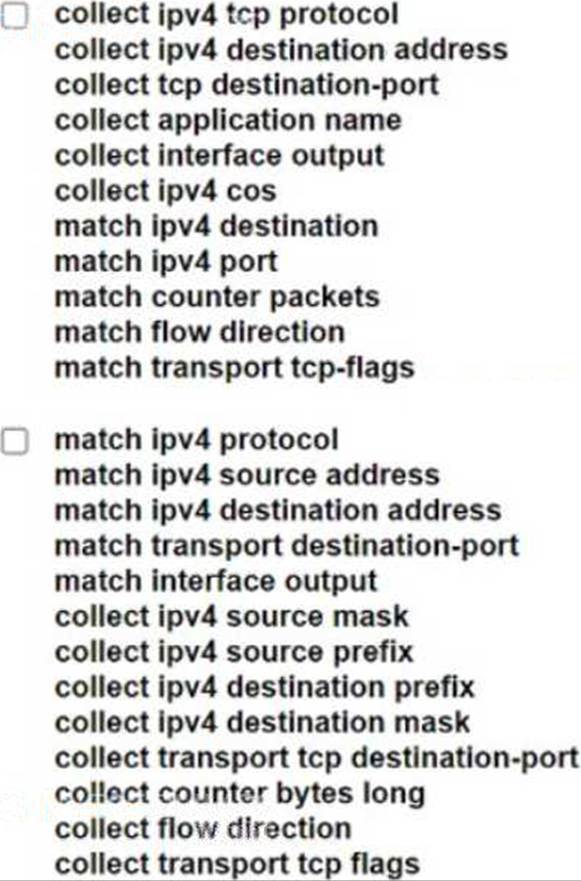
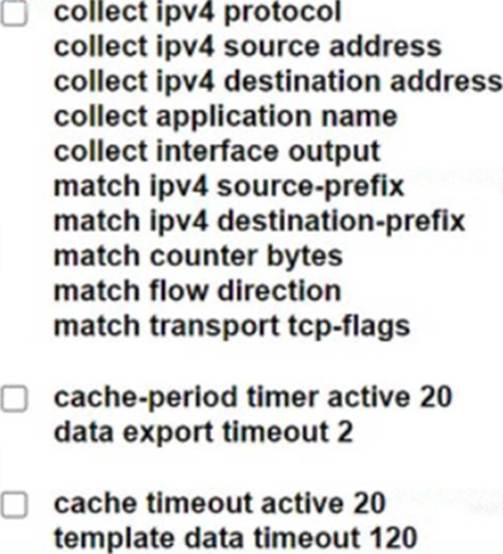
- A . Option A
- B . Option B
- C . Option C
- D . Option D
- E . Option E
A, D
Explanation:
To collect the required traffic statistics, the network engineer must configure the router to capture specific data points. The configurations in Option A and Option D align with these requirements.
Option A involves configuring the router to collect IPv4 protocol, source address, destination address, application name, interface output, IPv4 source-prefix, IPv4 destination-prefix, counter bytes, flow direction, and transport tcp-flags.
Option D involves setting the cache-period timer active to 20 seconds, which aligns with the CPU limit of processing samples that are a maximum of 20 seconds long.
Reference: = Implementing and Operating Cisco Service Provider Network Core Technologies (SPCOR) v1.0
Which configuration enables BGP FlowSpec client function and installation of policies on all local interfaces?
- A . flowspec
address-family ipv4
local-install all-interface - B . flowspec
address-family ipv4
install interface-all - C . flowspec
address-family ipv4
local-install interface-all - D . flowspec
address-family ipv4
install interface-all local
C
Explanation:
The correct configuration for enabling BGP FlowSpec client function and installation of policies on all local interfaces is flowspec address-family ipv4 install interface-all local. This command configures the router to accept FlowSpec policies from a BGP peer and apply them to all local interfaces. The flowspec keyword enables the BGP FlowSpec client function, address-family ipv4 specifies the address family, and install interface-all local ensures that the policies are installed on all local interfaces.
Reference: = Implementing and Operating Cisco Service Provider Network Core Technologies course.
Refer to Exhibit.
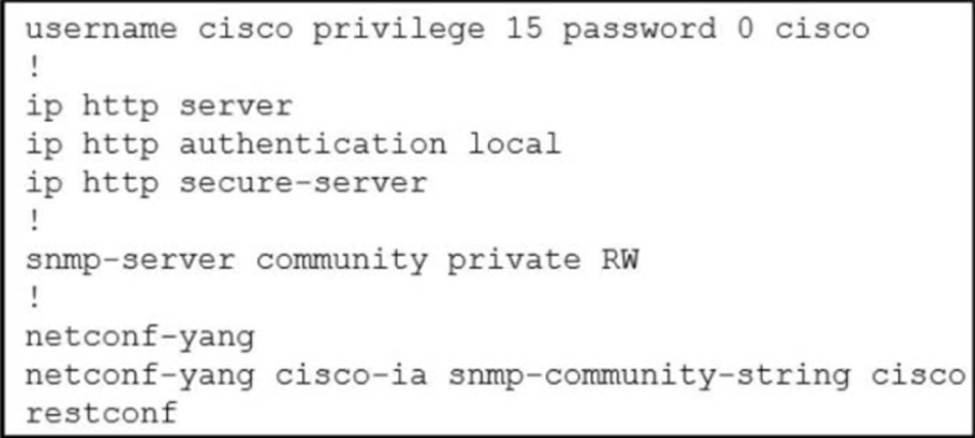
A network engineer is trying to retrieve SNMP MIBs with RESTCONF on the Cisco switch but fails. End-to-end routing is in place.
Which configuration must the engineer implement on the switch to complete?
- A . netconf-yang cisco-ia snamp-community -string Public
- B . snmp-server community cisco RW
- C . snmp-server community public RO
- D . netconf-yang cisco-Ia snmp-community-string Private
B
Explanation:
Reference: https://www.cisco.com/c/en/us/support/docs/storage-networking/management/200933-YANG-NETCONF-Configuration-Validation.html
A network engineer must configure a router for Flexible NetFlow IPFIX export. The IP address of the destination server is 172.17.12.1. The source address must be set to the Loopback0 IPv4 address and exported packets must be set to DSCP CS3. The TTL must be 64 and the transport protocol must be set to UDP with destination port 4739.
Which configuration must the engineer apply to the router?
- A . configure terminal
flow exporter EXPORTER-1
destination 172.17.12.1
source Loopback0
dscp 3
ttl 64
export-protocol netflow-v9
transport udp 4739
end - B . configure terminal
flow exporter EXPORTER-1
destination 172.17.12.1
source Loopback0
dscp 24
ttl 64
export-protocol ipfix
end - C . configure terminal
flow exporter EXPORTER-1
destination 172.17.12.1
source Loopback0
dscp 24
ttl 64
export-protocol netflow-v9
transport udp 4739
end - D . configure terminal
flow exporter EXPORTER-1
destination 172.17.12.1
source Loopback0
dscp 3
ttl 64
export-protocol ipfix
end
B
Explanation:
https://www.cisco.com/c/en/us/td/docs/ios-xml/ios/fnetflow/configuration/xe-3s/fnf-xe-3s-book/fnf-ipfix-
export.html#d27853e197a1635
Refer to the exhibit.
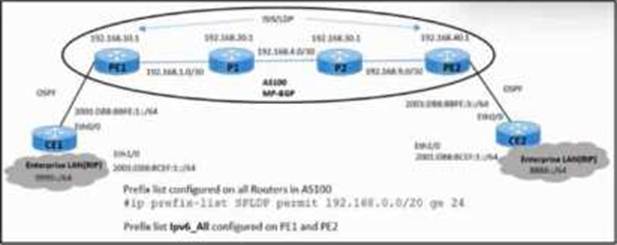
An engineer must update the configuration of the network with these requirements:
PE routers must define labels for IS-IS learned routes in AS100.
P routers must not receive LDP bindings for the external network in the IPv6 address family.
Which configuration must the engineer implement to meet these requirements?
- A . PE2(config)# mpls Idp label
PE2(config-Idp-Ibl)# allocate global host-routes - B . CE1(config)# mpls Idp label
CE1(config-Idp-Ibl)# allocate global host-routes - C . PE2(config)# mpls Idp label
PE2(config-Idp-Ibl)# allocate global prefix-list SPLDP - D . PE1(config)# mpls Idp label PE1(config-Idp-Ibl)# no allocate global prefix-list Ipv6_All
Which three OSPF parameters must match before two devices can establish an OSPF adjacency? (Choose three.)
- A . IP address
- B . interface cost
- C . subnet mask
- D . process ID
- E . hello timer setting
- F . area number
C, E, F
Explanation:
For OSPF, the subnet mask must match between two devices on the same network segment to form an adjacency, as it defines the network’s address range. The hello timer setting is crucial for the OSPF Hello protocol, which is used for neighbor discovery and maintaining neighbor relationships. Finally, the area number must be the same because OSPF uses areas to define a hierarchy within the network, and routers within the same area share routing information.
Reference: OSPF is a link-state protocol that requires certain parameters to match for a successful adjacency. This includes the subnet mask, hello timer, and area number, which are fundamental to OSPF’s operation and ensure that routers can communicate effectively within the same area
When implementing a REST API, how does an engineer mitigate security risks?
- A . by configuring the system to authenticate the client’s identity and avoid broken authentication
- B . by configuring object properties to protect data
- C . by configuring separate authorization schemes to securely compartmentalize different areas of the business
- D . by configuring rate limiting to reduce the risk of DOS and DDOS attacks against the system
Refer to the exhibit:
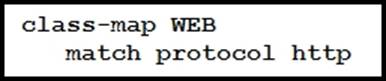
Which statement describes the effect of this configuration?
- A . It applies a service policy to all interfaces remarking HTTP traffic
- B . It creates an ACL named WEB that filters HTTP traffic.
- C . It matches HTTP traffic for use in a policy map
- D . It modifies the default policy map to allow all HTTP traffic through the router
C
Explanation:
The configuration creates a class map named WEB which is used to match HTTP traffic. This class map can then be referenced in a policy map to define specific actions for traffic that matches the criteria, such as applying QoS policies or traffic shaping.
Reference: This concept is covered in the Implementing and Operating Cisco Service Provider Network Core Technologies (SPCOR) course, where class maps and policy maps are discussed in the context of traffic classification and policy enforcement.
What is the primary role of a BR router in a 6rd environment?
- A . It provides connectivity between end devices and the IPv4 network.
- B . It embeds the IPv4 address in the 2002::/16 prefix.
- C . It connects the CE routers with the IPv6 network.
- D . It provides IPv4-in-IPv6 encapsulation
C
Explanation:
The primary role of a BR (Border Relay) router in a 6rd (IPv6 Rapid Deployment) environment is to connect the CE (Customer Equipment) routers with the IPv6 network. The BR router de-encapsulates IPv6 packets that are encapsulated in IPv4 packets from the CE routers and forwards them to the IPv6 internet. This process is stateless and allows for high availability and load balancing by potentially having more than one BR router configured with the same IPv4 address (anycast), so CE routers are routed to the closest BR router12.
Reference: NetworkLessons.com, “IPv6 6RD (Rapid Deployment)”
RFC 5969, “IPv6 Rapid Deployment on IPv4 Infrastructures (6rd) C Protocol Specification”
What is an enhancement that Cisco IOS XE Software has over Cisco IOS Software?
- A . It support symmetric multiprocessing
- B . It allows all processes to use the same pool of memory.
- C . It runs on a 32-bit operating system.
- D . It is built on a GNX Neutrino Microkernel.
A
Explanation:
Cisco IOS XE Software is an open and flexible operating system optimized for a variety of network infrastructures. One of its key enhancements over Cisco IOS Software is the support for symmetric multiprocessing (SMP). This allows the operating system to efficiently utilize multiple CPU cores, improving performance and scalability for network services.
Reference: The enhancement details are derived from the Cisco IOS XE Software overview, which highlights its capabilities and benefits over the traditional Cisco IOS Software.