
Practice Free 350-501 Exam Online Questions
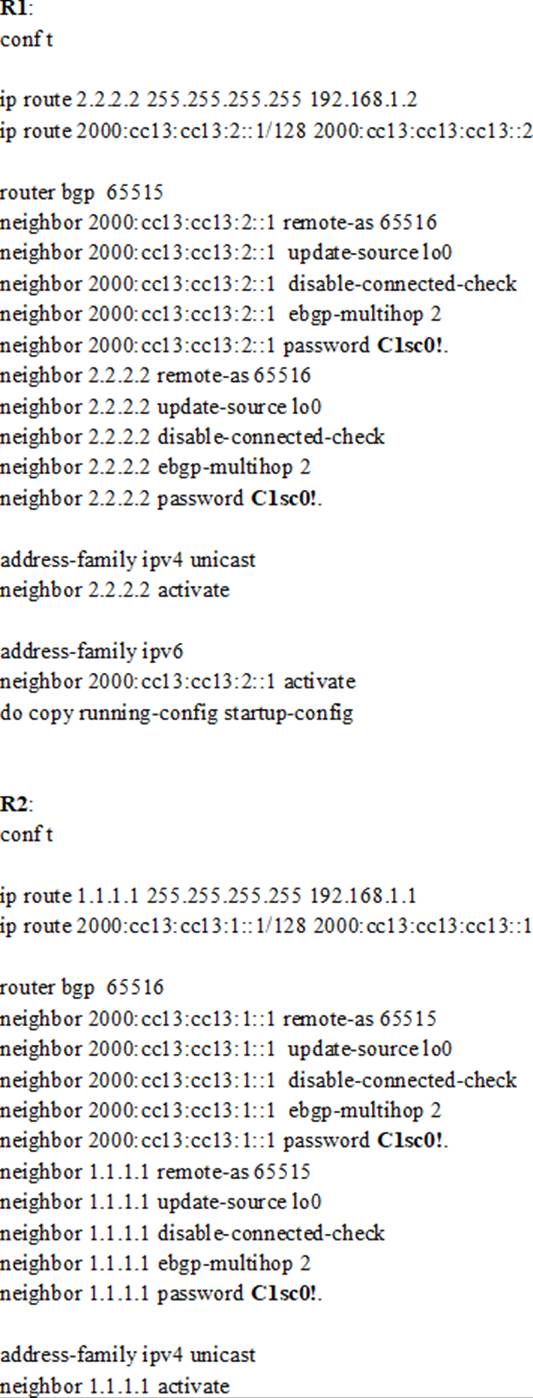
Configure MD5 Authentication for the EBGP adjacency between R1 and R2. The password is clear text C1sc0!.
A network operator working for a private outsourcing company with an employee id: 4261:72:778 needs to limit the malicious traffic on their network.
Which configuration must the engineer use to implement URPF loose mode on the GigabitEthernet0/1 interface?
- A . router(config)# interface gigabitethernet0/1
router(config-if)# ip address 192.168.200.1 255.255.255.0
router(config-if)# ip verify unicast source reachable-via any
router(config-if)# ipv6 address 2001:DB8:1::1/96
router(config-if)# ipv6 verify unicast source reachable-via any - B . router(config)# interface gigabitethernet0/1
router(config-if)# ip address 192.168.200.1 255.255.255.0
router(config-if)# ip verify unicast source reachable-via rx
router(config-if)# ipv6 address 2001:DB8:1::1/96
router(config-if)# ipv6 verify unicast source reachable-via rx - C . router(config)# interface gigabitethernet0/1
router(config if)# ip address 192.168.200.1 255.255.255.0
router(config-if)# ip verify unicast source reachable-via rx
router(config-if)# ipv6 address 2001:DB8:1::1/96
router(config-if)# ipv6 verify unicast source reachable-via any - D . router(config)# interface gigabitethernet0/1
router(config-if)# ip address 192.168.200.1 255.255.255.0
router(config-if)# ip verify unicast source reachable-via any
router(config-if)# ipv6 address 2001:DB8:1::1/96
router(config-if)# ipv6 verify unicast source reachable-via rx
SIMULATION
Simulation 5
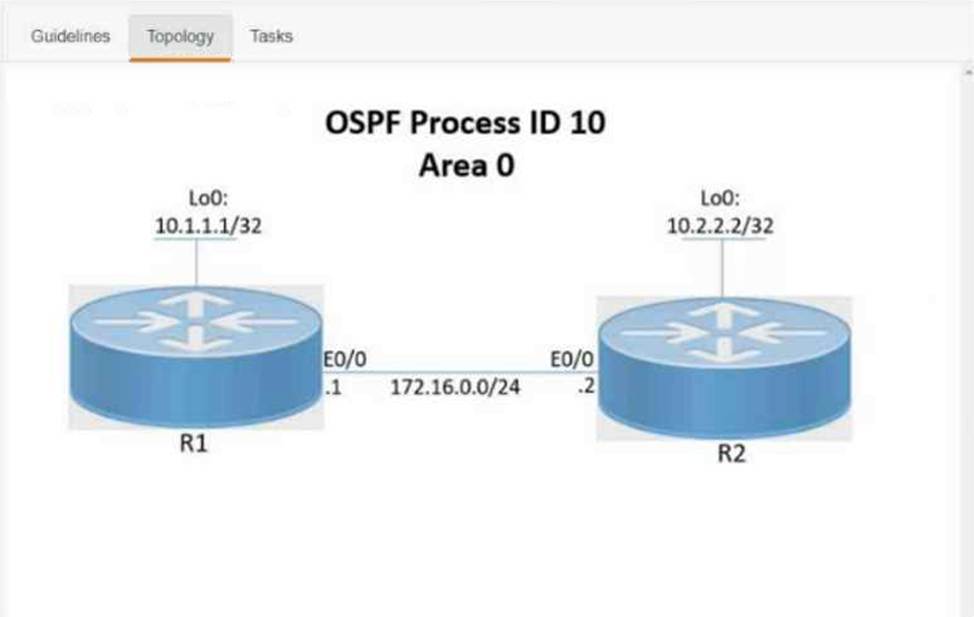
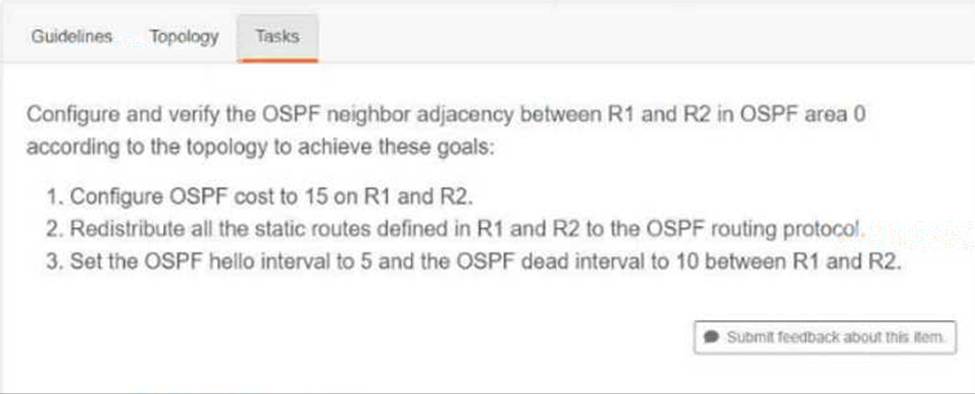
router ospf 10
redistribute static
int et0/0
ip ospf hello-interval 5
ip ospf dead-interval 10
ip ospf cost 15
ip ospf 10 area 0
copy run start
R2
router ospf 10
redistribute static
int et0/0
ip ospf hello-interval 5
ip ospf dead-interval 10
ip ospf cost 15
ip ospf 10 area 0
copy run start
What are two features of stateful NAT64? (Choose two.)
- A . It uses address overloading.
- B . It provides 1:N translations, so it supports an unlimited number of endpoints.
- C . It requires IPv4-translatable IPv6 address assignments.
- D . It requires the IPv6 hosts to use either DHCPv6-based address assignments or manual address assignments.
- E . It provides 1:1 translation, so it supports a limited number of endpoints.
A, B
Explanation:
Reference: https://www.cisco.com/c/en/us/td/docs/ios-xml/ios/ipaddr_nat/configuration/xe-16/nat-xe-16-book/iadnat-stateful-nat64.html
Refer to the exhibit.
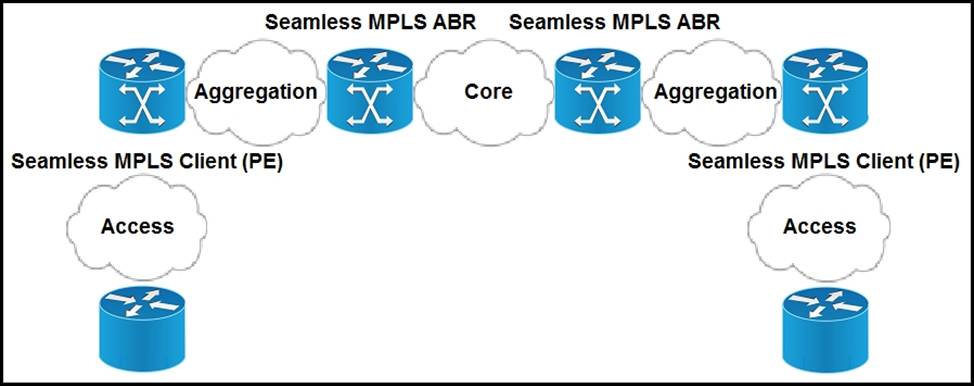
A network operator working for a telecommunication company with an employee 3994:37:650 is implementing a cisco Unified MPLS solution.
What is the effect of this implementation?
- A . EIGRP is deployed between the PEs and ABRs with RFC 3107.
- B . OSPF is deployed between the PEs and ABRs with RFC 3107.
- C . IS-IS is deployed between the PEs and ABRs with RFC 3107.
- D . BGP is deployed between the PEs and ABRs with RFC 3107.
D
Explanation:
In Cisco Unified MPLS, BGP (Border Gateway Protocol) is used to transport labels along with network layer reachability information. RFC 3107 defines BGP/MPLS IP Virtual Private Networks (VPNs) and allows BGP to carry MPLS labels, enhancing scalability and flexibility in MPLS networks.
Reference
1: Cisco. “Implementing and Operating Cisco Service Provider Network Core Technologies (SPCOR).” Link
Which statement about the Cisco MPLS TE forwarding adjacency feature is true?
- A . It enables the headend and tailend routers to establish a bidirectional tunnel
- B . It enables the tailend router to advertise routes to the headend router over the tunnel
- C . It enables the MPLS core to use EIGRP as the routing protocol
- D . It enables the Cisco MPLS TE tunnel to be advertised into the running IGP.
D
Explanation:
The Cisco MPLS TE forwarding adjacency feature allows a TE tunnel to be advertised into the IGP, effectively making the tunnel appear as a network link in the IGP topology. This integration helps in the optimal utilization of the TE tunnel by other routers for IP routing purposes.
Refer to the exhibit:
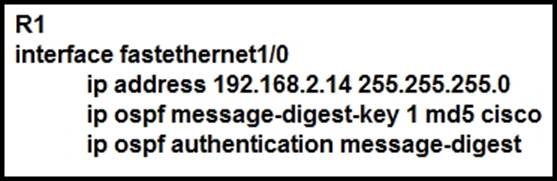
Which condition must be met by the OSPF peer of router R1 before the two devices can establish communication?
- A . The interface on the OSPF peer must use the same key ID and key value as the configured interface
- B . The interface on the OSPF peer may have a different key ID, but it must use the same key value as the configured interface
- C . The OSPF peer must be configured as an OSPF stub router
- D . The OSPF peer must use clear-text authentication
A
Explanation:
In OSPF, for two routers to establish communication, they must have the same key ID and key value on their interfaces. This ensures secure communication between the OSPF peers. The key ID and value are part of the OSPF authentication mechanism that helps in validating the identity of OSPF peers before exchanging routing information.
Reference: Implementing and Operating Cisco Service Provider Network Core Technologies (SPCOR) – Cisco SPCOR Training & Certification
A network engineer is testing an automation platform that interacts with Cisco networking devices via NETCONF over SSH.
In accordance with internal security requirements:
✑ NETCONF sessions are permitted only from trusted sources in the 172.16.20.0/24 subnet.
✑ CLI SSH access is permitted from any source.
Which configuration must the engineer apply on R1?
- A . configure terminal
hostname R1
ip domain-name mydomain.com
crypto key generate rsa
ip ssh version 1
access-list 1 permit 172.16.20.0 0.0.0.255
netconf ssh acl 1
line vty 0 4
transport input ssh
end - B . configure terminal
hostname R1
ip domain-name mydomain.com
crypto key generate rsa
ip ssh version 2
access-list 1 permit 172.16.20.0 0.0.0.255
access-list 1 permit any
netconf ssh
line vty 0 4
access-class 1 in
transport input ssh
end - C . configure terminal
hostname R1
ip domain-name mydomain.com
crypto key generate rsa
ip ssh version 1
access-list 1 permit 172.16.20.0 0.0.0.255
access-list 2 permit any
netconf ssh
line vty 0 4
access-class 2 in
transport input ssh
end - D . configure terminal
hostname R1
ip domain-name mydomain.com
crypto key generate rsa
ip ssh version 2
access-list 1 permit 172.16.20.0 0.0.0.255
netconf ssh acl 1
line vty 0 4
transport input ssh
end
Which capability does RSVP provide in an MPLS network?
- A . signaling a primary path for LSP tunnels
- B . reserving up to 75% of interface bandwidth by default
- C . reserving bandwidth for multicast flows
- D . supporting interoperability between IntServ and DiffServ architecture models
Refer to the exhibit.
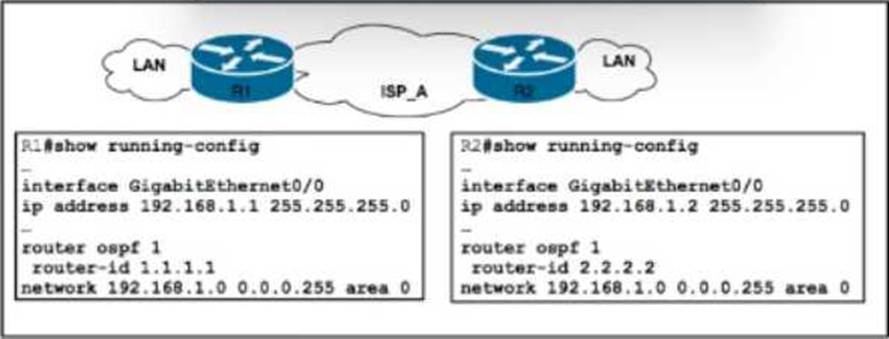
A growing company with an increasing international presence requires a secure and scalable solution for inter-office data transfer across their geographically dispersed locations. To ensure departmental privacy, the network must enforce granular access control. BGP is running in the network, and two VRF instances with unique route distinguishers and route targets have been configured to segregate critical financial data from regular network traffic. A network engineer with an employee ID: 5086:72:617 must find a solution that allows for future network expansion while maintaining robust security and data privacy between departments. The solution must comply with the RFC 4364 standard.
Which action must the engineer take to meet the requirements?
- A . Configure a GRE tunnel in AH mode between the two routers.
- B . Configure MPLS in L3VPN mode between the two routers.
- C . Configure a DMVPN connection between the two routers with Phase 2 mode enabled.
- D . Configure an IPsec VPN connection between the two routers with ESP protocol enabled.