
Practice Free 350-501 Exam Online Questions
Refer to the exhibit.
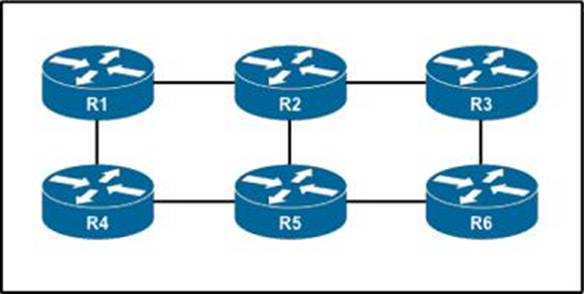
An engineer is configuring an administrative domain in the given multi-vendor environment with PIM-SM.
Which feature must the engineer implement so that devices will dynamically learn the RP?
- A . Auto-RP
- B . BIDIR-PIM
- C . SSM
- D . BSR
D
Explanation:
In a multi-vendor environment with PIM-SM, the Bootstrap Router (BSR) mechanism is used for devices to dynamically learn the Rendezvous Point (RP). BSR is a protocol feature that automates the dissemination of RP information in a PIM domain. This feature allows routers to automatically discover the RP set in use, which simplifies configuration and management compared to static RP configurations or Auto-RP.
Reference: Implementing and Operating Cisco Service Provider Network Core Technologies source documents or study guide
Refer to the exhibit.
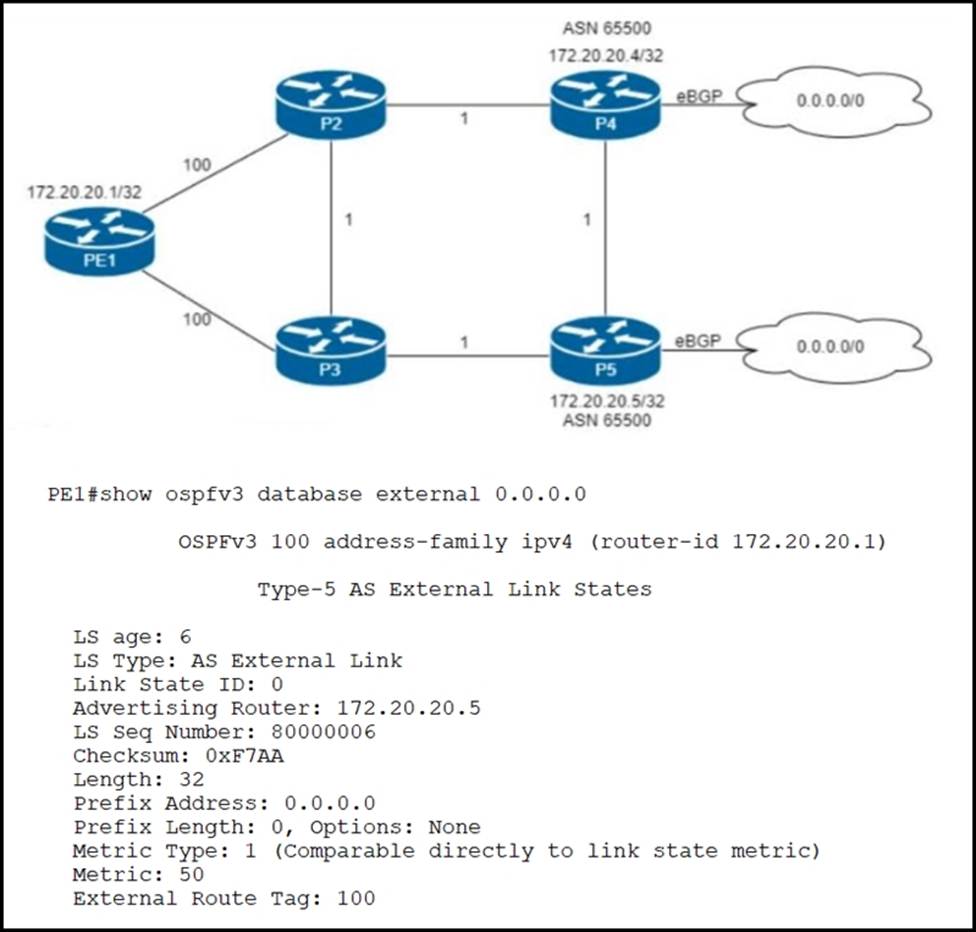
Router P4 and P5 receive the 0.0.0.0/0 route from the ISP via eBGP peering P4 is the primary Internet gateway router, and P5 is its Backup. P5 is already advertising a default route into OSPF domain.
Which configuration must Be applied to P4 so that advertises a default route Into OSPF and Becomes me primary internet gateway for the network?
- A . configure terminal
router ospfv3 100
address-family ipv4 unicast
default-information originate always metric 40 metric-type 1
end - B . configure terminal
router ospfv3 100
address-family ipv4 unicast
default-information originate metric 40 metric-type 2
end - C . configure terminal
router ospfv3 100
address-family ipv4 unicast
default-information originate metric 40 metric-type 1
end - D . configure terminal
router ospfv3 100
address-family ipv4 unicast
redistribute bgp 65500 metric 40 metric-type 1
end
Refer to the exhibit.
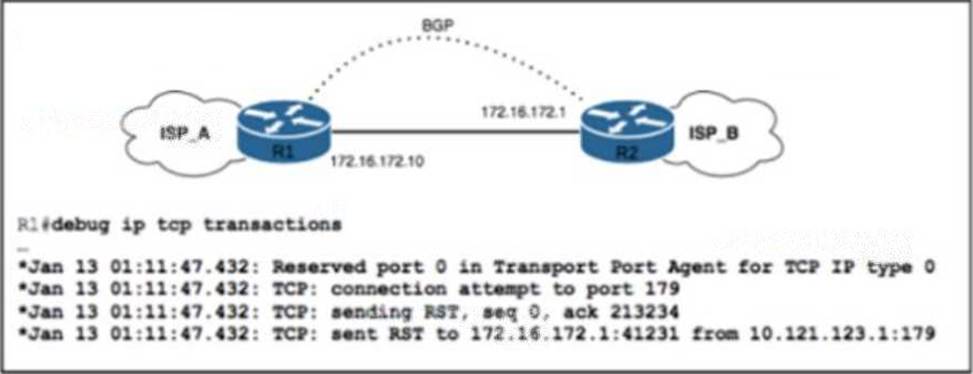
ISP_A and ISP_B use AS numbers 38321 and 16213 respectively. After a network engineer reloaded router R1, the BGP session with R2 failed to establish. The engineer confirmed BGP next-hop availability with a connectivity test between the router loopback addresses 10.121.123.2 and 10.121.123.1, as well as between interfaces Gi1/1 and Gi1/2. EBGP multihop has been configured on both routers.
Which action must the engineer take to resolve the issue?
- A . Configure transport connection-mod© passive on R2.
- B . Configure neighbor 172.16.172.1 authentication on R1
- C . Configure neighbor update-source lo0 on R2
- D . Configure remote-as 16213 on R1.
C
Explanation:
After a router reload, BGP sessions may fail to re-establish due to incorrect source interface configurations for BGP sessions. Since EBGP multihop has been configured, it’s essential that the BGP session uses the correct source interface for establishing the connection. By configuring the neighbor update-source command with the loopback interface on R2, the BGP session will use the stable loopback address rather than the physical interface, which can change state. This ensures that the BGP session remains stable and is not affected by interface states.
Reference: BGP Troubleshooting Cheat Sheet With Examples – Catchpoint2, BGP session stuck in Idle state after NSRP failover – Juniper Networks3, BGP Session is Disconnected – Network Playbook
What is a key capability of EVPN?
- A . providing built-in support for native integration with third-party cloud platforms
- B . supporting multitenancy for Layer 2 and Layer 3 VPN services
- C . establishing IPv6 overlay networks over IPv4 networks
- D . enabling real-time voice and video traffic optimization
Refer to me exhibit.
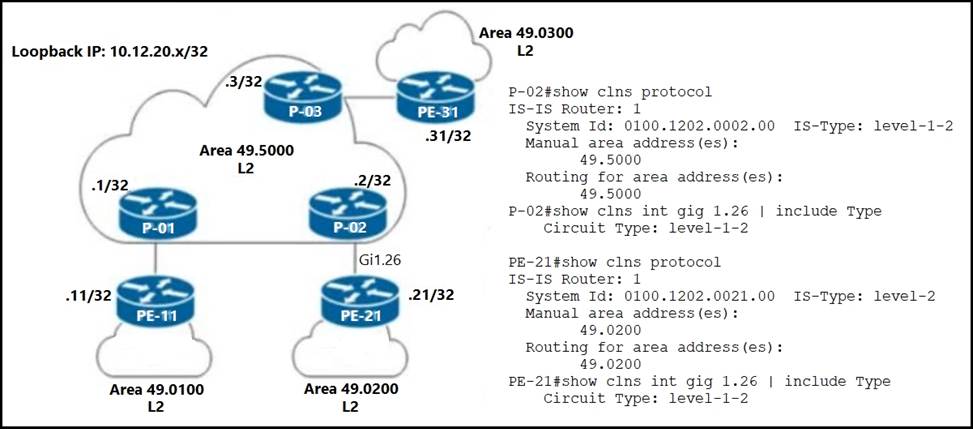
A network engineer notices PE-21 convergence degradation due to the growing LSDB size of Level 2 areas in the network. The engineer decides to migrate router PE-21 from an inter-area design to an intra-area implementation. Inter-area routing must be accomplished via an ATT-bit set by the Level 1/Level 2 router.
Which configuration must the engineer implement on PE-21 to complete the migration?
- A . configure terminal
router isis 1
no net 49.0200
net 49.5000
is-type level-1-2
end - B . configure terminal
router isis 1
net 49.5000.0100.1202.0021.00
is-type level-1-2
end - C . configure terminal
router isis 1
net 49.5000.0100.1222.0022.00
is-type level-1
end - D . configure terminal
router isis 1
no net 49.0200.0100.1202.0021.00
net 49.5000.0100.1202.0021.00
is-type level-1
end
Refer to the exhibit.

An engineer is implementing BGP selective prefix suppression. The router must advertise only 10.16.4.0/24,10.16.5.0/24. and summarized route 10.16.0.0/21. and suppress 10.16.6.0/24.
Which configuration must the engineer apply to the router?
- A . Router (config)# router bgp 300
Router(config-router)# aggregate-address 10.16.6.0 255.255.252.0 as-set suppress-map SuppressMap - B . Router (config)# router bgp 300
Router(config-router)# aggregate-address 10.16.0.0 255.255.248.0 as-set suppress-map SuppressMap - C . Router (config)# router bgp 300
Router(config-router)# aggregate-address 10.16.6.0 255.255.255.0 as-set suppress-map SuppressMap - D . Router (config)# router bgp 300
Router(config-router)# aggregate-address 10.16.0.0 255.255.255.0 as-set suppress-map SuppressMap
D
Explanation:
The configuration in Option D is correct for implementing BGP selective prefix suppression according to the requirements. The “aggregate-address” command is used to configure the advertisement of the summarized route 10.16.0.0/21, and the “suppress-map” option allows for selective suppression of specific prefixes, in this case, 10.16.6.0/24.
Reference: Implementing and Operating Cisco Service Provider Network Core Technologies (SPCOR) – Cisco SPCOR Training & Certification
Which two routing protocols support Cisco MPLS TE tunnels? (Choose two.)
- A . IS-IS
- B . RIP
- C . BGP
- D . OSPF
- E . EIGRP
A, D
Explanation:
Cisco MPLS TE tunnels can be established using IS-IS and OSPF as the routing protocols. These protocols allow the creation of traffic-engineered paths within the MPLS network.
Reference: Implementing and Operating Cisco Service Provider Network Core Technologies course materials.
Which regular expression query modifier function indicates the start of a string?
- A . ^
- B . [^]
- C . +
- D . $
A
Explanation:
In the context of regular expressions, the caret (^) is used to indicate the start of a string. This is a fundamental concept in pattern matching using regular expressions, where ^ matches the position at the beginning of the string.
Reference: This information is consistent with regular expression syntax as described in various Cisco documentation and resources related to Cisco IOS software configurations.
Refer to the exhibit.
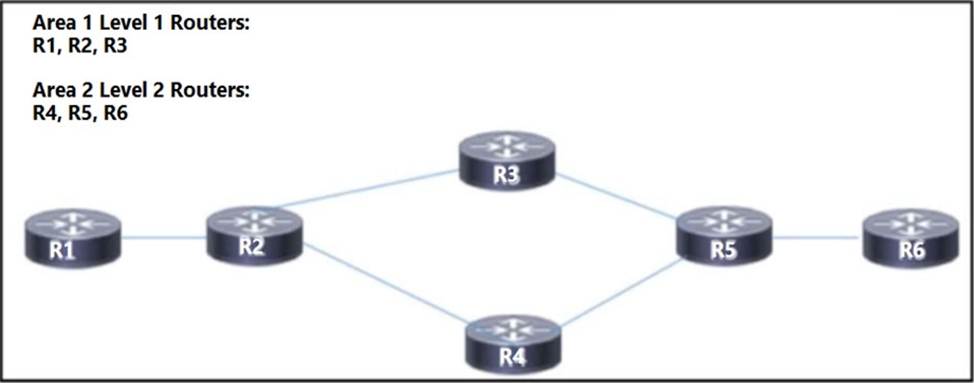
A network engineer is in the process of implementing IS-IS Area 1 and Area 2 on this network to segregate traffic between different segments of the network The hosts in the two new areas must maintain the ability to communicate with one another In both directions.
Which additional change must be applied?
- A . Reconfigure either R3 or R4 as a Level 1/Level 2 router.
- B . Reconfigure routers R1, R2 R5. and R6 as Level 1/Level 2 routers.
- C . Reconfigure routers R2 and R5 as Level 1/Level 2 routers.
- D . Reconfigure routers R4, R5 and R6 as Level 1 routers
Refer to the exhibit.
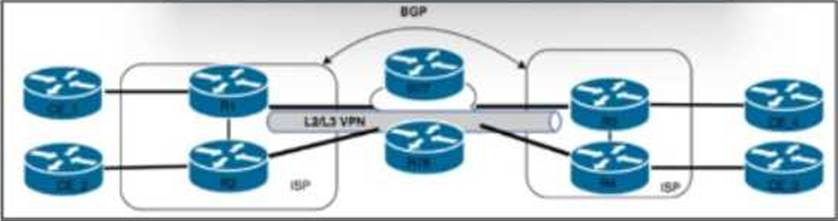
Company A’s network architect is implementing the capabilities that are described in RFC 4379 to provide new options for troubleshooting the company’s MPLS network. MPLS LSPs are signaled via the BGP routing protocol with IPv4 unicast prefix FECs. Due to company security policies, access is controlled on the control plane and management plane.
Which two tasks must the architect perform to achieve the goal? (Choose two.)
- A . Open UDP port 3503.
- B . Open MCP port 3505.
- C . Implement OAM on all MPLS-enabled routers.
- D . Implement LSP Ping on PE routers only.
- E . Implement VCCV on core routers only.