
Practice Free AZ-204 Exam Online Questions
You manage an Azure subscription that contains 100 Azure App Service web apps. Each web app is associated with art individual Application Insights instance.
You plan to remove Classic availability tests from all Application Insights instances that have this functionality configured.
You have the following PowerShell statement:
Get-AzApplicationlnsifihtsrtebTest | Where-Object {$condition}
You need to set the value of the Scondition variable.
Which value should you use?
A)

B)

C)

D)

- A . Option A
- B . Option B
- C . Option C
- D . Option D
You have an Azure App Service plan named APSPIanl set to the Basic B1 pricing tier. APSPIanl contains an App Service web app named WebAppl. You plan lo enable schedule-based autoscaling for APSPIanl. You need to minimize the cost of running WebAppl.
Solution: Scale out APSPIan1.
Does the solution meet the goal?
- A . Yes
- B . No
You have an Azure App Service plan named APSPIanl set to the Basic B1 pricing tier. APSPIanl contains an App Service web app named WebAppl. You plan lo enable schedule-based autoscaling for APSPIanl. You need to minimize the cost of running WebAppl.
Solution: Scale out APSPIan1.
Does the solution meet the goal?
- A . Yes
- B . No
You have an Azure App Service plan named APSPIanl set to the Basic B1 pricing tier. APSPIanl contains an App Service web app named WebAppl. You plan lo enable schedule-based autoscaling for APSPIanl. You need to minimize the cost of running WebAppl.
Solution: Scale out APSPIan1.
Does the solution meet the goal?
- A . Yes
- B . No
You develop Azure Web Apps for a commercial diving company. Regulations require that all divers fill out a health questionnaire every 15 days after each diving job starts.
You need to configure the Azure Web Apps so that the instance count scales up when divers are filling out the questionnaire and scales down after they are complete.
You need to configure autoscaling.
What are two possible autoscaling configurations to achieve this goal? Each correct answer presents a complete solution. NOTE: Each correct selection is worth one point.
- A . Predictive autoscaling
- B . CPU usage-based autoscaling
- C . Recurrence profile
- D . Fixed date profile
You are creating a hazard notification system that has a single signaling server which triggers audio and visual alarms to start and stop.
You implement Azure Service Bus to publish alarms. Each alarm controller uses Azure Service Bus to receive alarm signals as part of a transaction. Alarm events must be recorded for audit purposes. Each transaction record must include information about the alarm type that was activated.
You need to implement a reply trail auditing solution.
Which two actions should you perform? Each correct answer presents part of the solution. NOTE: Each correct selection is worth one point.
- A . Assign the value of the hazard message SessionID property to the ReplyToSessionId property.
- B . Assign the value of the hazard message MessageId property to the DevileryCount property.
- C . Assign the value of the hazard message SessionID property to the SequenceNumber property.
- D . Assign the value of the hazard message MessageId property to the CorrelationId property.
- E . Assign the value of the hazard message SequenceNumber property to the DeliveryCount property.
- F . Assign the value of the hazard message MessageId property to the SequenceNumber property.
A,C
Explanation:
Reference: https://docs.microsoft.com/en-us/azure/service-bus-messaging/service-bus-messages-payloads
You develop and add several functions to an Azure Function app that uses the latest runtime host. The functions contain several REST API endpoints secured by using SSL. The Azure Function app runs in a Consumption plan.
You must send an alert when any of the function endpoints are unavailable or responding too slowly.
You need to monitor the availability and responsiveness of the functions.
What should you do?
- A . Create a URL ping test.
- B . Create a timer triggered function that calls TrackAvailability() and send the results to Application Insights.
- C . Create a timer triggered function that calls GetMetric("Request Size") and send the results to Application Insights.
- D . Add a new diagnostic setting to the Azure Function app. Enable the FunctionAppLogs and Send to Log Analytics options.
B
Explanation:
You can create an Azure Function with TrackAvailability() that will run periodically according to the configuration given in TimerTrigger function with your own business logic. The results of this test will be sent to your Application Insights resource, where you will be able to query for and alert on the availability results data. This allows you to create customized tests similar to what you can do via Availability Monitoring in the portal.
Customized tests will allow you to write more complex availability tests than is possible using the portal UI, monitor an app inside of your Azure VNET, change the endpoint address, or create an availability test even if this feature is not available in your region.
Reference: https://docs.microsoft.com/en-us/azure/azure-monitor/app/availability-azure-functions
HOTSPOT
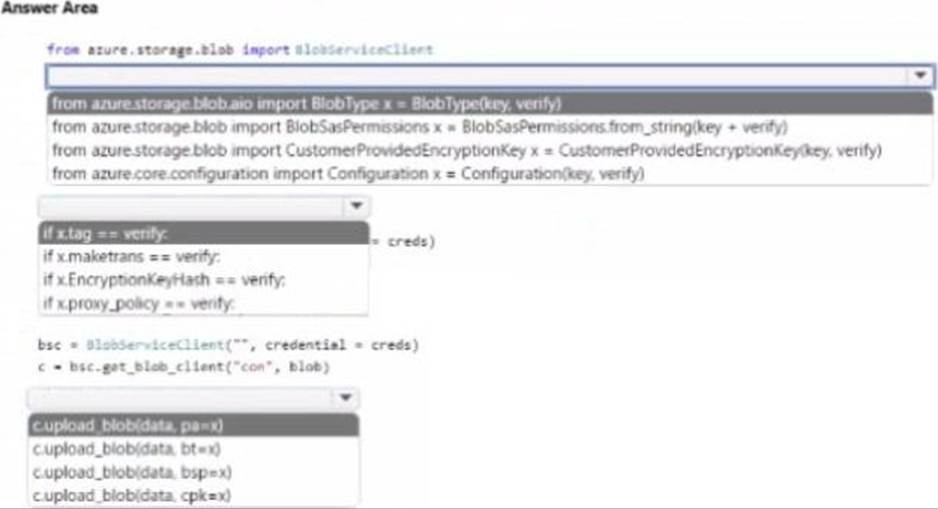
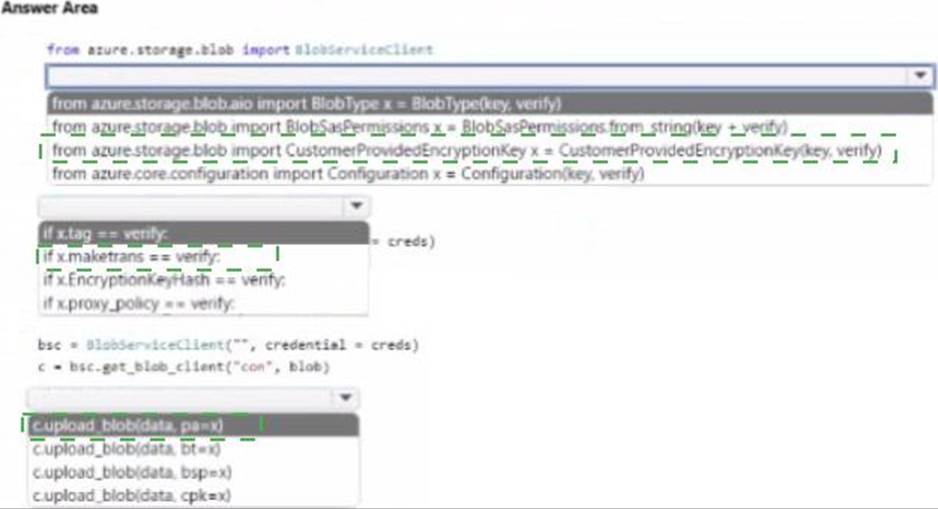
You are building an application that stores sensitive customer data in Azure Blob storage. The data must be encrypted with a key that is unique for each customer.
If the encryption key has been corrupted it must not be used for encryption.
You need to ensure that the blob is encrypted.
How should you complete the code segment? To answer, select the appropriate options in the answer area. NOTE: Each correct selection is worth one point.
HOTSPOT
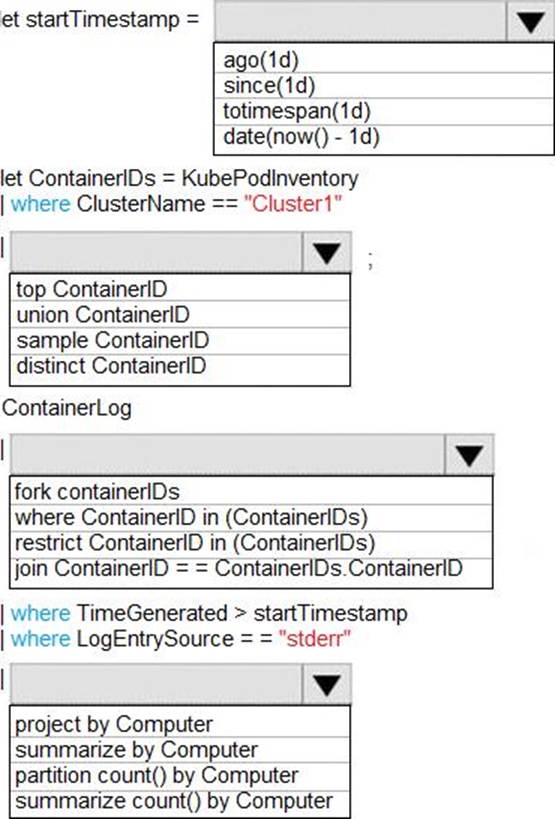
You are debugging an application that is running on Azure Kubernetes cluster named cluster1. The cluster uses Azure Monitor for containers to monitor the cluster.
The application has sticky sessions enabled on the ingress controller.
Some customers report a large number of errors in the application over the last 24 hours.
You need to determine on which virtual machines (VMs) the errors are occurring.
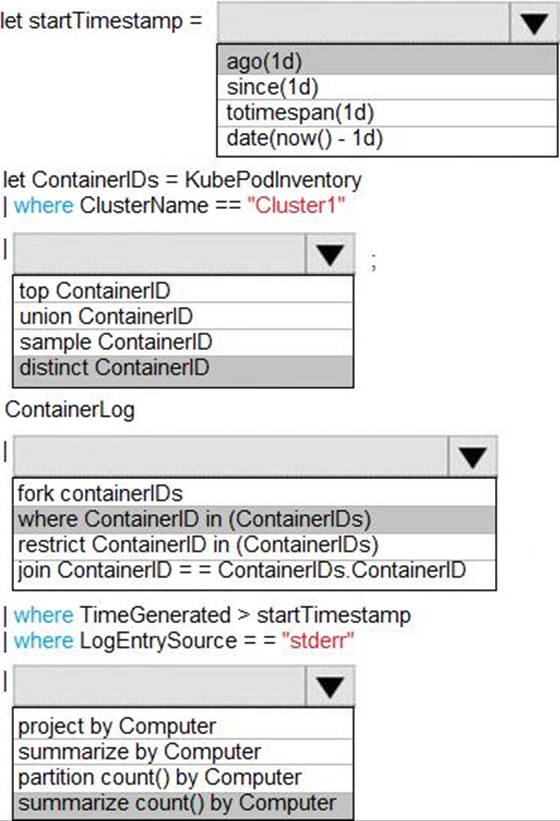
How should you complete the Azure Monitor query? To answer, select the appropriate options in the answer area. NOTE: Each correct selection is worth one point.
Explanation:
Box 1: ago(1d)
Box 2: distinct containerID
Box 3: where ContainerID in (ContainerIDs)
Box 4: summarize Count by Computer
Summarize: aggregate groups of rows
Use summarize to identify groups of records, according to one or more columns, and apply aggregations to them. The most common use of summarize is count, which returns the number of results in each group.
Reference:
https://docs.microsoft.com/en-us/azure/azure-monitor/log-query/get-started-queries
https://docs.microsoft.com/en-us/azure/azure-monitor/log-query/query-optimization
You develop an ASP. Net Core application by integrating the Application Insights SDK into your solution.
The application sends a very high rate of telemetry in a short time interval. You observe a reduced number of events, traces, and metrics being recorded and increased error rates for telemetry ingestion. Telemetry data must synchronize the client and server information to allow HTTP request and response correlation.
You need to reduce telemetry traffic, data costs, and storage costs while preserving a statistically correct analysis of application telemetry data.
What should you do?
- A . Set a daily cap on the Log Analytics workspace. Create an Activity log alert rule
- B . Verify adaptive sampling is enabled Set the maxTelemetrylterns Per Second value.
- C . Set retention and archive policies by table in the Log Analytics workspace. Purge retained data beyond 30 days.
- D . Modify the pricing tier for the Log Analytics workspace.